



For digital publishers, advertising reports are more than a collection of numbers. They are an important way to communicate campaign performance, demonstrate advertising value, and maintain trust with advertisers.
When a direct-sold advertising campaign ends, advertisers want to understand what happened. Did their advertisements appear in the agreed placements? How many impressions were delivered? How many clicks did the campaign receive? Did the campaign meet its delivery expectations? What can the results tell them about their audience?
Publishers often rely on reports containing metrics such as impressions, clicks, click-through rate (CTR), and campaign duration to answer these questions.
However, simply presenting these numbers does not always provide a complete picture.
A report might show that a campaign delivered 50,000 impressions, but it may not explain where those impressions came from, whether delivery was consistent across placements, or how the campaign performed against its original objective.
Another report might show a low click-through rate without explaining that the campaign was designed primarily to build awareness rather than generate website visits.
In these situations, the numbers may be accurate, but the story behind them is incomplete.
The problem often comes from unclear reporting requirements, disconnected campaign information, inconsistent tracking, and limited performance context.
For digital publishers managing direct-sold advertising, reporting should do more than summarize campaign activity. It should help advertisers understand what was delivered, how the campaign performed, and what the results mean.
In this article, we explore why ad reports often fail to tell the full story, the common reporting challenges publishers face, and how better AdOps processes can improve campaign reporting and advertiser communication.
1. Why Advertising Reports Matter to Digital Publishers
Advertising reports play an important role in the relationship between publishers and advertisers.
When an advertiser purchases a direct-sold placement, they are investing in access to the publisher's audience and the opportunity to communicate their message through the publisher's digital properties.
After the campaign runs, the advertiser needs information about its delivery and performance.
A clear report helps answer several important questions:
Was the campaign delivered during the agreed period?
Did the advertisement appear in the correct placements?
How many impressions were recorded?
How many clicks did the campaign receive?
Which placements generated the most activity?
Did the campaign meet its agreed delivery requirements?
What should be considered when planning the next campaign?
For publishers, reporting is equally important.
It provides a record of campaign delivery, supports advertiser communication, and helps internal teams understand how campaigns are performing.
A well-prepared report can also make future conversations easier. When advertisers understand what was delivered and how results were measured, they have a clearer basis for evaluating their advertising experience.
However, when reports contain only isolated metrics without sufficient context, they may leave advertisers with more questions than answers.
2. A Collection of Numbers Is Not the Same as a Performance Story
One of the most common reporting problems is treating metrics as the complete story.
Consider a campaign report that contains the following information:
Campaign duration: 30 days
Impressions: 50,000
Clicks: 250
Click-through rate: 0.5%
These numbers provide a basic summary of campaign activity.
But what do they actually tell the advertiser?
The report does not necessarily explain which website sections delivered those impressions, how performance varied across placements, or whether the campaign achieved its intended objective.
It also does not explain whether the results were consistent throughout the campaign period.
A number becomes more useful when it is connected to the information surrounding it.
For example, instead of reporting only the total number of impressions, publishers may provide a placement-level breakdown showing how impressions were distributed across the homepage, article pages, and category pages.
Similarly, reporting clicks alongside impressions gives advertisers a better understanding of how often users interacted with the advertisement relative to its recorded exposure.
The purpose of reporting is not to add as many numbers as possible. It is to present the most relevant information in a way that helps advertisers understand campaign delivery and performance.
3. Reporting Without Campaign Objectives Creates Confusion
Every advertising campaign has a purpose.
Some advertisers want to increase brand awareness. Others want to generate website visits, promote a product, support a seasonal offer, or communicate a specific message to a relevant audience.
The campaign objective influences how its performance should be interpreted.
However, publishers sometimes prepare reports using the same metrics and format for every campaign, without considering what the advertiser originally wanted to achieve.
This can lead to misleading conclusions.
For example, imagine an advertiser runs a brand awareness campaign on a publisher's website.
The report focuses heavily on clicks. The advertiser sees a relatively low click count and assumes the campaign performed poorly.
But the campaign was primarily intended to increase visibility among the publisher's audience, not necessarily generate immediate website visits.
In this case, impressions, placement visibility, and campaign delivery may be more relevant to the original objective.
For another campaign focused on driving website traffic, clicks and CTR may deserve greater attention.
This is why campaign objectives should be established before the campaign begins.
Publishers should understand what the advertiser expects, identify the appropriate performance indicators, and make sure the reporting format reflects those requirements.
Without this connection, even accurate reports may create confusion.
4. Total Impressions Don't Explain Where Delivery Happened
Impressions are one of the most commonly used metrics in digital advertising reports.
They indicate how many times an advertisement was recorded as displayed, according to the applicable measurement method.
While total impressions are useful, they do not always provide enough information on their own.
Imagine a publisher reports 100,000 impressions for a direct-sold campaign.
The advertiser knows the campaign generated 100,000 impressions, but several questions remain:
Which placements contributed to that total?
Were impressions distributed evenly?
Did one website section account for most of the delivery?
Did every agreed placement receive activity?
Were there differences in delivery across the campaign period?
A total number can hide important differences between placements.
For example:
PlacementImpressionsHomepage50,000Article Pages30,000Category Pages20,000Total100,000
This breakdown provides more context than the overall total.
The advertiser can see where the campaign appeared and how delivery was distributed.
Placement-level reporting is especially valuable when an advertiser has purchased multiple locations across a publisher's website.
It helps publishers communicate campaign delivery more clearly and gives advertisers a better understanding of the placements included in their campaign.
5. Clicks and CTR Need More Context
Clicks and click-through rate are useful metrics for understanding how users interact with an advertisement.
CTR is calculated by dividing clicks by impressions and multiplying the result by 100.
For example, if a campaign receives 250 clicks from 50,000 impressions, its CTR is 0.5%.
However, CTR should not be treated as a complete measure of campaign success.
A high CTR does not automatically mean a campaign achieved every business objective. Likewise, a low CTR does not necessarily mean an advertisement failed.
Several factors can influence click activity:
Campaign objective.
Creative design and message.
Advertisement placement.
Audience relevance.
Campaign duration.
Destination URL and offer.
Visibility of the advertisement.
A campaign designed to increase brand awareness may not generate the same click activity as one promoting a specific product or offer.
Similarly, a placement's position and surrounding content may influence how users interact with an advertisement.
A useful report should present clicks and CTR alongside relevant campaign information.
It should also avoid making conclusions that the available data cannot support.
The goal is to help advertisers understand the numbers rather than simply label them as good or bad.
6. Placement-Level Performance Is Often Overlooked
Digital publishers offer different advertising opportunities across their websites.
An advertiser may purchase a homepage banner, an article-page placement, and an advertisement within a specific category.
Each placement may reach users in a different browsing context.
However, when reports combine all placements into one total, useful information can disappear.
For example, an advertiser may discover that the homepage placement generated more impressions, while article-page placements generated a higher CTR.
These differences could help inform future campaign planning.
Without placement-level reporting, the advertiser sees only the combined result.
Publishers should consider including relevant placement-level information when the campaign structure and available tracking data support it.
This may include:
Placement name.
Number of impressions.
Number of clicks.
CTR, where applicable.
Campaign duration.
Delivery status.
This level of detail helps advertisers understand how different parts of their campaign performed.
It can also support more informed conversations about which placements may be appropriate for future campaigns.
7. Reports Can Hide Campaign Delivery Gaps
A campaign report may show a final impression total without explaining whether the advertisement was delivered as expected throughout the campaign.
For example, an advertiser may purchase a 30-day campaign with specific placements.
The final report shows the total impressions, but it does not explain whether all placements remained active for the full period or whether any delivery interruptions occurred.
This creates a gap between campaign results and campaign delivery information.
Publishers should distinguish between the performance metrics collected and the operational details needed to understand how the campaign was delivered.
Depending on the campaign requirements, useful delivery information may include:
Campaign start and end dates.
Agreed advertising placements.
Actual placement activity.
Creative changes made during the campaign.
Known delivery interruptions.
Relevant campaign adjustments.
This does not mean every report needs a detailed operational history.
However, when delivery issues or changes affect the campaign, the report should provide enough context to explain what happened.
Clear delivery information helps prevent misunderstandings and makes campaign discussions more transparent.
8. Inconsistent Tracking Makes Reports Less Reliable
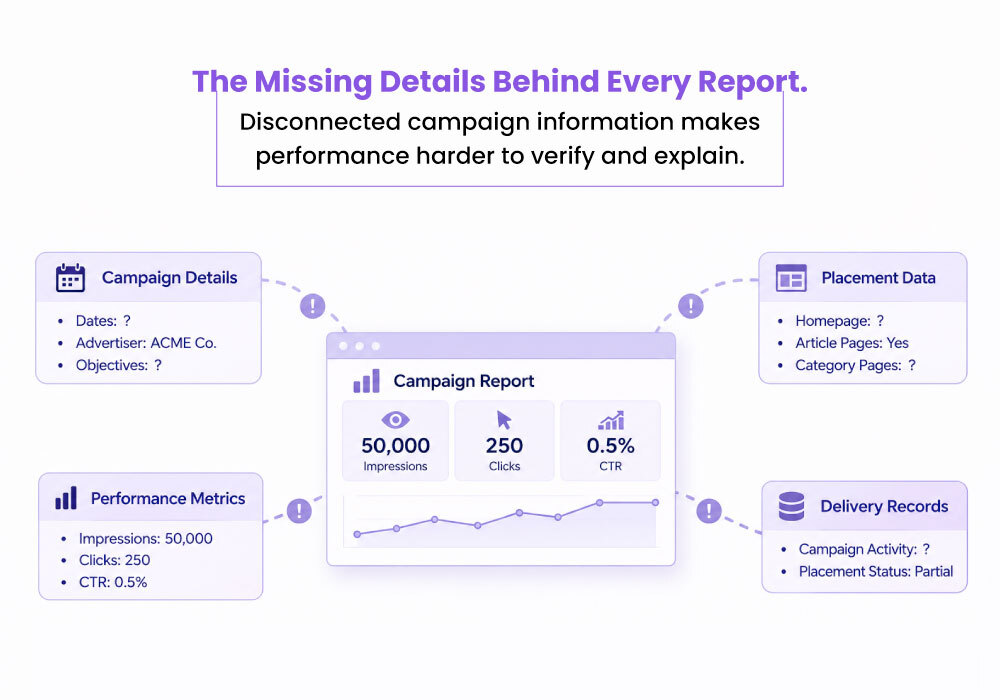
A report can only be as reliable as the information used to prepare it.
When publishers manage campaigns through disconnected processes, tracking information may be collected from multiple sources.
For example, impressions may come from one reporting source, clicks from another, and campaign details from a spreadsheet maintained by the AdOps team.
If these sources are not organized consistently, matching the information becomes difficult.
Different team members may also use different naming conventions for placements or campaigns.
One spreadsheet might refer to a placement as "Homepage Banner," while another calls it "Home Top Banner."
Although these labels may describe the same location, inconsistent naming can make reporting and comparison more complicated.
Other tracking challenges include:
Missing campaign identifiers.
Inconsistent placement names.
Different reporting periods.
Incomplete campaign records.
Manual data entry errors.
Missing measurement requirements.
These problems can affect how easily publishers verify and organize campaign results.
A structured tracking process should be established before campaigns launch.
Campaign names, placement labels, reporting periods, and measurement requirements should be clearly defined.
When information is recorded consistently from the beginning, preparing and reviewing reports becomes easier.
9. Manual Reporting Increases the Risk of Errors
Many publishers still rely heavily on spreadsheets and manual data collection when preparing direct-sold advertising reports.
This approach may work when campaign volume is low.
However, as the number of advertisers and campaigns increases, manual reporting can become difficult to maintain.
Employees may need to collect performance figures, copy them into spreadsheets, calculate metrics, format reports, and verify that every number matches the correct campaign.
Every additional manual step creates another opportunity for mistakes.
For example:
An impression total may be copied incorrectly.
A campaign's reporting dates may be entered incorrectly.
Data from two campaigns may be combined.
A formula may be applied to the wrong cells.
An outdated report may be sent to an advertiser.
Even a small reporting error can create unnecessary questions.
The publisher may need to investigate the discrepancy, correct the report, and explain the updated information.
This takes time and can affect advertiser confidence.
A structured reporting workflow helps reduce unnecessary manual handling and makes it easier to verify campaign information before reports are shared.
10. Delayed Reports Affect Advertiser Communication
Reporting is not only about accuracy. Timing matters too.
Advertisers expect to receive campaign updates and final reports within an agreed timeframe.
When reporting depends on manual data collection and several internal handoffs, delays can occur.
The AdOps team may need to collect figures from different sources. Someone may need to verify campaign details. Another team member may be responsible for formatting the report before it is shared.
If responsibilities are unclear, the process can take even longer.
Delayed reporting can create several problems:
Advertisers may need to follow up repeatedly.
Campaign discussions may lose momentum.
Future planning may be postponed.
The publisher may appear disorganized.
Internal teams may spend additional time responding to questions.
Timely reporting demonstrates that the publisher is paying attention to campaign delivery and advertiser requirements.
Publishers should establish clear reporting timelines and responsibilities for every campaign.
A consistent process makes it easier to prepare reports on schedule and communicate results without unnecessary delays.
11. Reports Without Comparisons Offer Limited Insight
A campaign's final numbers become more meaningful when they can be understood in context.
For example, 20,000 impressions may sound impressive, but the advertiser may still want to know whether the campaign delivered the agreed volume.
Similarly, a CTR of 0.4% does not provide enough information to determine whether a campaign met its objectives.
Useful comparisons may include:
Actual delivery versus agreed delivery.
Performance across different placements.
Results across different reporting periods.
Campaign performance against its stated objective.
Changes made during the campaign.
However, comparisons must be used carefully.
Publishers should not compare campaigns with completely different objectives, audiences, placements, or measurement methods as though they were directly equivalent.
The purpose of comparison is to provide context, not to create unsupported performance claims.
For direct-sold campaigns, comparing actual delivery against the agreed campaign requirements is particularly important.
It helps advertisers understand whether the campaign fulfilled the commitment made by the publisher.
12. Too Much Information Can Make Reports Harder to Understand
Incomplete reports are a problem, but reports containing too much unnecessary information can be equally difficult to interpret.
Some publishers attempt to make reports more comprehensive by including every available metric.
The result may be a long document filled with numbers that do not directly answer the advertiser's questions.
An effective report should prioritize relevance.
For example, an advertiser running a campaign to generate website visits may want to understand impressions, clicks, CTR, placements, and campaign duration.
Including unrelated metrics without explaining their importance may make the report harder to understand.
A good reporting structure should answer three basic questions:
What was delivered?
Show the campaign period, agreed placements, and relevant delivery information.
How did it perform?
Present the metrics that relate to the campaign's objective.
What does the information tell us?
Provide a short explanation of important results, placement differences, or delivery considerations.
The goal is to make reports easier to read, not simply longer.
13. Poor Reporting Can Weaken Advertiser Relationships
Advertisers want confidence that their campaigns are being managed professionally.
That confidence is influenced by several operational factors, including communication, delivery, monitoring, and reporting.
Imagine an advertiser who receives a report containing only a few numbers without placement details or an explanation of campaign delivery.
They may need to contact the publisher to ask:
Where did the advertisement appear?
Were all agreed placements active?
Why did the campaign generate fewer clicks than expected?
Was the campaign delivered for the full period?
Can the results be broken down by placement?
If these questions are not answered clearly, the advertiser may feel that the publisher does not have sufficient visibility into campaign activity.
Repeated reporting problems can affect the overall relationship.
Even when the campaign itself was delivered correctly, poor communication can make the experience feel incomplete.
For publishers, reporting should be treated as part of advertiser service rather than a final administrative task.
Clear and timely reports help demonstrate accountability and provide a stronger foundation for future advertising discussions.
14. How Publishers Can Make Their Ad Reports More Meaningful
Improving reporting does not necessarily require complicated dashboards or an entirely new measurement strategy.
It starts with creating a consistent process for collecting, organizing, checking, and presenting campaign information.
Here are practical steps publishers can follow.
1. Define Reporting Requirements Before Launch
Discuss the campaign objective and reporting expectations with the advertiser before the campaign begins.
Confirm which metrics are required, which placements need separate reporting, and when reports should be delivered.
2. Maintain Consistent Campaign Records
Use clear campaign names, advertiser details, placement labels, creative information, and campaign dates.
Consistent records make it easier to connect performance information to the correct campaign.
3. Track Relevant Metrics
Choose metrics based on the campaign's objective.
Impressions, clicks, and CTR can be useful, but they should be supported by relevant delivery and placement information.
4. Include Placement-Level Breakdowns Where Relevant
When campaigns include multiple placements, provide separate performance details where tracking supports it.
This helps advertisers understand how different website sections contributed to campaign activity.
5. Verify Data Before Sharing Reports
Check figures, dates, calculations, and campaign details before sending reports.
A simple review process can prevent avoidable reporting errors.
6. Explain Important Results
Do not expect advertisers to interpret every number without context.
Include concise explanations of relevant delivery information, placement differences, and any campaign changes that affected the results.
7. Establish Clear Reporting Responsibilities
Define who collects campaign data, who verifies it, who prepares the report, and who communicates it to the advertiser.
Clear ownership helps prevent delays and confusion.
15. The Role of AdOps in Better Campaign Reporting
Accurate campaign reporting depends on the work that happens throughout the advertising lifecycle.
It is difficult to produce a meaningful report if campaign details were not recorded correctly during setup, placement information was not maintained, or tracking requirements were unclear from the beginning.
This is why AdOps plays an important role in reporting.
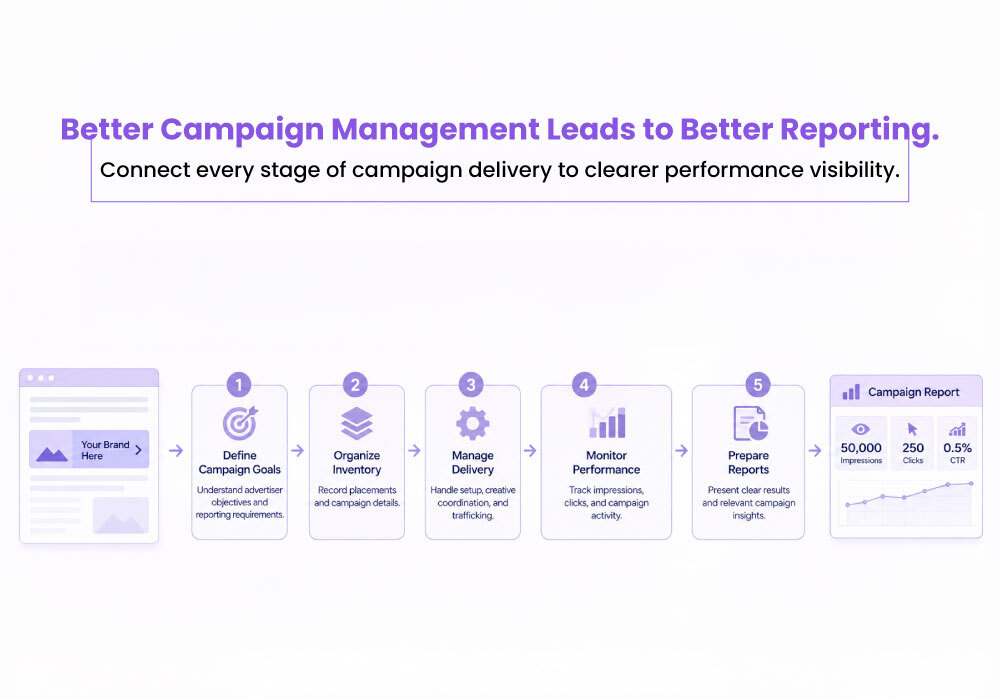
AdOps connects campaign setup, inventory management, trafficking, monitoring, and reporting into a more consistent operational process.
For direct-sold advertising, this support helps publishers maintain clearer campaign records and improve the quality of information available at the reporting stage.
RevAdOps supports digital publishers with the operational activities required to manage direct-sold advertising campaigns.
Its services include:
Ad Inventory Management
Helping publishers organize advertising placements and maintain clearer visibility into their available inventory.
Campaign Setup and Trafficking
Supporting campaign requirements, creative coordination, placement details, and campaign setup.
Campaign Optimization
Monitoring campaign activity and supporting adjustments based on campaign requirements and delivery performance.
Detailed Performance Reporting
Helping publishers organize campaign information and communicate performance results clearly to advertisers.
By supporting these operational activities, RevAdOps works as an extension of publishers' teams.
This helps publishers establish more consistent campaign management processes, improve reporting visibility, and reduce the burden of handling every operational task internally.
Conclusion: Better Reports Start With Better Ad Operations
An advertising report should do more than present impressions, clicks, and percentages.
It should help advertisers understand what was delivered, where their advertisements appeared, how the campaign performed, and how the results relate to the original campaign objective.
When reports lack context, tracking is inconsistent, or campaign information is scattered across different sources, important details can get lost.
The result is a report that may contain accurate numbers but still fail to communicate the complete campaign story.
For digital publishers managing direct-sold advertising, better reporting starts long before a campaign ends.
It requires clear campaign requirements, organized inventory information, accurate setup, consistent monitoring, reliable tracking, and a structured reporting process.
When these activities work together, publishers can provide more meaningful campaign reports and build stronger relationships with advertisers.
Your reports should show more than numbers. They should demonstrate the value of the campaign.
Ready to improve your direct-sold advertising operations? Explore how RevAdOps can support your team with inventory management, campaign setup and trafficking, campaign optimization, and detailed performance reporting.
Leave a reply
Your email address will not be published. Required fields are marked *