


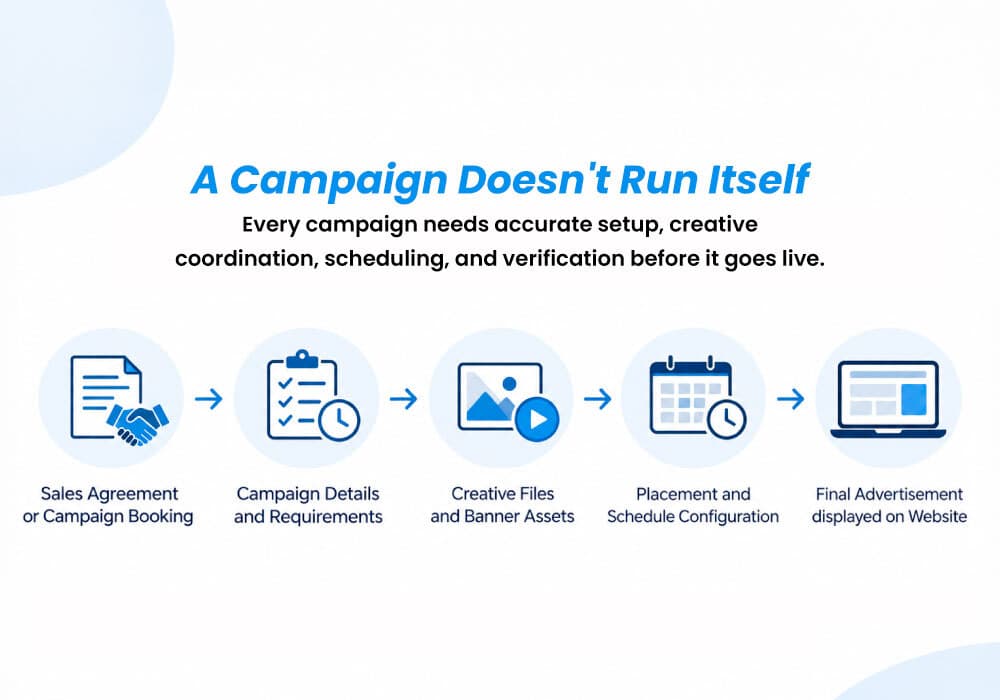
Digital advertising revenue depends on more than attracting advertisers and securing campaign agreements. Once a publisher sells an advertising placement, the campaign must be properly prepared, scheduled, delivered, monitored, and reported. Every step matters because advertisers expect their campaigns to run according to agreed requirements.
This is where ad trafficking becomes essential.
Ad trafficking is the process of setting up and managing advertising campaigns so that the right creative appears in the right placement, at the right time, and for the agreed duration. It connects the commercial agreement between a publisher and an advertiser with the actual delivery of the campaign.
However, when trafficking is handled through scattered spreadsheets, lengthy email conversations, manual updates, and inconsistent processes, even a straightforward campaign can become difficult to manage.
A campaign may launch late because the creative was not received on time. An advertisement may appear in the wrong placement because campaign instructions were unclear. A scheduled campaign may continue running beyond its agreed end date because nobody updated the schedule. Reporting may also become difficult when delivery information is spread across multiple records.
These problems may appear operational, but their impact can extend directly to revenue.
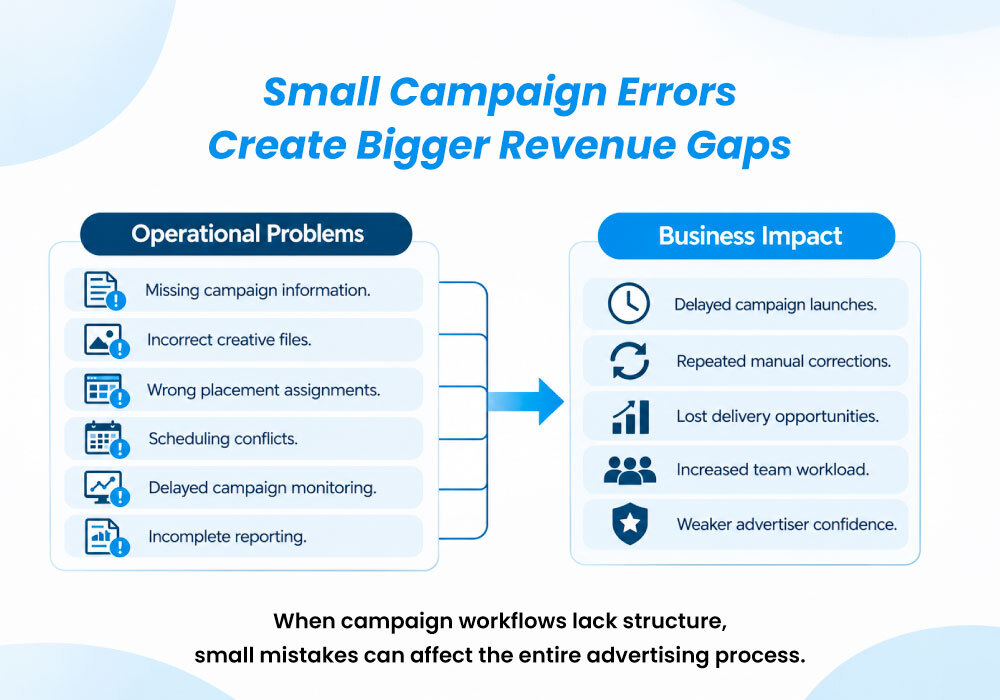
Inefficient trafficking consumes valuable time, delays campaign delivery, creates avoidable errors, increases the workload on AdOps teams, and can weaken advertiser confidence. Over time, these challenges can affect a publisher's ability to manage more campaigns and build stronger advertising relationships.
Understanding how trafficking works, where inefficiencies develop, and how publishers can improve the process is an important step toward building a more reliable direct-sold advertising operation.
1. What Is Ad Trafficking?
Ad trafficking is the operational process of preparing and managing an advertising campaign after it has been sold.
When an advertiser purchases an advertising placement on a publisher's website, several details must be translated into an actual campaign setup.
These details may include:
Advertiser and campaign information.
Campaign start and end dates.
Approved advertising creative.
Required ad dimensions and formats.
Specific website pages or placements.
Agreed campaign delivery requirements.
Tracking links and campaign measurement details.
Reporting requirements.
The AdOps team uses this information to prepare the campaign, assign the appropriate placement, upload or configure the creative, establish the schedule, and verify that everything is working correctly.
For example, imagine a digital publisher sells a homepage banner campaign to a retail advertiser for two weeks.
The sales team confirms the agreement. The advertiser provides the creative. The AdOps team receives the campaign details, checks the banner dimensions, assigns the appropriate homepage placement, configures the schedule, and verifies that the advertisement appears correctly.
That entire operational process is part of ad trafficking.
When performed efficiently, trafficking helps campaigns move smoothly from a signed agreement to successful delivery.
When performed inefficiently, it creates delays and unnecessary complications.
2. Why Ad Trafficking Is Important for Publisher Revenue
Trafficking may seem like a technical or administrative responsibility, but it plays a direct role in how publishers generate advertising revenue.
Selling a campaign is only the beginning. Publishers must also deliver what they have promised.
If a campaign is not configured correctly, the advertiser may not receive the expected exposure. If a campaign launches late, some of its scheduled delivery opportunity may be lost. If campaign details are not documented properly, the publisher may struggle to verify performance or answer advertiser questions.
Consider a simple example.
A publisher sells a 14-day banner campaign. The advertiser expects the advertisement to be live from the agreed start date.
However, the creative is uploaded two days late because the campaign details were incomplete. The publisher now has to coordinate with the advertiser, revise the setup, and adjust the delivery schedule.
The campaign has already experienced an operational delay.
Depending on the agreement, the publisher may need to extend the campaign, arrange additional delivery, or otherwise address the missed time.
This creates extra work for the team and may affect the revenue expected from the original campaign.
Efficient trafficking helps publishers:
Launch campaigns according to agreed schedules.
Reduce errors in campaign setup.
Maintain accurate placement information.
Manage advertising creative effectively.
Monitor campaign delivery.
Prepare reliable performance reports.
Maintain advertiser confidence.
In other words, trafficking protects the value of the advertising inventory that publishers have already sold.
3. Manual Campaign Setup Creates Unnecessary Delays
One of the most common causes of inefficient trafficking is excessive dependence on manual campaign setup.
In many publishing organizations, campaign information arrives through emails, spreadsheets, shared documents, and messages from different team members.
The AdOps team must collect these details, review them, identify missing information, and manually transfer everything into the relevant campaign management tools.
This process can become time-consuming, especially when several campaigns are being handled simultaneously.
For example, an AdOps executive may need to:
Find the original campaign confirmation email.
Download the advertiser's creative files.
Check the agreed placement and campaign dates.
Confirm the creative dimensions.
Update the campaign schedule.
Configure the advertisement.
Verify the setup.
Inform the sales team that the campaign is ready.
If information is missing, the process becomes even longer.
The team may need to contact sales, request clarification from the advertiser, wait for updated creative, and revise the campaign setup.
Each additional step increases the time required to launch the campaign.
Manual work is not automatically inefficient. However, when repetitive tasks depend on disconnected records and individual memory, the possibility of delays and mistakes increases.
A structured campaign workflow helps reduce unnecessary back-and-forth and gives the AdOps team a clearer process to follow.
4. Missing Campaign Information Slows Everything Down
Accurate campaign information is essential for successful trafficking.
Before a campaign can be configured, the AdOps team needs to understand exactly what was sold and what the advertiser expects.
However, campaign instructions are not always complete.
A sales team might share the advertiser's name and campaign duration but forget to include the final creative dimensions. Another campaign request might mention a homepage placement without specifying the exact advertising position.
Sometimes, the campaign dates are confirmed in one email while the creative requirements are discussed in another.
These small information gaps create operational delays.
The AdOps team must stop the setup process, identify what is missing, contact the relevant person, and wait for clarification.
This creates several challenges:
Campaign setup cannot begin immediately.
Advertisers may experience delayed launches.
Sales and AdOps teams spend more time coordinating.
Campaign details may be interpreted differently.
Last-minute corrections become more frequent.
A standardized campaign brief can help solve this problem.
Every campaign request should include the essential information required for setup, such as advertiser details, placement, creative specifications, campaign dates, delivery requirements, and tracking information.
When the required details are available from the beginning, trafficking becomes more predictable and efficient.
5. Creative Management Errors Affect Campaign Delivery
Advertising creative is one of the most important parts of campaign trafficking.
Publishers must ensure that the correct creative is assigned to the correct campaign and placement.
However, managing multiple creative files manually can become confusing.
An advertiser may send an initial banner and later provide a revised version. The sales team may forward the updated file, but the AdOps team might still have access to the earlier version.
If the wrong creative is uploaded, the campaign may display outdated branding, incorrect messaging, or an offer that is no longer valid.
Other common creative management problems include:
Incorrect banner dimensions.
Missing creative files.
Broken or incorrect destination links.
Duplicate files with unclear names.
Outdated campaign assets.
Delays in receiving advertiser approvals.
These issues can affect campaign quality and create additional work.
For example, if an advertiser notices that an outdated promotional banner is running, the publisher must investigate the issue, locate the latest creative, replace the existing asset, and verify the updated advertisement.
This takes time that could have been spent managing other campaigns.
Publishers should establish a consistent creative management process.
Files should be clearly named, campaign versions should be identifiable, creative specifications should be documented, and final approvals should be recorded.
A reliable creative workflow reduces confusion and helps ensure that the correct advertisement reaches the intended placement.
6. Incorrect Placement Assignment Can Waste Valuable Inventory
Not every advertising placement has the same value.
A homepage banner, an article-page placement, and a category-page advertisement may offer different levels of visibility and audience relevance.
When trafficking is handled without clear placement records, advertisements may be assigned to the wrong locations.
For example, an advertiser may purchase a premium homepage placement, but the campaign is accidentally configured for a standard article-page position.
Even if the advertisement is technically live, the publisher may not be delivering the placement that was agreed upon.
This can create several consequences:
The advertiser may receive less visibility than expected.
Premium inventory may be underutilized.
Campaign corrections may require additional coordination.
The publisher may need to arrange replacement delivery.
Advertiser confidence may decline.
Placement accuracy is particularly important when publishers manage several advertising positions across multiple website sections.
A structured inventory and placement management process helps AdOps teams understand which positions are available, which are reserved, and which campaigns are assigned to them.
This reduces the possibility of placement conflicts and helps publishers protect the value of their advertising inventory.
7. Scheduling Errors Can Result in Lost Revenue Opportunities
Campaign scheduling is another critical part of trafficking.
Every campaign has an agreed start date, end date, and delivery period. These details must be configured accurately and monitored throughout the campaign.
However, manual scheduling can create problems when multiple campaigns overlap.
For example:
A campaign may launch later than agreed.
An advertisement may continue running after its end date.
Two campaigns may be assigned to the same placement during overlapping periods.
A campaign may be removed before its agreed duration is complete.
Updated campaign dates may not be communicated to everyone involved.
These mistakes can affect both the publisher and the advertiser.
A delayed launch may reduce the time available for campaign delivery. An advertisement that runs beyond its agreed schedule may interfere with another advertiser's booking. A campaign that ends too early may require additional delivery arrangements.
The impact becomes more significant when publishers manage several campaigns across multiple placements.
A clear campaign calendar helps teams maintain visibility into upcoming launches, active campaigns, and scheduled end dates.
It also allows the AdOps team to identify potential conflicts before they affect campaign delivery.
8. Poor Communication Between Sales and AdOps Creates Bottlenecks
Successful campaign trafficking depends on coordination between different teams.
The sales team understands what the advertiser purchased. The AdOps team is responsible for translating that agreement into a properly configured campaign.
If communication between these teams is inconsistent, campaign execution can become complicated.
For example, sales may confirm a change in campaign dates directly with an advertiser but forget to update the AdOps team.
Alternatively, an advertiser may send revised creative to the sales representative, who assumes the AdOps team has already received it.
The result is a disconnect between what was promised and what is being delivered.
Common communication problems include:
Incomplete campaign handovers.
Unrecorded changes to campaign requirements.
Unclear task ownership.
Repeated requests for the same information.
Delayed responses to setup questions.
Conflicting campaign instructions.
These issues do not necessarily indicate that employees are making mistakes intentionally. Often, the problem is the absence of a consistent communication process.
Publishers can improve coordination by creating a standard campaign handover procedure.
The sales team should provide complete campaign details before setup begins. Any changes should be documented and shared with the relevant team members.
A centralized campaign record can also help everyone work from the same information.
9. Inefficient Trafficking Makes Campaign Monitoring Difficult
Campaign trafficking does not end once an advertisement goes live.
Publishers must also monitor campaigns to confirm that they are running correctly.
Campaign monitoring helps identify issues such as:
Advertisements not appearing in the intended placement.
Incorrect creative being displayed.
Broken destination links.
Campaigns starting or ending at the wrong time.
Unexpected delivery gaps.
Technical problems affecting ad visibility.
When campaign information is poorly organized, monitoring becomes more difficult.
The AdOps team may have to search through emails and spreadsheets to understand the original campaign requirements before investigating an issue.
This increases the time needed to identify and resolve problems.
For example, if an advertiser reports that their banner is not visible on a particular page, the team needs to verify the campaign configuration, placement assignment, schedule, and creative status.
If those details are scattered across different records, troubleshooting takes longer.
A structured monitoring process gives the team better visibility into active campaigns and makes it easier to identify problems before they become larger concerns.
10. Delayed Reporting Makes Advertiser Communication Harder
Campaign reporting is an important part of the direct-sold advertising relationship.
Advertisers want to understand how their campaigns performed and whether the agreed advertising activity was delivered.
Publishers must therefore maintain accurate campaign records and prepare reports that clearly communicate performance.
However, inefficient trafficking can create reporting problems.
When campaign details are entered inconsistently, creative versions are not documented, or delivery information is stored across different tools, collecting accurate reporting data becomes more difficult.
The AdOps team may need to spend additional time:
Collecting campaign information.
Checking campaign dates.
Verifying placement details.
Reviewing delivery records.
Identifying missing information.
Preparing and validating reports.
This can delay the reporting process.
Delayed reports may also affect advertiser communication. Advertisers might need to follow up repeatedly to receive campaign updates or final performance information.
Over time, inconsistent reporting can weaken confidence in the publisher's campaign management process.
A structured trafficking workflow makes reporting easier because campaign details are documented consistently from the beginning.
When setup, scheduling, placement, and delivery information are organized, the team has a stronger foundation for preparing accurate reports.
11. Repeated Corrections Increase the Cost of Campaign Management
An inefficient trafficking process creates work that should not have been necessary in the first place.
A campaign may need to be corrected because the wrong creative was uploaded. Another may require rescheduling because the original dates were entered incorrectly. A third may need to be reconfigured because the placement assignment did not match the agreement.
Each correction consumes time.
The team must identify the problem, investigate its cause, coordinate with relevant stakeholders, make the necessary changes, and verify that the campaign is working correctly.
These tasks can quickly accumulate.
Imagine an AdOps team managing 30 active campaigns. If even a portion of those campaigns requires repeated corrections, the team may spend a significant amount of time resolving avoidable issues.
That time could otherwise be used to:
Prepare upcoming campaigns.
Monitor active advertising placements.
Improve campaign delivery.
Support sales teams.
Review inventory availability.
Prepare advertiser reports.
The cost of inefficient trafficking is therefore not limited to the individual campaign that experienced a problem.
It also affects the overall productivity of the AdOps team.
Reducing repeated corrections helps publishers use their operational resources more effectively.
12. Inefficient Trafficking Limits a Publisher's Ability to Scale
A trafficking process that works for five campaigns may not work as effectively for fifty.
As a publisher attracts more advertisers, the number of campaign requests, creative assets, schedules, placement assignments, and reporting requirements increases.
If the organization continues relying on disconnected spreadsheets and informal communication, operational complexity grows.
The team may begin experiencing:
Longer campaign setup times.
More frequent scheduling conflicts.
Increased creative management errors.
Delayed campaign launches.
Greater dependence on individual employees.
More difficult reporting processes.
This creates a capacity problem.
The publisher may have the audience and advertising opportunities to generate more business, but the AdOps team may struggle to manage the additional workload.
As a result, the organization could become hesitant to accept more campaigns or may struggle to maintain the quality of existing advertiser relationships.
Scaling requires more than increasing sales activity. Publishers also need operational processes that can support a larger campaign volume.
Standardized workflows, organized campaign information, and reliable management systems help create that foundation.
13. How Publishers Can Improve Their Ad Trafficking Process
Improving trafficking does not always require a complete operational overhaul.
Publishers can begin by identifying the most common sources of delays and introducing more consistent processes.
Here are several practical ways to improve campaign trafficking.
A. Standardize Campaign Briefs
Every campaign should follow a consistent handover format.
The brief should include:
Advertiser name.
Campaign name.
Campaign objectives.
Approved placements.
Start and end dates.
Creative specifications.
Creative files and destination links.
Delivery requirements.
Reporting expectations.
A standardized brief reduces missing information and makes campaign setup easier.
B. Organize Creative Assets
Publishers should establish clear naming conventions and file management practices.
Every creative asset should be associated with the correct advertiser and campaign.
Updated versions should be identifiable, and final approvals should be recorded.
This helps prevent outdated or incorrect advertisements from being used.
C. Maintain a Centralized Campaign Calendar
A campaign calendar gives the team visibility into upcoming launches, active campaigns, and scheduled end dates.
It also helps identify overlapping bookings and potential placement conflicts.
When campaign dates change, the updated schedule should be reflected in the central record.
D. Define Team Responsibilities
Sales and AdOps teams should understand their respective responsibilities.
Sales should provide complete campaign information and communicate advertiser requirements.
AdOps should manage campaign configuration, creative setup, scheduling, monitoring, and delivery reporting.
Clear ownership reduces confusion and prevents important tasks from being overlooked.
E. Introduce Campaign Quality Checks
Before a campaign goes live, the team should verify essential details.
A campaign checklist may include:
Correct advertiser and campaign.
Approved creative.
Correct creative dimensions.
Correct placement.
Accurate destination link.
Confirmed start and end dates.
Successful display verification.
These checks help identify errors before they affect advertisers.
F. Review Campaign Workflows Regularly
Publishers should periodically review how campaigns move from sales confirmation to final reporting.
Identify where delays occur, which tasks require repeated manual work, and where communication breaks down.
The objective is to improve the process continuously rather than waiting for problems to become serious.
14. The Role of an Ad Management System in Efficient Trafficking
A structured AdOps process becomes easier to maintain when publishers have the right management systems in place.
An ad management system can help organize important campaign information and reduce dependence on scattered records.
Depending on the system's capabilities, publishers may be able to manage:
Advertising inventory and placements.
Campaign details and schedules.
Creative assets.
Campaign setup and trafficking workflows.
Active campaign information.
Delivery monitoring.
Performance reporting.
The benefit is not simply having another tool.
The real value comes from bringing important campaign information into a more organized and accessible workflow.
For example, when campaign details, creative information, and schedules are properly maintained, the AdOps team can spend less time searching for information and more time managing campaign delivery.
A suitable system can also improve coordination between teams by providing a clearer view of campaign status and responsibilities.
However, technology alone cannot fix every operational problem.
Publishers still need accurate campaign information, defined responsibilities, consistent processes, and people who understand how to manage direct-sold advertising.
The strongest approach combines structured workflows with the right operational support.
15. How RevAdOps Helps Publishers Manage Campaign Operations
For digital publishers, managing direct-sold advertising requires coordination across inventory, campaign setup, trafficking, monitoring, and reporting.
As campaign volume increases, these responsibilities can become difficult to manage internally, particularly when teams rely heavily on manual processes.
RevAdOps helps publishers strengthen their direct advertising operations by supporting the essential stages of campaign management.
Its services include:
Ad Inventory Management
Organizing and managing advertising inventory so publishers have better visibility into available placements and campaign opportunities.
Campaign Setup and Trafficking
Supporting campaign configuration, creative coordination, scheduling, and delivery requirements to help campaigns move from agreement to execution.
Campaign Optimization
Reviewing campaign performance and identifying opportunities to improve delivery and make better use of advertising inventory.
Performance Reporting
Providing detailed campaign reporting so publishers can understand delivery and communicate results more effectively to advertisers.
RevAdOps works as an extension of the publisher's team, helping manage operational responsibilities while allowing internal teams to focus on their broader business and advertiser relationships.
For publishers looking to improve campaign consistency, reduce manual workload, and manage direct-sold advertising more effectively, structured AdOps support can make a meaningful difference.
16. Efficient Trafficking Protects More Than Campaign Delivery
Ad trafficking is often viewed as a behind-the-scenes responsibility, but its impact reaches across the entire publishing business.
It influences how quickly campaigns launch, how accurately advertising placements are managed, how efficiently teams work, and how confidently publishers communicate with advertisers.
Inefficient trafficking creates friction at every stage.
A missing campaign detail can delay setup. An outdated creative can create delivery problems. A scheduling error can affect an advertiser's booking. Disorganized records can make reporting more difficult.
Individually, these issues may appear manageable. Together, they can reduce operational efficiency and limit revenue opportunities.
Publishers need to treat trafficking as an essential part of their advertising revenue operations, not simply as an administrative task that happens after a campaign is sold.
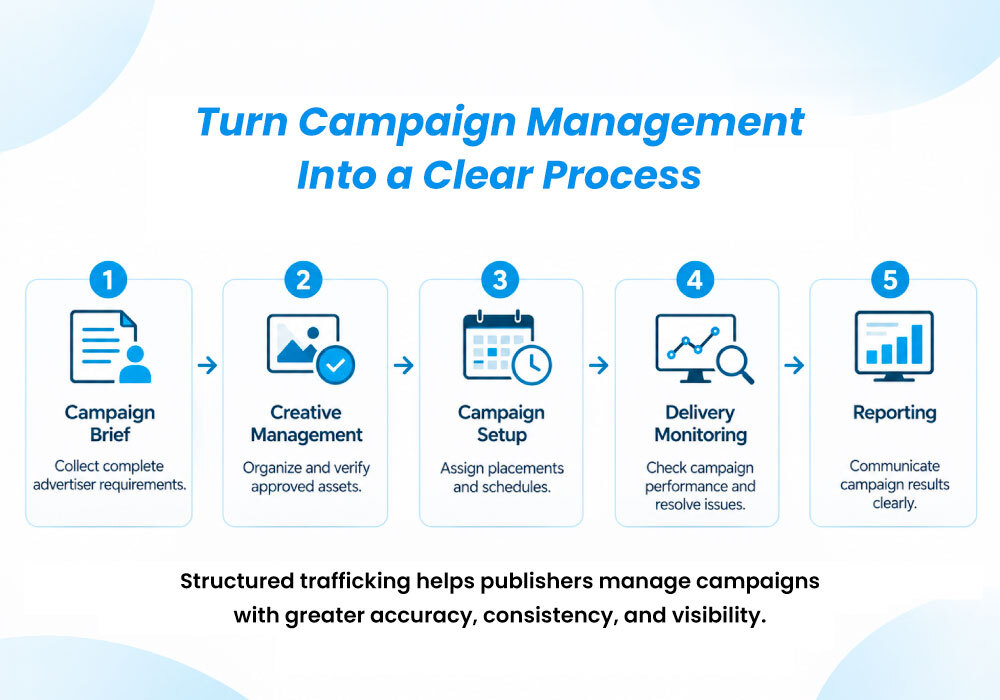
A structured approach helps ensure that every campaign has clear requirements, accurate setup, reliable scheduling, consistent monitoring, and proper reporting.
Because selling an advertising campaign creates an opportunity. Delivering it correctly protects that opportunity.
When publishers improve the way campaigns are trafficked, they create a stronger foundation for operational efficiency, advertiser confidence, and sustainable direct advertising revenue.
Leave a reply
Your email address will not be published. Required fields are marked *