


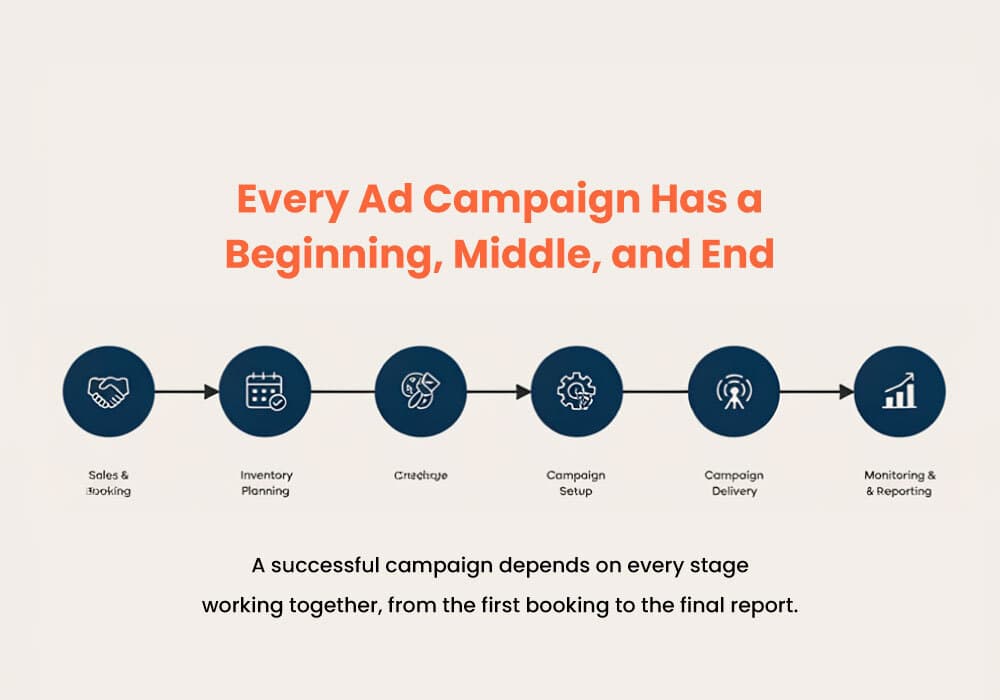
A direct advertising campaign involves much more than an advertiser purchasing space on a publisher's website. From the first conversation with an advertiser to the final performance report, several teams and processes work together to ensure that the campaign is planned, configured, delivered, and evaluated correctly.
For digital publishers, understanding this process is essential. A campaign may be successfully sold, but without proper inventory management, campaign setup, creative coordination, monitoring, and reporting, delivering the agreed advertising experience can become challenging.
This complete process is known as the direct ad campaign lifecycle.
Each stage has a specific purpose. Sales teams identify advertising opportunities and confirm bookings. AdOps teams prepare campaigns and manage delivery. Advertisers provide creative materials and campaign requirements. Publishers monitor performance and communicate results.
When these activities follow a structured workflow, publishers can manage campaigns more efficiently, maintain advertiser confidence, and make better use of their advertising inventory.
However, when the process lacks organization, even a simple campaign can experience delays, incorrect placements, scheduling conflicts, and reporting problems.
In this guide, we will explain the lifecycle of a direct ad campaign, explore what happens at each stage, and understand how publishers can improve the entire process.
1. What Is a Direct Ad Campaign?
A direct ad campaign is an advertising arrangement in which a publisher sells advertising space directly to an advertiser or agency.
The advertiser works with the publisher to agree on campaign requirements, placements, duration, pricing, and other delivery expectations.
For example, a technology company may approach a digital news publisher to promote a new product launch.
The publisher offers advertising placements across its website, such as:
Homepage banner advertisements.
Article-page banner placements.
Sidebar advertisements.
Category-page placements.
Mobile advertising positions.
Newsletter placements.
The advertiser selects the placements that align with its campaign objectives and agrees to purchase them for a specific period.
Once the booking is confirmed, the publisher must manage the operational work required to deliver the campaign.
This includes preparing the campaign, collecting creative assets, assigning placements, configuring schedules, monitoring delivery, and reporting performance.
Unlike the initial sales conversation, these operational activities continue throughout the campaign lifecycle.
2. Understanding the Direct Ad Campaign Lifecycle
The direct ad campaign lifecycle refers to the complete journey of an advertising campaign, beginning with the initial opportunity and ending with campaign reporting and evaluation.
Although the exact workflow may vary between publishers, a typical lifecycle includes eight stages:
Advertising opportunity and sales.
Campaign booking and confirmation.
Inventory allocation and planning.
Creative collection and approval.
Campaign setup and trafficking.
Campaign launch and delivery.
Monitoring and optimization.
Campaign completion and reporting.
These stages are connected.
Information collected during the sales process influences campaign setup. Inventory planning determines where advertisements can appear. Creative approval affects launch readiness. Monitoring helps identify delivery problems, while reporting communicates the final campaign results.
A clear understanding of each stage helps publishers build a more consistent advertising operation.
3. Stage One: Identifying Advertising Opportunities
Every direct ad campaign begins with an advertising opportunity.
Publishers build audiences through their websites, digital publications, articles, newsletters, and other content platforms.
These audiences create opportunities for advertisers looking to reach relevant readers.
The sales team identifies potential advertisers whose products, services, or target audiences align with the publisher's content and readership.
For example:
A business publication may attract advertisers from the finance, technology, and professional services industries.
A lifestyle publisher may have advertising opportunities for fashion, beauty, travel, and consumer brands.
A local news publisher may attract businesses interested in reaching audiences within a particular geographic area.
At this stage, the publisher needs to understand what advertising inventory is available and which opportunities can be presented to advertisers.
Important considerations include:
Audience relevance.
Available advertising placements.
Website traffic and visibility.
Advertising formats.
Campaign duration.
Advertiser objectives.
The goal is to identify a suitable advertising opportunity and establish the foundation for a direct campaign.
4. Stage Two: Sales Discussion and Campaign Booking
Once an advertising opportunity is identified, the sales team begins discussions with the advertiser.
The advertiser explains its objectives, preferred placements, campaign duration, creative requirements, and expected outcomes.
The publisher then presents suitable advertising options.
For example, an advertiser launching a new product may want prominent visibility during the first week of its campaign.
The publisher could recommend a homepage banner along with additional placements within relevant article pages.
After reviewing the options, the advertiser confirms the campaign.
The sales team records the agreement and shares the booking details with the AdOps team.
A typical campaign booking includes:
Advertiser and campaign name.
Campaign objective.
Selected advertising placements.
Agreed campaign dates.
Pricing and booking details.
Creative requirements.
Destination URLs.
Delivery expectations.
Reporting requirements.
This handover is important because the AdOps team needs accurate information before campaign preparation begins.
Incomplete booking details can create unnecessary back-and-forth between sales and AdOps.
A standardized campaign booking document helps ensure that all essential information is captured from the beginning.
5. Stage Three: Inventory Planning and Allocation
After the campaign is confirmed, the publisher needs to allocate the appropriate advertising inventory.
Ad inventory refers to the advertising spaces available across a publisher's digital properties.
These spaces may differ in visibility, position, format, and audience context.
For example:
A homepage banner may provide prominent visibility.
An article-page banner may appear alongside relevant editorial content.
A sidebar placement may offer additional exposure.
A mobile banner may reach visitors browsing on smartphones.
The AdOps team must confirm that the placements purchased by the advertiser are available during the agreed campaign period.
This stage helps prevent overlapping bookings and ensures that the publisher can deliver what was promised.
Imagine a publisher has one premium homepage banner placement.
Advertiser A has booked the placement from December 1 to December 10. Advertiser B requests the same placement from December 7 to December 15.
There is an overlap between the two campaigns.
Without proper inventory planning, the publisher may accidentally confirm conflicting bookings.
Maintaining organized inventory records helps the team understand:
Which placements are available.
Which placements are already booked.
When existing campaigns will end.
Which advertising opportunities can be offered.
Whether a requested campaign can be accommodated.
Effective inventory management protects the value of advertising space and supports more reliable campaign planning.
6. Stage Four: Creative Collection and Approval
Once the campaign placements are confirmed, the advertiser needs to provide the creative assets.
Creative assets are the advertisements that will appear on the publisher's website or other digital properties.
Depending on the campaign, these may include:
Static banner images.
Animated banners.
HTML5 advertisements.
Video creatives.
Destination URLs.
Tracking links, where required.
The publisher usually provides creative specifications before the advertiser submits the files.
These specifications may include dimensions, accepted formats, file-size limits, and other technical requirements.
The AdOps team reviews the submitted creative to ensure that it meets the publisher's requirements.
For example, if the advertiser purchases a 300 × 250 pixel placement, the submitted creative should match the required dimensions.
The team should also check whether the advertisement displays correctly and whether the destination URL directs visitors to the intended landing page.
Creative approval is equally important.
An advertiser may initially send one banner and later provide an updated version. The AdOps team must ensure that the final approved creative is used during the campaign.
A consistent creative management process helps prevent:
Incorrect banner dimensions.
Outdated advertisements.
Missing creative files.
Broken destination links.
Confusion between creative versions.
Delayed campaign launches.
Once the assets are approved, they can move into campaign setup.
7. Stage Five: Campaign Setup and Trafficking
Campaign setup and trafficking are where the confirmed advertising agreement becomes an operational campaign.
The AdOps team takes the booking details, approved creative, inventory information, and campaign schedule and configures them within the publisher's advertising management environment.
This stage requires accuracy because mistakes in setup can affect the entire campaign.
The team generally needs to configure:
Campaign Information
Enter the advertiser name, campaign name, and other relevant booking details.
Creative Assignment
Upload or configure the approved advertising creative.
Placement Selection
Connect the creative to the correct website page, section, or advertising position.
Campaign Scheduling
Enter the agreed start date and end date.
Destination Links
Add and verify the advertiser's landing page URL.
Delivery Requirements
Configure any agreed campaign-specific delivery settings.
For example, a retail advertiser may have purchased a homepage banner for 14 days.
The AdOps team creates the campaign record, selects the homepage placement, uploads the approved banner, adds the destination URL, and enters the campaign schedule.
Before launch, the team should verify every detail against the original booking.
A structured trafficking process helps reduce setup errors and makes it easier to manage multiple campaigns at the same time.
8. Stage Six: Campaign Testing and Launch
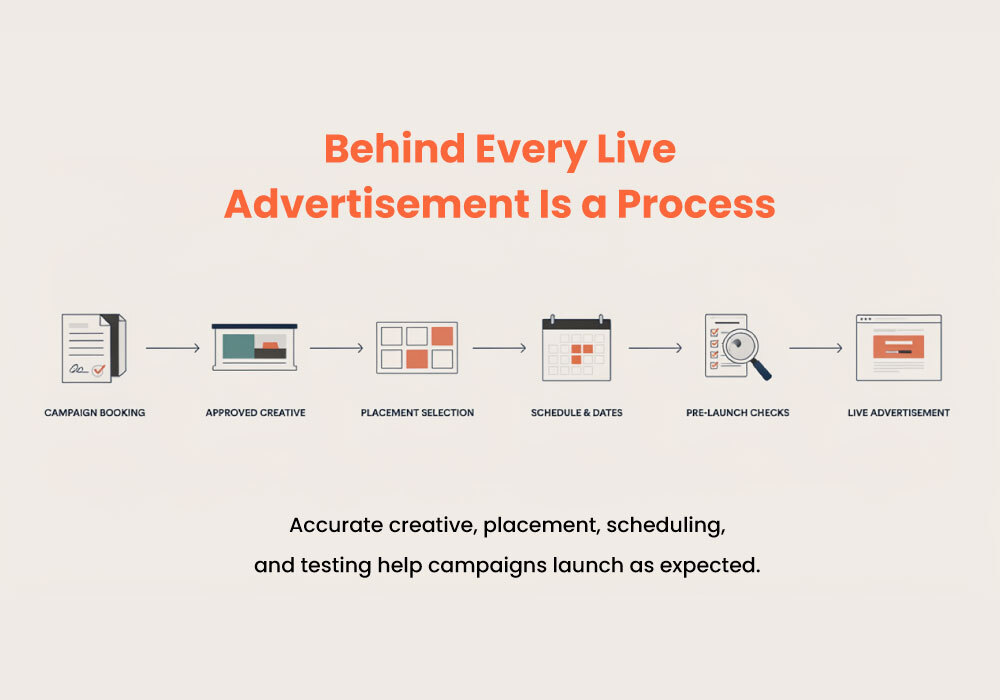
Before an advertisement goes live, the AdOps team should perform a final quality check.
This stage confirms that the campaign has been configured correctly and that the advertisement is ready for the publisher's audience.
The team should verify:
Is the correct creative being displayed?
Is the advertisement assigned to the right placement?
Are the campaign dates accurate?
Does the destination URL work?
Does the creative display correctly?
Are there any formatting or visibility issues?
Does the campaign meet the agreed requirements?
For example, an advertiser may have purchased a banner on a publisher's homepage.
During testing, the AdOps team discovers that the banner appears correctly on desktop but is not displaying properly on mobile.
The team can investigate and correct the issue before the campaign launch.
Once the campaign passes the required checks, it can go live according to the agreed schedule.
The team should then confirm that the advertisement is visible in the intended placement.
A successful launch means that the campaign has moved from planning and configuration into active delivery.
9. Stage Seven: Campaign Monitoring and Delivery Management
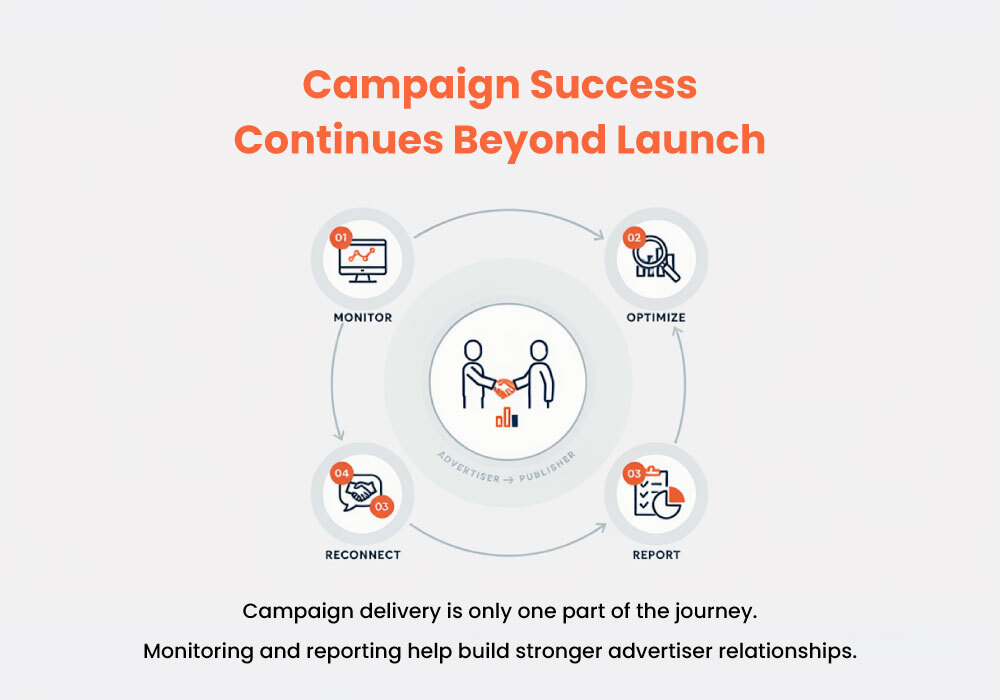
Launching a campaign does not mean the operational work is finished.
Throughout the campaign period, the AdOps team needs to monitor its delivery.
Monitoring helps publishers confirm that advertisements continue to run correctly and that campaign requirements are being fulfilled.
The team may review:
Advertisement visibility.
Creative accuracy.
Placement assignment.
Campaign start and end dates.
Delivery performance.
Technical issues.
Unexpected interruptions.
For example, an advertiser may contact the publisher because its banner is not appearing on a particular article page.
The AdOps team must investigate the campaign configuration, placement assignment, creative status, and schedule to identify the issue.
Regular monitoring helps the publisher detect problems and take corrective action.
It also supports better communication with advertisers because the team can provide more accurate updates about campaign delivery.
Monitoring should be treated as an ongoing responsibility rather than a one-time activity performed immediately after launch.
10. Stage Eight: Campaign Optimization
Campaign optimization involves reviewing an active campaign and identifying opportunities to improve its delivery or performance.
The appropriate optimization activities depend on the campaign agreement, available performance information, and the advertiser's objectives.
For example, a publisher may notice that one advertising placement is receiving more engagement than another.
The AdOps team can review the available campaign information and identify whether any adjustments are appropriate and permitted under the agreement.
Optimization may involve:
Reviewing placement-level performance.
Identifying delivery issues.
Checking creative display.
Reviewing campaign pacing.
Correcting configuration problems.
Recommending suitable placement adjustments.
Coordinating approved creative updates.
Consider an advertiser running a campaign across homepage and article-page placements.
The campaign report shows that the homepage placement is generating more clicks.
The publisher can use this information to discuss future campaign opportunities with the advertiser.
Any changes to an active campaign should follow the agreed campaign requirements and be communicated appropriately.
Optimization is not simply about changing campaign settings. It is about using delivery information to improve campaign management while protecting the advertiser's expectations.
11. Stage Nine: Campaign Completion and Reporting
When the campaign reaches its scheduled end date, the publisher moves into the final reporting stage.
The AdOps team reviews the campaign records and prepares a report showing what was delivered.
The report helps the advertiser understand the campaign's activity and performance.
Depending on the campaign requirements, reporting may include:
Advertiser and campaign details.
Campaign start and end dates.
Advertising placements.
Total impressions.
Total clicks.
Click-through rate (CTR).
Other agreed performance metrics.
Delivery observations.
For example, a publisher may complete a 15-day campaign for a travel company.
The final report could include the campaign duration, placements used, total impressions, clicks, and relevant performance observations.
Accurate reporting is important because it provides transparency and helps advertisers evaluate their campaigns.
It also gives the publisher useful information for future advertising conversations.
If the campaign experienced delivery issues or required adjustments, these should be documented and addressed appropriately.
The reporting stage closes the operational lifecycle of the campaign and creates a record that can support future planning.
12. What Happens After a Campaign Ends?
Although campaign reporting marks the end of the active campaign, the relationship between the publisher and advertiser may continue.
The publisher can use the completed campaign as an opportunity to understand the advertiser's experience and discuss future requirements.
This may involve:
Reviewing campaign feedback.
Discussing performance observations.
Identifying successful placements.
Understanding advertiser priorities.
Recommending future advertising opportunities.
Discussing campaign renewals.
For example, an advertiser may have received positive results from a homepage banner campaign.
The publisher could use those results to discuss another campaign around an upcoming product launch.
Similarly, if the advertiser experienced delivery problems, the publisher should understand what happened and identify improvements before proposing another campaign.
The end of one campaign can therefore become the starting point for another advertising opportunity.
13. Common Challenges Across the Direct Ad Campaign Lifecycle
Although the campaign lifecycle follows a clear sequence, publishers can experience operational difficulties at different stages.
These challenges often arise when information is scattered, responsibilities are unclear, or campaign workflows depend heavily on manual coordination.
Incomplete Sales Handover
The AdOps team receives campaign details without all the necessary information.
This creates delays and additional communication.
Solution: Use standardized booking briefs with mandatory campaign details.
Poor Inventory Visibility
The team does not have an accurate view of available and booked advertising placements.
This can create scheduling conflicts.
Solution: Maintain organized inventory records and a centralized campaign calendar.
Creative Management Issues
Multiple creative versions, unclear file names, or missing approvals can lead to incorrect advertisements being used.
Solution: Establish clear creative naming, approval, and storage processes.
Campaign Setup Errors
Incorrect placements, dates, or destination links can affect campaign delivery.
Solution: Use a structured setup checklist and verify campaign details before launch.
Insufficient Monitoring
Campaign issues may go unnoticed until the advertiser reports them.
Solution: Establish regular monitoring procedures for active campaigns.
Delayed Reporting
Campaign information is difficult to collect because records are incomplete or inconsistent.
Solution: Maintain accurate campaign records throughout the lifecycle.
Addressing these challenges helps publishers create a more reliable campaign management process.
14. Why a Structured Campaign Lifecycle Matters
Every stage of a direct ad campaign depends on the quality of the previous stage.
If the booking information is incomplete, campaign setup becomes difficult.
If inventory is not properly allocated, placement conflicts may occur.
If creative assets are incorrect, the campaign may not launch as expected.
If monitoring is inconsistent, delivery problems may remain unresolved.
If campaign records are incomplete, reporting becomes more challenging.
This is why publishers need to think about the campaign lifecycle as one connected process rather than a collection of unrelated tasks.
A structured workflow helps publishers:
Improve Operational Efficiency
Clear responsibilities and repeatable processes reduce unnecessary manual work.
Protect Advertising Inventory
Accurate placement management helps prevent conflicts and supports better use of available inventory.
Improve Campaign Accuracy
Consistent setup and quality checks reduce avoidable mistakes.
Strengthen Advertiser Relationships
Reliable delivery and clear communication help build advertiser confidence.
Improve Reporting
Consistent campaign records make it easier to prepare accurate performance reports.
Support Business Growth
Organized operations help publishers manage increasing campaign volumes without losing visibility or control.
The objective is not simply to complete individual tasks faster. It is to make the entire campaign journey more consistent and manageable.
15. The Role of an Ad Management System in the Campaign Lifecycle
As publishers manage more advertisers and campaigns, coordinating every stage manually can become increasingly difficult.
An ad management system can help bring important campaign information and workflows into a more organized environment.
Depending on the system's capabilities, it may support:
Advertising inventory management.
Campaign booking records.
Campaign setup and trafficking.
Creative asset organization.
Campaign scheduling.
Delivery monitoring.
Performance reporting.
The main benefit is improved visibility across the campaign lifecycle.
Instead of searching through separate spreadsheets, emails, and documents, teams can work with more organized campaign information.
For example, a centralized campaign record can help AdOps quickly identify the advertiser, selected placement, approved creative, campaign dates, and current campaign status.
This can improve coordination between sales and AdOps while reducing repetitive administrative work.
However, technology alone does not guarantee successful campaign management.
Publishers still need accurate information, clear responsibilities, defined workflows, and consistent quality checks.
The right system should support these processes and make them easier to maintain.
16. How RevAdOps Supports the Direct Ad Campaign Lifecycle
Managing direct-sold advertising requires coordination across several operational responsibilities.
For publishers with limited internal AdOps resources, maintaining consistency across every stage of the campaign lifecycle can be challenging.
RevAdOps supports publishers with the essential operational services required to manage direct advertising campaigns.
Its services include:
Ad Inventory Management
Helping publishers organize advertising inventory and maintain better visibility into available placements and advertising opportunities.
Campaign Setup and Trafficking
Supporting campaign configuration, creative coordination, scheduling, and the operational activities involved in campaign delivery.
Campaign Optimization
Reviewing campaign performance and identifying opportunities to improve delivery and make better use of advertising inventory.
Performance Reporting
Providing detailed campaign reporting to help publishers understand delivery and communicate results to advertisers.
RevAdOps works as an extension of the publisher's team, supporting the operational processes behind direct-sold advertising.
This allows publishers to focus on their audiences, advertisers, and broader business priorities while maintaining a more structured approach to campaign management.
Conclusion: Every Stage Contributes to Campaign Success
The lifecycle of a direct ad campaign begins long before an advertisement appears on a publisher's website.
It starts with identifying advertising opportunities, continues through sales discussions and booking confirmation, and moves into inventory allocation, creative management, campaign setup, testing, and launch.
Once the campaign is live, monitoring and optimization help maintain delivery, while reporting communicates the final results.
Each stage plays an important role in fulfilling the advertiser's agreement.
When these activities are properly coordinated, publishers can manage campaigns with greater accuracy, improve operational efficiency, and build stronger advertiser relationships.
When the process lacks structure, even small gaps can create delays, errors, and missed opportunities.
A successful direct ad campaign is not just about getting an advertisement live. It is about managing the entire journey from the first booking to the final report.
For publishers looking to improve their direct advertising operations, understanding the complete campaign lifecycle is the first step toward building a more reliable and scalable AdOps process.
Leave a reply
Your email address will not be published. Required fields are marked *