



Managing direct-sold advertising campaigns involves much more than securing an advertiser and placing a banner on a website. Every campaign requires coordination, accurate information, proper scheduling, creative management, monitoring, and reporting.
For digital publishers, these activities need to work together. The sales team must communicate advertiser requirements clearly, the AdOps team must manage campaign setup and delivery, and the reporting process must provide advertisers with a clear picture of campaign performance.
But what happens when these activities are handled without a structured process?
Campaign details get scattered across emails and spreadsheets. Creative files become difficult to track. Campaign schedules overlap. Team members struggle to understand responsibilities, and advertisers have to follow up repeatedly for updates.
What may begin as a few small operational inefficiencies can eventually turn into a larger problem: campaign chaos.
For publishers managing direct-sold advertising, a lack of structure can affect campaign accuracy, team productivity, advertiser relationships, and revenue opportunities.
The challenge is not necessarily the number of campaigns being managed. It is whether the publisher has a reliable process for managing them.
In this article, we explore what happens when Ad Operations lack structure, the common problems publishers experience, and how organized AdOps processes can help create a more consistent campaign management experience.
1. What Does Unstructured Ad Operations Actually Mean?
Ad Operations is the process of managing the operational activities involved in delivering advertising campaigns.
For digital publishers handling direct-sold advertising, this includes:
Managing advertising inventory.
Recording advertiser requirements.
Setting up campaigns.
Coordinating creative materials.
Managing ad placements.
Scheduling campaign delivery.
Monitoring active campaigns.
Tracking campaign performance.
Preparing advertiser reports.
Each activity is connected to the next.
When publishers have a structured AdOps process, campaign information is recorded consistently, responsibilities are clear, and teams understand what needs to happen at every stage.
Unstructured Ad Operations looks very different.
Campaign information may be maintained in separate spreadsheets. Advertiser instructions may exist only in email conversations. Creative files may be stored in different folders. Campaign schedules may depend on individual calendars, and reporting may be handled through separate documents.
There may be no consistent process for checking whether a campaign is ready to launch or whether an advertiser's requested changes have been completed.
The result is an operation that depends heavily on individual memory, repeated communication, and manual coordination.
This may seem manageable when campaign volume is low. However, as more advertisers and campaigns are added, the lack of structure becomes increasingly difficult to manage.
2. Scattered Campaign Information Creates Confusion
One of the first signs of unstructured Ad Operations is scattered campaign information.
A single direct-sold campaign can involve multiple details, including:
Advertiser name.
Campaign objective.
Creative files.
Placement requirements.
Start and end dates.
Creative specifications.
Destination URLs.
Delivery expectations.
Reporting requirements.
When these details are stored in different places, team members may struggle to find the information they need.
For example, the sales team may confirm campaign requirements through email. The AdOps team may record placement details in a spreadsheet, while creative files are shared through a separate folder.
If an advertiser requests a change, the updated information may not reach everyone involved.
This creates unnecessary back-and-forth.
Team members spend time searching for emails, checking documents, and confirming details that should already be available.
The problem becomes even more serious when several campaigns are active at the same time.
Without a centralized record or consistent documentation process, employees may struggle to determine which information is current.
A structured campaign management process helps keep essential details organized and accessible to the relevant team members.
3. Unclear Responsibilities Slow Down Campaign Delivery
Campaign management involves several people and responsibilities.
The sales team communicates with advertisers and confirms campaign requirements. The AdOps team handles campaign setup, creative coordination, trafficking, monitoring, and reporting.
Sometimes additional team members are involved in reviewing creative materials, managing website placements, or communicating campaign updates.
When responsibilities are not clearly defined, important tasks can fall between teams.
For example, an advertiser may send an updated banner to the sales team. The sales representative assumes the AdOps team has received it, but no one confirms whether the creative has been updated.
The campaign continues running with the old banner.
In another situation, the AdOps team may be waiting for a final destination URL while the sales team assumes all campaign details have already been submitted.
These situations create delays that could have been avoided through clearer responsibilities.
Publishers should establish who is responsible for each stage of the campaign lifecycle.
A simple responsibility structure can include:
Sales: Confirm advertiser requirements and campaign agreements.
AdOps: Manage campaign setup, trafficking, monitoring, and reporting.
Creative coordination: Ensure approved creative materials are available.
Reporting: Verify campaign information and communicate performance results.
Clear ownership reduces confusion and helps every campaign move through the process more efficiently.
4. Campaign Setup Becomes Inconsistent
Campaign setup is one of the most important stages of direct-sold advertising.
Before a campaign goes live, the publisher needs to confirm that the correct creative is being used, the right placement has been assigned, and the agreed schedule has been followed.
Without a consistent setup process, different team members may follow different methods.
One person may use a checklist, while another relies on email instructions. Someone may record campaign details in a spreadsheet, while another updates the website directly.
This creates inconsistency.
Common campaign setup problems include:
Incorrect banner dimensions.
Missing campaign details.
Wrong placement assignments.
Incorrect destination URLs.
Outdated creative files.
Missing start or end dates.
Incomplete advertiser instructions.
These mistakes can affect campaign delivery and create additional work for the team.
Imagine an advertiser purchasing a specific homepage placement for a product launch. If the campaign is configured incorrectly, the publisher may need to investigate the issue, correct the placement, and communicate the delay.
A structured setup process reduces the likelihood of these problems.
Every campaign should follow a consistent checklist that confirms the required information before launch.
5. Creative Management Turns Into a Version-Control Problem
Creative materials are an important part of direct-sold advertising.
Advertisers may provide banners in different sizes, request creative changes, or send updated versions during an active campaign.
Without a clear creative management process, it becomes difficult to identify which file should be used.
For example, an advertiser may initially send a banner called:
Campaign_Final.jpg
Later, they may send:
Campaign_Final_Updated.jpg
Then another version arrives:
Campaign_Final_Updated_2.jpg
If the team does not have a clear approval and file-management process, someone may accidentally upload an outdated creative.
This can lead to:
Incorrect advertisements appearing on the website.
Delays while teams confirm the approved version.
Repeated communication with advertisers.
Confusion about completed creative updates.
Additional work correcting mistakes.
Publishers should maintain a clear process for receiving, reviewing, approving, storing, and implementing creative materials.
Each creative should be connected to the correct advertiser and campaign.
This makes it easier for the AdOps team to identify the approved version and reduce avoidable mistakes.
6. Poor Scheduling Creates Campaign Conflicts
Campaign scheduling is another area where a lack of structure can create serious operational problems.
Digital publishers may have multiple advertisers purchasing placements across different website sections and time periods.
Some campaigns may run for a few days, while others may remain active for several weeks.
Without an organized schedule, it becomes difficult to maintain visibility into campaign start dates, end dates, and placement availability.
For example, two advertisers may request the same homepage banner placement during overlapping periods.
If inventory records are not updated consistently, the publisher may accidentally promise the same placement to both advertisers.
Other scheduling problems include:
Campaigns launching later than agreed.
Advertisements remaining live after the end date.
Creative changes being implemented too late.
Overlapping placement assignments.
Missing upcoming campaign deadlines.
These problems can affect advertiser confidence and create unnecessary pressure for the operations team.
A structured campaign calendar should clearly show upcoming launches, active campaigns, scheduled changes, and end dates.
This allows teams to prepare in advance instead of reacting to problems at the last minute.
7. Poor Inventory Management Leads to Missed Opportunities
Advertising inventory represents the spaces publishers make available to advertisers across their digital properties.
These may include homepage banners, article-page advertisements, category-page placements, and other designated website locations.
Publishers need accurate information about which placements are available, which are booked, and which are currently being used.
When inventory management lacks structure, this information can become outdated or difficult to access.
The sales team may not know which placements are available for a particular campaign period.
The AdOps team may have a different understanding of what has already been reserved.
This creates a disconnect between selling advertising opportunities and delivering them.
Poor inventory management can result in:
Duplicate placement commitments.
Incorrect availability information.
Underutilized advertising spaces.
Missed sales opportunities.
Difficulty planning future campaigns.
Confusion between sales and AdOps teams.
An organized inventory management process helps publishers maintain a clearer view of their advertising opportunities.
It also allows sales and AdOps teams to work from consistent placement information.
For publishers looking to grow direct-sold advertising revenue, inventory visibility is an important operational foundation.
8. Manual Communication Increases the Risk of Mistakes
Email and messaging platforms are useful for communicating campaign requirements and advertiser updates.
However, they should not become the only place where important campaign information exists.
When campaign management depends entirely on individual conversations, essential details can easily get lost.
For example, an advertiser may request a creative replacement through an email conversation. The sales representative may forward the request to AdOps, but the updated file may be missing.
The AdOps team then needs to follow up for clarification.
Similarly, an advertiser may confirm a campaign schedule in one conversation while another team member continues working with an earlier version of the schedule.
This creates unnecessary communication loops.
Manual communication becomes especially difficult when:
Multiple people are involved in one campaign.
Advertisers request frequent changes.
Campaign details are updated regularly.
Several campaigns are managed simultaneously.
Important instructions are buried in long email threads.
A better process is to record important campaign decisions and updates in a shared campaign record.
Communication should support the workflow, not replace proper documentation.
9. Campaign Monitoring Becomes Reactive Instead of Proactive
Once a campaign goes live, the publisher still needs to monitor its delivery.
This includes checking whether the correct creative is appearing in the assigned placement, whether the campaign is running within the agreed schedule, and whether delivery is progressing as expected.
When AdOps lacks structure, monitoring often becomes reactive.
Team members may check campaigns only when an advertiser raises a concern or when someone notices an issue.
For example, a banner may stop appearing in its assigned location. If nobody is responsible for reviewing active campaigns, the issue may remain unnoticed.
The advertiser may eventually report the problem.
At that point, the team needs to investigate the cause, determine how long the issue existed, and explain what happened.
This creates additional work and can affect the advertiser's confidence.
A structured monitoring process should define:
Which campaigns need regular checks.
Who is responsible for monitoring.
What campaign information should be reviewed.
How delivery issues should be recorded.
Who needs to be informed when problems occur.
The objective is to identify operational issues earlier and maintain more consistent campaign delivery.
10. Reporting Becomes Delayed and Inconsistent
Reporting is one of the final stages of the campaign lifecycle, but its quality depends on everything that happens before it.
If campaign information is scattered, tracking is inconsistent, and delivery records are incomplete, preparing accurate reports becomes difficult.
The team may need to collect information from different spreadsheets, website analytics records, campaign documents, and internal conversations.
This can make reporting a time-consuming process.
Unstructured reporting often leads to:
Delayed advertiser reports.
Inconsistent reporting formats.
Incorrect campaign information.
Missing placement-level details.
Difficulty verifying impressions and clicks.
Repeated advertiser follow-ups.
A report should clearly communicate what was delivered and how the campaign performed against its requirements.
To achieve this, publishers need consistent records throughout the campaign lifecycle.
Reporting should not begin only when a campaign ends. The information required for reporting should be organized from the beginning.
11. Advertiser Experience Suffers When Campaigns Lack Structure
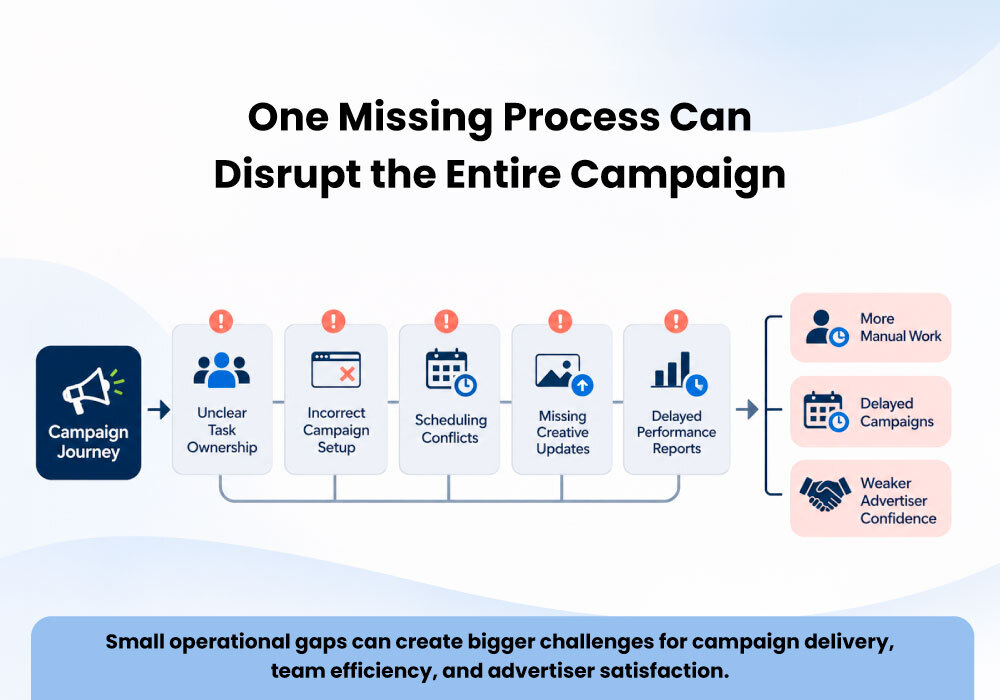
Advertisers evaluate more than the audience reach of a publisher.
They also pay attention to how professionally their campaigns are managed.
Consider an advertiser who purchases a direct-sold campaign and experiences the following:
The campaign launches later than expected.
The wrong creative appears initially.
A requested update takes several days.
Campaign status is unclear.
The final report arrives late.
Even if the publisher has a valuable audience, the overall experience may leave the advertiser dissatisfied.
These operational problems can affect trust.
Advertisers may become less confident about booking future campaigns if they repeatedly need to follow up or resolve avoidable issues.
This is why AdOps structure is not just an internal efficiency concern.
It directly contributes to the advertiser experience.
A consistent process helps publishers deliver campaigns more reliably, communicate updates clearly, and provide better visibility throughout the campaign lifecycle.
12. Small Inefficiencies Become Bigger Problems as Publishers Grow
A manual process may appear manageable when a publisher has only a few active campaigns.
However, the same process may become difficult to maintain as the business expands.
Imagine a publisher managing five direct-sold campaigns per month.
The team can probably track most information through a few spreadsheets and regular communication.
Now imagine that the publisher begins managing thirty campaigns across multiple website sections.
Each campaign may have different:
Advertisers.
Creative requirements.
Placement assignments.
Campaign durations.
Delivery expectations.
Reporting requirements.
The number of operational tasks increases.
If there is no consistent workflow, the team spends more time coordinating, checking, correcting, and updating information.
This can create a cycle where growth increases operational pressure rather than improving the publisher's business.
A structured AdOps process helps publishers build repeatable workflows that can support a growing number of campaigns.
The objective is to make campaign management more predictable, not simply to handle more tasks.
13. How to Bring Structure Into Ad Operations
Improving AdOps does not necessarily require a complicated system.
Publishers can begin by reviewing their existing processes and identifying where information, responsibilities, or campaign tasks become unclear.
Here are practical steps to create a more organized operation.
Step 1: Create a Central Campaign Record
Maintain one reliable record for every direct-sold campaign.
Include:
Advertiser details.
Campaign name.
Campaign objective.
Creative specifications.
Placement assignments.
Start and end dates.
Destination URLs.
Reporting requirements.
Current campaign status.
Relevant team members should know where to find the latest campaign information.
Step 2: Standardize Campaign Setup
Create a repeatable checklist for every campaign.
Before launch, confirm that the creative, placement, dates, advertiser requirements, and destination URLs have been reviewed.
This helps reduce preventable setup errors.
Step 3: Organize Creative Files
Establish clear naming conventions and folder structures for creative materials.
Keep approved creatives connected to the correct campaign and make it easy to identify the latest version.
Step 4: Maintain a Campaign Calendar
Track upcoming launches, active campaigns, creative updates, and end dates.
This improves scheduling visibility and helps teams prepare for upcoming work.
Step 5: Establish Clear Responsibilities
Define who manages campaign setup, trafficking, monitoring, advertiser communication, and reporting.
Every important task should have a clear owner.
Step 6: Create a Consistent Monitoring Process
Review active campaigns regularly and document any delivery issues or changes.
Do not wait for advertisers to report problems before checking campaign activity.
Step 7: Standardize Reporting
Use a consistent reporting structure that includes relevant campaign details, performance metrics, placement information, and delivery context.
Verify the information before sharing it with advertisers.
14. The Role of Ad Management Systems in Creating Structure
As publishers manage more campaigns, maintaining every detail manually can become increasingly difficult.
An ad management system can help organize important campaign information and support a more consistent operational process.
Depending on the system's capabilities, publishers may be able to manage:
Advertising inventory.
Campaign details.
Creative materials.
Placement assignments.
Campaign schedules.
Delivery information.
Performance records.
Reporting requirements.
The value of such a system is not simply that information is stored digitally.
It is that the publisher has a more organized way to manage campaign activity.
Instead of depending on disconnected documents and individual memory, teams can work with a clearer process.
However, a system alone does not guarantee successful AdOps.
Publishers also need defined responsibilities, accurate campaign information, consistent procedures, and people who understand how to manage direct-sold advertising.
Technology and operational expertise need to work together.
15. How RevAdOps Helps Bring Structure to Direct-Sold Advertising
For many digital publishers, building and maintaining a dedicated AdOps team can be challenging.
They may have a small internal team handling multiple responsibilities, limited experience managing complex campaign workflows, or growing advertising demand that requires additional operational support.
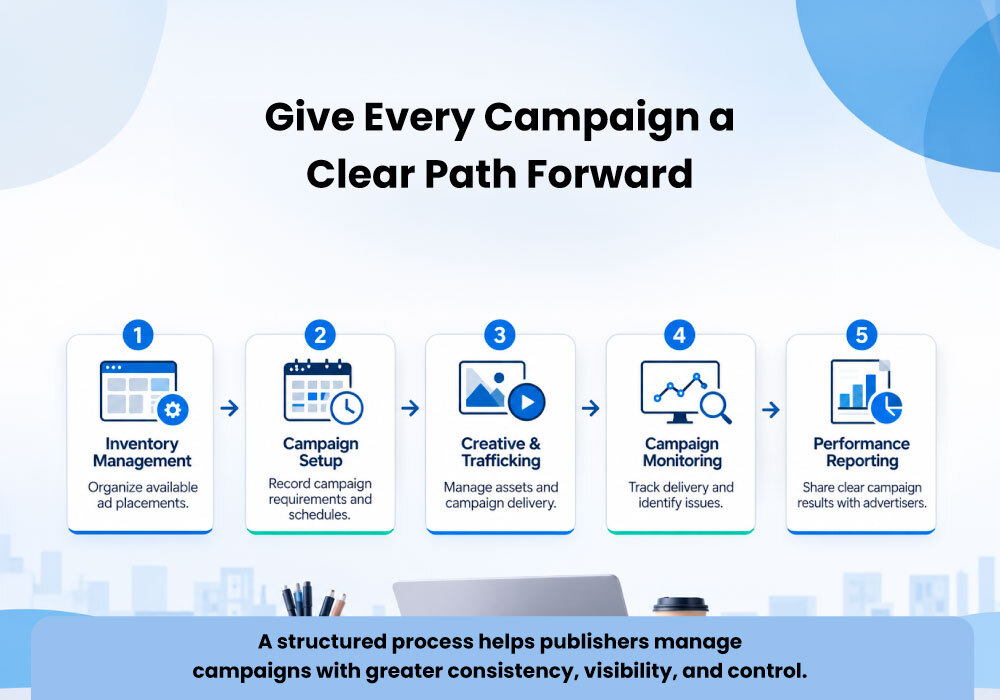
RevAdOps works as an extension of publishers' teams, helping manage the operational activities involved in direct-sold advertising.
Its services include:
Ad Inventory Management
Helping publishers organize advertising placements and maintain clearer visibility into available inventory and campaign assignments.
Campaign Setup and Trafficking
Supporting campaign setup, creative coordination, placement requirements, and the operational steps needed to prepare campaigns for delivery.
Campaign Optimization
Monitoring campaign activity and supporting adjustments based on campaign requirements and delivery performance.
Detailed Performance Reporting
Helping publishers organize campaign performance information and provide advertisers with clear, structured reports.
By supporting these activities, RevAdOps helps publishers reduce the operational burden of managing direct-sold campaigns independently.
The focus is on creating more consistent campaign processes, improving coordination, and supporting a better advertising experience for publishers and their advertisers.
Conclusion: Structure Turns Campaign Chaos Into Consistent Operations
Campaign chaos rarely happens because of one major mistake.
It often develops through small operational problems that accumulate over time.
A missing campaign detail, an outdated creative, an unclear responsibility, a scheduling conflict, or a delayed report may seem like an isolated issue.
But when these problems happen repeatedly, they create a larger operational challenge.
For digital publishers managing direct-sold advertising, structure is essential.
It helps teams organize inventory, manage campaign requirements, coordinate creative materials, monitor delivery, and prepare reliable reports.
More importantly, it creates a consistent experience for advertisers.
Publishers should not have to depend on endless email conversations, scattered spreadsheets, and individual memory to manage every campaign.
With clear processes, organized information, and the right AdOps support, campaign management becomes more predictable and easier to maintain as the business grows.
A successful advertising operation is not built on constant firefighting. It is built on a process that keeps every campaign moving in the right direction.
Ready to bring more structure to your direct-sold advertising operations? Explore how RevAdOps can support your team with inventory management, campaign setup and trafficking, campaign optimization, and detailed performance reporting.
Leave a reply
Your email address will not be published. Required fields are marked *