


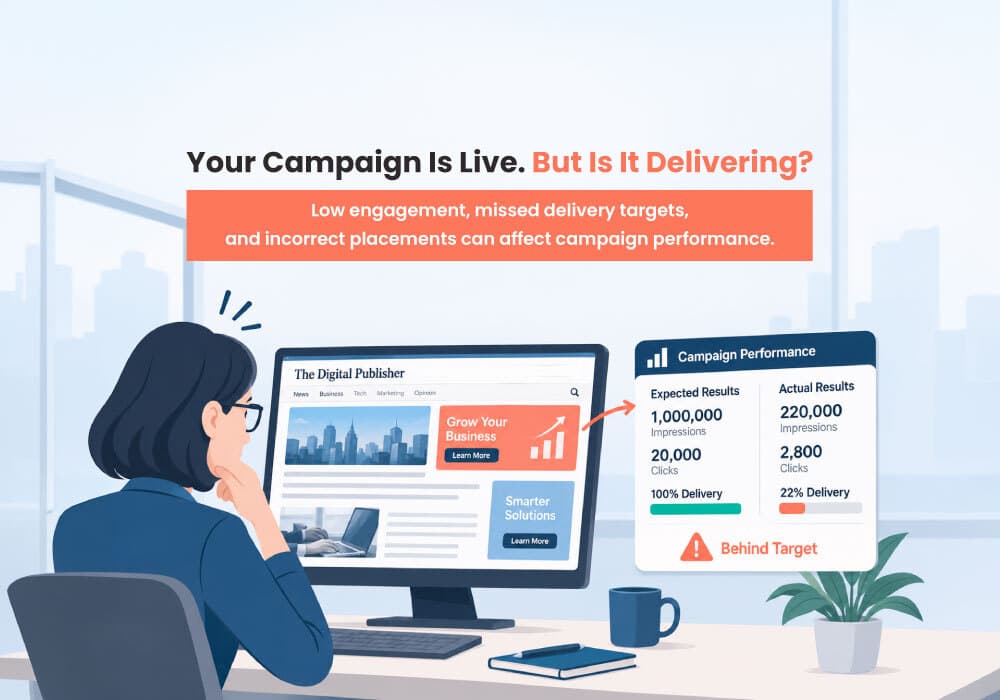
A publisher can have a loyal audience, valuable website traffic, and strong relationships with advertisers and still struggle to deliver successful advertising campaigns.
An advertiser books a banner placement expecting visibility, engagement, and measurable results. The publisher confirms the campaign, prepares the creative, and launches the advertisement. Yet, when the campaign ends, the results may fall short of expectations.
Impressions may be lower than anticipated. Click-through rates may be disappointing. Certain placements may receive very little engagement. In some cases, the advertiser may even question whether the campaign delivered the value originally promised.
For digital publishers managing direct-sold advertising, these challenges can affect more than one campaign. They can influence advertiser satisfaction, future bookings, and the overall value of the publisher's digital inventory.
But underperforming campaigns are not always the result of low website traffic or an unappealing audience. Often, the problem lies in how campaigns are planned, configured, placed, monitored, and reported.
Understanding these factors can help publishers identify what is going wrong and make better decisions before the next campaign begins.
Let's explore the common reasons direct ad campaigns underperform and what publishers can do to improve their results.
1. Campaign Objectives Are Not Clearly Defined
One of the biggest reasons a direct advertising campaign underperforms is that the publisher and advertiser do not have a shared understanding of what success looks like.
An advertiser may book a homepage banner because they want brand visibility. Another may want website traffic. A third may be promoting a product launch and looking for clicks from a specific audience.
Although all three advertisers may purchase the same banner format, their campaign objectives are different.
If the publisher does not understand these objectives, it becomes difficult to recommend the right placement, establish suitable expectations, or evaluate the results.
Why This Affects Campaign Performance
Imagine an advertiser purchases a premium homepage banner to increase awareness of a new product.
The publisher focuses entirely on the number of clicks generated. However, the advertiser is more interested in reaching a large and relevant audience.
Even if the banner receives significant visibility, the advertiser may consider the campaign unsuccessful if the reporting does not demonstrate the exposure they expected.
Similarly, an advertiser looking for website traffic may be disappointed if the campaign generates impressions but very few clicks.
The issue is not necessarily the campaign itself. It may be a mismatch between the original objective and the way performance is evaluated.
How Publishers Can Improve It
Before confirming a direct ad campaign, publishers should understand what the advertiser wants to achieve.
Clarify:
Is the campaign intended to build brand awareness?
Is the advertiser looking to drive website traffic?
Is the campaign promoting a specific product or offer?
Does the advertiser have a particular audience or content category in mind?
Which campaign metrics will be used to evaluate results?
Once the objective is clear, publishers can recommend suitable advertising placements and agree on realistic delivery expectations.
A successful campaign starts with a clear objective, not simply a confirmed booking.
2. The Advertising Placement Does Not Match the Audience
A publisher may have thousands of daily visitors, but not every page or advertising placement will be equally relevant to every advertiser.
This is where placement selection becomes important.
For example, a technology brand may want to reach readers interested in gadgets, software, and consumer electronics. A banner placed within the technology section may be more relevant to that campaign than a general placement on an unrelated article.
Likewise, a lifestyle advertiser may prefer placements within fashion, wellness, or entertainment content.
When advertisements appear in locations that do not match the advertiser's intended audience, the campaign may receive limited engagement.
Why Placement Relevance Matters
Website traffic alone does not determine campaign quality.
The context in which an advertisement appears can influence whether readers notice it and find it relevant.
Consider two situations:
A travel brand advertises on a publisher's travel and lifestyle pages.
The same brand advertises across unrelated website sections without a clear audience connection.
Both campaigns may generate impressions, but the first placement may provide a more relevant environment for the advertiser's message.
Poor placement selection can result in:
Lower engagement.
Fewer clicks.
Limited relevance to the advertiser's audience.
Disappointing campaign results.
Reduced interest in future bookings.
How Publishers Can Improve It
Publishers should understand their website audience and organize advertising inventory around meaningful content categories.
Review:
Which sections attract the most relevant readers?
Which pages receive consistent traffic?
Which placements are most visible?
Which categories align with particular advertiser industries?
Which advertising formats are available across desktop and mobile?
This information can help sales teams recommend placements based on audience relevance rather than simply offering whichever banner space is available.
The right advertising placement is not always the one with the most traffic. It is the one that best matches the campaign objective and audience.
3. Campaign Targeting Is Too Broad or Too Restrictive
Targeting helps publishers control where an advertisement appears.
For direct-sold campaigns, this may involve selecting specific website sections, content categories, URLs, devices, or other agreed placement conditions.
However, targeting can create problems when it is not planned carefully.
Some publishers use broad placement settings that allow advertisements to appear across too many unrelated pages. Others restrict campaigns to a very small number of pages without checking whether those pages can generate sufficient traffic.
Both approaches can affect performance.
When Targeting Is Too Broad
Suppose an advertiser books a campaign intended for readers interested in business and finance.
If the advertisement appears across unrelated entertainment, lifestyle, and general news pages, the campaign may reach a larger audience but have less relevance.
The advertiser may receive impressions without seeing the engagement they expected.
When Targeting Is Too Restrictive
Now consider an advertiser requesting a banner on only two specific article pages.
Those pages may receive limited daily traffic. Even if the creative and campaign setup are correct, the available impressions may not be sufficient to meet the agreed delivery expectations.
How Publishers Can Improve It
Publishers should review targeting requirements before campaign confirmation.
Check:
Whether the requested pages receive enough traffic.
Whether the selected categories match the advertiser's audience.
Whether the campaign has enough eligible placements.
Whether the campaign duration is appropriate.
Whether the agreed delivery target is realistic for the selected inventory.
If the advertiser requests a highly specific placement, explain the available inventory and any limitations before confirming the booking.
Where appropriate, recommend additional relevant pages or categories to provide more delivery opportunities.
Effective targeting balances audience relevance with realistic inventory availability.
4. Creative Assets Are Not Designed for the Placement
Even when a campaign has the right audience and placement, the creative itself can affect its performance.
An advertisement needs to communicate its message clearly, fit the available space, and encourage readers to take the intended action.
A banner with unclear messaging, difficult-to-read text, or an unsuitable design may receive limited engagement.
Technical creative issues can also affect delivery.
For example, a banner may have incorrect dimensions, an unsuitable file format, a broken destination URL, or a design that does not display properly on mobile devices.
Common Creative Problems
Publishers may encounter issues such as:
Banner dimensions that do not match the available ad slot.
Text that becomes difficult to read on smaller screens.
Low-quality or stretched images.
Unclear calls to action.
Outdated promotional information.
Broken destination links.
Incorrect or unapproved creative versions.
A visually attractive advertisement is not necessarily an effective advertisement. It must also communicate the advertiser's message in the context of the placement.
How Publishers Can Improve It
Publishers should introduce a creative review process before launching campaigns.
The review should cover:
Correct banner dimensions.
Image quality and display compatibility.
Readability across desktop and mobile.
Clear promotional messaging.
Working destination URLs.
Advertiser approval of the final creative.
Where the publisher offers multiple advertising formats, it should communicate the specifications before the advertiser prepares the artwork.
This reduces last-minute changes and helps ensure the campaign is ready for launch.
Publishers can also share basic creative recommendations with advertisers, such as keeping banner copy concise and making the main call to action easy to identify.
A well-planned placement needs a creative that is equally well prepared.
5. Campaign Setup and Scheduling Contain Errors
A campaign can have a strong creative, a relevant audience, and an appropriate placement but still underperform because of incorrect setup.
Campaign setup involves translating the advertiser's booking requirements into the actual advertising configuration.
This includes selecting the correct ad zone, assigning the creative, defining campaign dates, confirming placement conditions, and checking that the advertisement displays as intended.
Small mistakes during this process can affect the entire campaign.
Common Setup Issues
Consider the following examples:
The campaign is assigned to the wrong ad slot.
The start date is entered incorrectly.
The end date does not match the advertiser's booking.
The creative is uploaded to the wrong placement.
The destination URL is missing or incorrect.
The campaign is restricted to fewer pages than agreed.
The mobile creative is not configured correctly.
These issues may not be obvious when the campaign is first created.
A banner might appear on the website, giving the impression that everything is working, while the campaign is actually running in the wrong location or under the wrong conditions.
How Publishers Can Improve It
Create a standard campaign setup checklist.
Before launch, verify:
Advertiser and campaign details.
Correct website and ad placement.
Approved creative assets.
Campaign start and end dates.
Target pages and categories.
Destination URL.
Agreed impression or delivery requirements.
Display across relevant devices.
The team should also test the advertisement before making it live.
A short pre-launch review can prevent issues that might otherwise affect several days of campaign delivery.
Accurate campaign setup is essential because even a small configuration mistake can create a much larger delivery problem.
6. Campaign Delivery Is Not Monitored Regularly
Launching an advertisement is not the final step in campaign management.
Publishers need to monitor active campaigns to understand whether they are delivering as expected.
One common mistake is assuming that once a banner appears on the website, the campaign will continue running correctly until its scheduled end date.
However, website changes, creative updates, placement issues, and configuration problems can affect delivery.
Without regular checks, publishers may not discover these problems until the advertiser asks for an update or the campaign ends.
Understanding Campaign Underdelivery
Imagine an advertiser books 150,000 impressions over a 30-day campaign.
After 15 days, the campaign has delivered only 40,000 impressions.
At this point, the publisher should investigate whether the campaign is progressing as expected.
Possible reasons could include:
The selected pages are receiving less traffic than anticipated.
The campaign is assigned to an incorrect placement.
The creative is not displaying consistently.
The campaign has more restrictive conditions than originally planned.
The website's traffic has changed.
The campaign setup needs to be reviewed.
If the publisher waits until the final day to investigate, there may be limited time to address the shortfall.
How Publishers Can Improve It
Establish a regular monitoring process for active campaigns.
Review delivery based on the campaign's duration, impression commitment, placement type, and advertiser requirements.
Track:
Total impressions delivered.
Delivery progress against the agreed target.
Campaign start and end dates.
Creative display issues.
Placement performance.
Click activity, where relevant.
When a campaign falls behind expectations, investigate the reason and determine whether the issue can be corrected through an appropriate campaign adjustment.
Publishers should communicate material changes to advertisers when necessary.
Campaign monitoring helps publishers identify delivery problems early and protect advertiser commitments.
7. Publishers Focus on Impressions but Ignore Engagement
Impressions are an important measurement for many direct-sold display campaigns. They indicate how often an advertisement was delivered according to the publisher's measurement setup.
However, impressions do not tell the entire story.
An advertiser may also want to understand whether readers interacted with the advertisement.
Depending on the campaign objective, clicks, click-through rate, and performance by placement can provide useful additional context.
A campaign may deliver the agreed impressions but still receive fewer clicks than the advertiser expected.
This does not automatically mean the campaign failed. It means the publisher should look beyond total delivery when evaluating the results.
Why Engagement May Be Low
Several factors can influence engagement:
The creative message is unclear.
The call to action is not compelling.
The placement is not relevant to the advertiser's audience.
The banner is difficult to notice.
The landing page does not match the advertisement.
The advertiser's offer is not attractive to the intended audience.
Publishers should also recognize that they do not control every factor influencing clicks or conversions.
The advertiser's product, pricing, offer, brand recognition, and landing page experience can all influence the final outcome.
How Publishers Can Improve It
Review engagement alongside the campaign's original objective.
For example:
For an awareness campaign, focus on agreed impression delivery and placement visibility.
For a traffic-focused campaign, review clicks and click-through rate.
For campaigns using multiple placements, compare available results by placement or category.
Share the results with the advertiser and identify possible improvements for future campaigns.
Where the data supports it, publishers can recommend a more relevant placement, a different banner size, or a revised creative approach.
Good campaign evaluation looks at the objective, delivery, and engagement together—not just one number.
8. Reporting Does Not Give Advertisers Enough Information
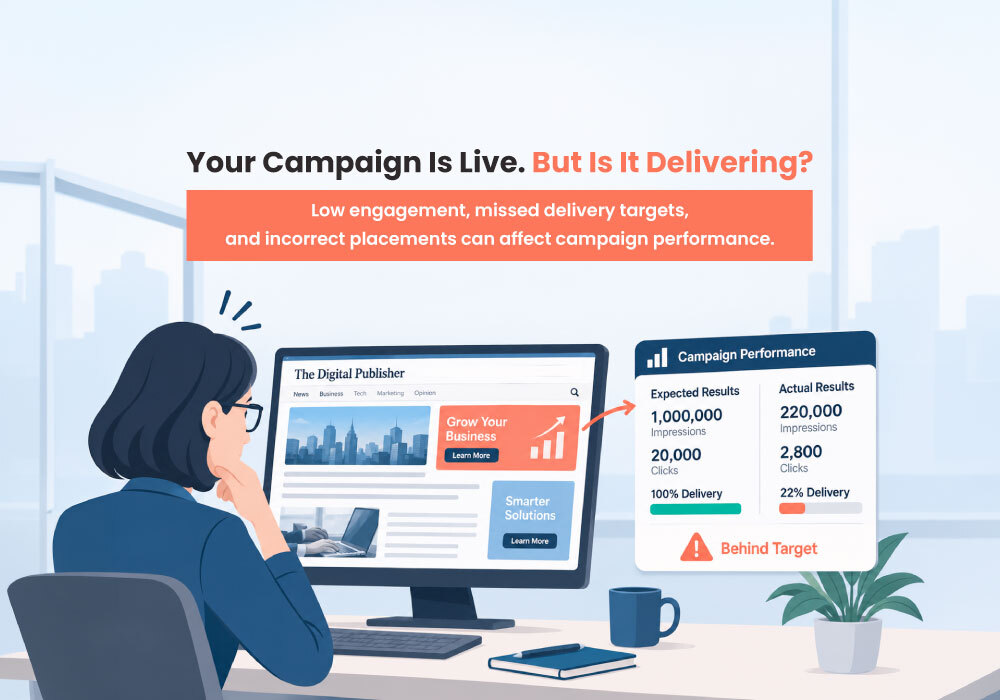
A campaign may be delivered correctly, but poor reporting can make the results difficult for an advertiser to understand.
Some publishers share only a total impression count. Others provide a spreadsheet without explaining the campaign period, placements, or other relevant metrics.
This leaves advertisers with questions.
Did the advertisement appear on the agreed pages? How many clicks were generated? Which placement performed better? Did the campaign meet its delivery commitment?
When these details are missing, advertisers may struggle to evaluate the campaign's value.
What Should a Good Campaign Report Include?
The reporting requirements should be agreed upon before the campaign begins.
Depending on the campaign, a report may include:
Advertiser and campaign name.
Campaign start and end dates.
Advertising formats and placements.
Total impressions delivered.
Total clicks.
Click-through rate, where relevant.
Performance by placement or category, where available.
Delivery against the agreed commitment.
Important campaign notes or adjustments.
Publishers should make sure the information is accurate and clearly explained.
If a campaign experienced underdelivery or technical issues, the report should provide appropriate context rather than hiding the problem.
How Publishers Can Improve It
Use a consistent reporting template and maintain campaign records throughout the delivery period.
This makes it easier to prepare reports without searching through multiple spreadsheets and email conversations.
Reports should also be shared within the agreed timeframe.
Most importantly, publishers should use reporting as an opportunity to discuss what worked, what could be improved, and which placements may be suitable for future campaigns.
Clear reporting helps advertisers understand the campaign and gives publishers a stronger foundation for future bookings.
How to Diagnose an Underperforming Direct Ad Campaign
When a campaign does not deliver the expected results, publishers should avoid immediately changing placements or creative assets without understanding the underlying issue.
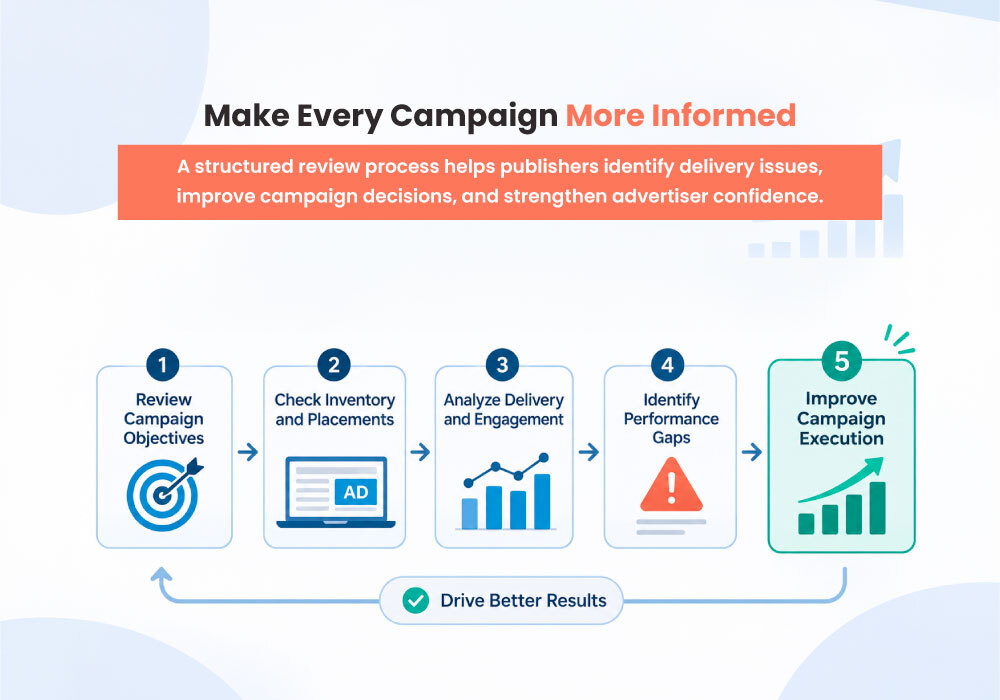
A better approach is to review the campaign systematically.
Here is a simple troubleshooting process:
Step 1: Revisit the Campaign Objective
Confirm what the advertiser expected from the campaign.
Was the priority impressions, clicks, visibility, or a specific website audience?
Compare the results with the original objective.
Step 2: Review the Booked Inventory
Check whether the campaign is running on the agreed website pages and advertising placements.
Confirm that the selected inventory was suitable for the expected delivery.
Step 3: Verify Campaign Setup
Review the campaign dates, creative assignments, placement settings, destination URL, and other relevant requirements.
Check whether the live campaign matches the original booking.
Step 4: Examine Delivery Data
Compare actual impressions with the agreed delivery target.
Look for unusual changes in delivery over the campaign period.
Step 5: Review Engagement
If clicks or other engagement metrics are part of the campaign evaluation, examine the results by placement or category where possible.
This may help identify whether certain placements are more relevant than others.
Step 6: Check the Creative
Review the banner's messaging, dimensions, visibility, and destination link.
Confirm that the approved version is being displayed correctly.
Step 7: Document Findings and Take Action
Record what caused the issue and agree on appropriate next steps.
This may involve correcting campaign settings, adjusting placements, replacing creative assets, or discussing revised expectations with the advertiser.
A documented review also helps prevent the same problem from occurring in future campaigns.
How AdOps Support Helps Improve Direct Ad Campaign Performance
Managing direct-sold advertising requires coordination across several activities.
Publishers must maintain inventory records, understand advertiser requirements, prepare campaign assets, configure placements, schedule advertisements, monitor delivery, and report results.
As the number of campaigns grows, these responsibilities can become increasingly difficult for internal teams to manage consistently.
This is where dedicated Ad Operations support can help.
An experienced AdOps team can support publishers with:
Inventory Management
Organizing website advertising zones and slots, maintaining placement information, and helping publishers understand their available inventory.
Campaign Setup and Trafficking
Reviewing campaign requirements, assigning the correct creative assets, configuring placements, and checking campaign schedules before launch.
Campaign Monitoring
Reviewing delivery progress, identifying campaign issues, and helping ensure advertisements run according to the agreed requirements.
Campaign Optimization
Reviewing available campaign data and making appropriate adjustments to placements, schedules, or creative configurations where possible.
Reporting and Analysis
Preparing clear campaign reports that help publishers communicate delivery results and understand performance.
RevAdOps supports digital publishers with the operational side of direct-sold advertising, including inventory management, campaign setup, trafficking, optimization, and reporting.
For publishers with established audiences but limited internal digital advertising resources, dedicated AdOps support can help create a more consistent campaign management process.
The objective is not simply to get advertisements live. It is to help publishers manage campaigns accurately, deliver on advertiser commitments, and build stronger long-term relationships.
Conclusion: Better Campaign Performance Starts Behind the Scenes
A direct advertising campaign can underperform for many reasons.
The campaign objective may not be clear. The selected placement may not match the intended audience. Creative assets may be unsuitable, campaign settings may contain errors, or delivery may not be monitored regularly.
Sometimes the campaign delivers its agreed impressions but still fails to meet the advertiser's expectations because engagement and reporting were not properly considered.
These challenges highlight an important point: successful digital advertising depends on more than the advertisement itself.
It requires careful planning, accurate inventory information, reliable campaign setup, consistent monitoring, and transparent reporting.
Publishers who understand these areas can identify performance problems earlier, improve their campaign processes, and offer advertisers a more dependable experience.
Your website traffic creates advertising opportunities. Your campaign management process determines how effectively you deliver them.
Better AdOps means better campaign control, stronger advertiser confidence, and a more reliable foundation for direct advertising revenue.
Leave a reply
Your email address will not be published. Required fields are marked *