



For digital publishers, advertising revenue does not depend only on attracting advertisers or securing campaign deals. It also depends on what happens after an advertiser agrees to buy an ad placement. Campaigns need to be set up correctly, advertisements must appear in the right locations, schedules need to be followed, delivery must be monitored, and performance reports must reach advertisers on time.
When publishers manage these activities without a structured ad management system, the work often becomes more complicated than it needs to be.
At first, handling a few direct-sold advertising campaigns manually may seem manageable. A publisher might use spreadsheets to track available inventory, emails to coordinate campaign details, a content management system to place banners, and separate documents to record campaign performance. These methods can work when advertising operations are limited.
However, as the number of advertisers, placements, campaigns, and campaign requirements increases, disconnected processes create operational challenges. Teams spend more time updating information, checking placements, coordinating changes, and preparing reports. Small mistakes become harder to identify, and important campaign details can get lost between different tools and people.
The cost is not always immediately visible. It may appear as additional working hours, delayed campaign launches, missed advertising opportunities, inconsistent delivery, or weaker advertiser relationships.
An ad management system helps publishers organize these activities in a more structured way. It provides a clearer process for managing advertising inventory, campaign details, placements, schedules, and reporting.
In this article, we explore the real cost of not using an ad management system, the operational challenges publishers may face, and how structured AdOps processes can help improve direct-sold advertising management.
1. Why Ad Management Matters for Digital Publishers
Digital publishers invest significant effort in building their audiences. They publish content, maintain websites, attract readers, and develop relationships with advertisers.
But attracting an advertiser is only one part of the advertising process.
Once a direct-sold campaign is agreed upon, the publisher needs to manage several operational activities:
Confirming available advertising inventory.
Recording campaign requirements and specifications.
Assigning the correct ad placements.
Uploading and checking creative materials.
Managing campaign start and end dates.
Monitoring campaign delivery.
Tracking impressions and clicks where required.
Preparing performance reports.
Communicating campaign updates to advertisers.
Each activity contributes to the overall advertiser experience.
If these tasks are handled through disconnected spreadsheets, emails, manual website updates, and individual records, the team may struggle to maintain a consistent view of campaign activity.
An ad management system helps bring these operational details into a more organized workflow. Instead of relying on scattered information, publishers can manage important campaign details through a structured process.
This becomes particularly important as a publisher grows and begins handling multiple advertisers and campaigns simultaneously.
2. The Hidden Cost of Managing Campaigns Manually
One of the biggest disadvantages of not using an ad management system is the amount of manual work involved.
Without a centralized process, employees may need to update several documents whenever a campaign changes. They might record the campaign details in a spreadsheet, communicate the changes through email, update the website placement separately, and maintain another document for reporting.
The same information may need to be entered multiple times.
Consider a publisher managing ten direct-sold campaigns across different website sections. Each campaign may have its own creative files, placement requirements, delivery dates, and reporting expectations.
If campaign information is maintained manually, the team must repeatedly check different records to understand what is running, where it is running, and when it needs to change.
This creates several challenges:
Repeated data entry.
Time spent searching for campaign information.
Multiple versions of the same document.
Additional coordination between team members.
More opportunities for human error.
Less time available for campaign monitoring and advertiser communication.
The problem is not simply that manual work takes time. It is that repetitive operational tasks can prevent the team from focusing on activities that directly support campaign quality and advertiser relationships.
An organized ad management process reduces unnecessary repetition and gives teams a clearer way to manage campaign information.
3. Poor Ad Inventory Visibility Can Lead to Missed Opportunities
Advertising inventory is one of a digital publisher's important commercial assets.
It includes the advertising spaces available across a website, such as homepage banners, article placements, category pages, and other designated advertising locations.
Publishers need to understand which placements are available, which are already booked, and which are currently being used by active campaigns.
Without an ad management system or a reliable inventory management process, this information may be spread across spreadsheets, emails, and individual team records.
That creates a visibility problem.
For example, an advertiser may request a specific homepage placement for a particular period. The sales team believes the placement is available, but another team member has already reserved it for a different campaign.
If the information is not updated consistently, the publisher may accidentally promise the same inventory to multiple advertisers.
Another situation involves available placements that are not being actively tracked. A publisher may have advertising opportunities across several website sections but lack a clear record of their availability.
As a result, the team may overlook opportunities when responding to advertiser inquiries.
Poor inventory visibility can create:
Confusion about available placements.
Incorrect availability information.
Scheduling conflicts.
Difficulty planning future campaigns.
Underutilized advertising spaces.
Lost opportunities to sell available inventory.
An ad management system can help publishers maintain a clearer record of advertising placements and campaign assignments.
When inventory information is organized, sales and AdOps teams can work with a more consistent understanding of available advertising opportunities.
4. Campaign Setup Errors Can Affect Advertiser Confidence
Campaign setup involves more than uploading an advertisement to a website.
Every direct-sold campaign comes with specific requirements. These may include creative dimensions, placement locations, campaign dates, destination URLs, and other agreed delivery details.
If these requirements are recorded manually across different documents, mistakes can happen.
For example:
A banner may be uploaded to the wrong website section.
An outdated creative may remain live.
A campaign may start on the wrong date.
A destination URL may be entered incorrectly.
An agreed placement may not be configured as expected.
Even a small setup error can affect the campaign experience.
Imagine an advertiser who has paid for a particular placement during a product launch. If the advertisement appears in the wrong section or goes live later than agreed, the advertiser may question the publisher's campaign management process.
The issue is not always related to the advertisement itself. It may be the result of missing information, unclear instructions, or an inconsistent setup workflow.
A structured ad management process helps teams maintain campaign specifications in one organized place and verify important details before launch.
This improves operational consistency and reduces the likelihood of preventable setup mistakes.
5. Delayed Campaign Launches Can Create Revenue and Relationship Problems
Timing is an important part of direct-sold advertising.
Advertisers may purchase placements around product launches, seasonal promotions, special events, or specific marketing periods. They expect their advertisements to appear according to the agreed campaign schedule.
Without an organized system, managing these schedules can become difficult.
Campaign dates may be recorded in separate spreadsheets, discussed through email, or maintained in individual calendars. When several campaigns are active, the team must continuously check different sources to understand upcoming launches and campaign deadlines.
This can result in:
Campaigns going live later than expected.
Delays in creative approvals or updates.
Missed start and end dates.
Confusion about campaign priorities.
Last-minute coordination between departments.
A delayed campaign can create more than an administrative inconvenience.
If an advertiser has planned a promotion around a specific date, a late launch may reduce the value of the advertising opportunity. The publisher may also need to spend additional time addressing concerns, explaining the delay, or adjusting the campaign schedule.
An ad management system supports better campaign organization by helping teams maintain visibility into campaign dates, placements, and delivery requirements.
When campaign schedules are clearly documented, teams can prepare in advance and reduce avoidable delays.
6. Creative Updates Become Harder to Manage
Direct-sold advertising campaigns often involve creative changes.
An advertiser may provide a revised banner, request an updated message, change a destination URL, or replace an existing creative during an active campaign.
These requests need to be communicated accurately and implemented at the correct placement.
Without a structured process, creative management can become confusing.
A team member might receive a revised banner through email while another person continues working with the previous file. Someone may update the website placement without informing the person responsible for campaign records.
This can result in different versions of the creative being used across the publisher's internal records and live website.
Common creative management challenges include:
Difficulty identifying the latest approved creative.
Multiple versions of the same banner.
Delays in implementing advertiser changes.
Unclear communication about approved updates.
Incorrect creative files remaining live.
Missing records of when a change was made.
These problems can affect campaign accuracy and advertiser confidence.
A structured ad management workflow should make it clear which creative is approved, which campaign it belongs to, where it needs to appear, and whether an update has been completed.
Better creative organization also helps publishers respond more efficiently when advertisers request changes.
7. Campaign Monitoring Becomes More Time-Consuming
Launching a campaign does not mean the operational work is finished.
Publishers need to monitor active direct-sold campaigns to check whether advertisements are appearing as expected and whether agreed delivery requirements are being followed.
Depending on the campaign, this may involve checking:
Whether the correct creative is live.
Whether the advertisement appears in the agreed placement.
Whether the campaign is running within the scheduled period.
Whether delivery is progressing as expected.
Whether impressions and clicks are being recorded where applicable.
Whether any campaign updates are required.
When campaign information is scattered across different tools, monitoring becomes a repetitive process.
Team members may need to open several website pages, check campaign records, compare dates, review available performance information, and contact other departments to confirm whether everything is running correctly.
This increases the time required to manage each campaign.
It can also make it harder to identify problems early.
For instance, if an advertisement is missing from its assigned placement, the issue may remain unnoticed until the advertiser reports it. By that point, the publisher may need to investigate the problem and explain why the campaign was not delivered as expected.
A structured campaign management process helps establish clearer monitoring responsibilities and makes it easier to review active campaigns.
The objective is to identify issues earlier, maintain campaign accuracy, and provide a more consistent advertising experience.
8. Reporting Takes Longer and Becomes Less Consistent
Reporting is an important part of managing direct-sold advertising campaigns.
Advertisers want to understand how their campaigns performed and whether the agreed advertising activity was delivered.
Depending on the campaign requirements, publishers may need to report metrics such as impressions, clicks, click-through rate, campaign duration, and placement-level performance.
Without an organized reporting process, collecting this information can become time-consuming.
The team may need to gather data from different sources, review campaign records, organize spreadsheets, verify figures, and prepare reports manually.
This creates several problems.
Information may be scattered.
Campaign details and performance data may exist in separate documents, making it difficult to bring everything together.
Reports may take longer to prepare.
Employees spend time collecting and checking information instead of focusing on analysis and advertiser communication.
Reporting formats may be inconsistent.
Different team members may use different layouts, naming conventions, or measurement descriptions.
Errors become harder to identify.
When figures are transferred manually between documents, there is a greater possibility of incorrect entries or mismatched campaign information.
Advertiser communication may be delayed.
If reports are not ready on time, publishers may struggle to provide timely campaign updates.
An organized ad management process can make campaign information easier to access and reporting responsibilities easier to manage.
The goal is not simply to create reports faster. It is to provide advertisers with clear, accurate, and consistent information about their campaigns.
9. Poor Coordination Between Sales and AdOps Teams
Direct-sold advertising involves multiple teams working together.
The sales team communicates with advertisers, discusses requirements, and confirms campaign agreements. The AdOps team handles the operational work required to set up, manage, monitor, and report on those campaigns.
For this relationship to work effectively, both teams need access to accurate campaign information.
Without a structured ad management process, important details may be communicated through scattered emails, messages, spreadsheets, or informal conversations.
For example, the sales team may confirm a specific placement and campaign duration with an advertiser. However, the operational team may receive incomplete information about the agreed requirements.
The AdOps team then needs to follow up, clarify details, and sometimes delay campaign setup until the missing information is available.
This creates unnecessary back-and-forth.
Common coordination problems include:
Missing campaign specifications.
Unclear placement requirements.
Delayed communication about creative changes.
Conflicting campaign schedules.
Limited visibility into campaign status.
Difficulty confirming whether advertiser requests have been completed.
An ad management system helps create a more organized information flow.
When campaign details are recorded consistently, sales and AdOps teams can work from the same information instead of relying entirely on individual communication.
This improves coordination and reduces avoidable operational confusion.
10. Advertiser Relationships Can Suffer
Advertisers do not evaluate publishers only by the audience they reach.
They also consider the overall campaign experience.
Was the campaign launched on time? Did the advertisement appear in the agreed location? Were creative updates handled correctly? Was performance monitored? Did the advertiser receive a clear report?
These operational details influence how advertisers perceive a publisher.
A publisher may have a valuable audience and attractive advertising inventory, but inconsistent campaign management can weaken the overall experience.
Consider an advertiser who repeatedly has to follow up about campaign status, creative updates, or performance reports.
Even if the publisher delivers strong audience reach, the advertiser may become frustrated by the amount of coordination required.
Over time, this can affect trust and future campaign discussions.
A more structured ad management process helps publishers deliver a consistent experience across the campaign lifecycle.
It gives teams a clearer way to manage requests, track campaign details, and communicate updates.
For publishers building long-term direct advertiser relationships, operational reliability is an important part of retaining confidence.
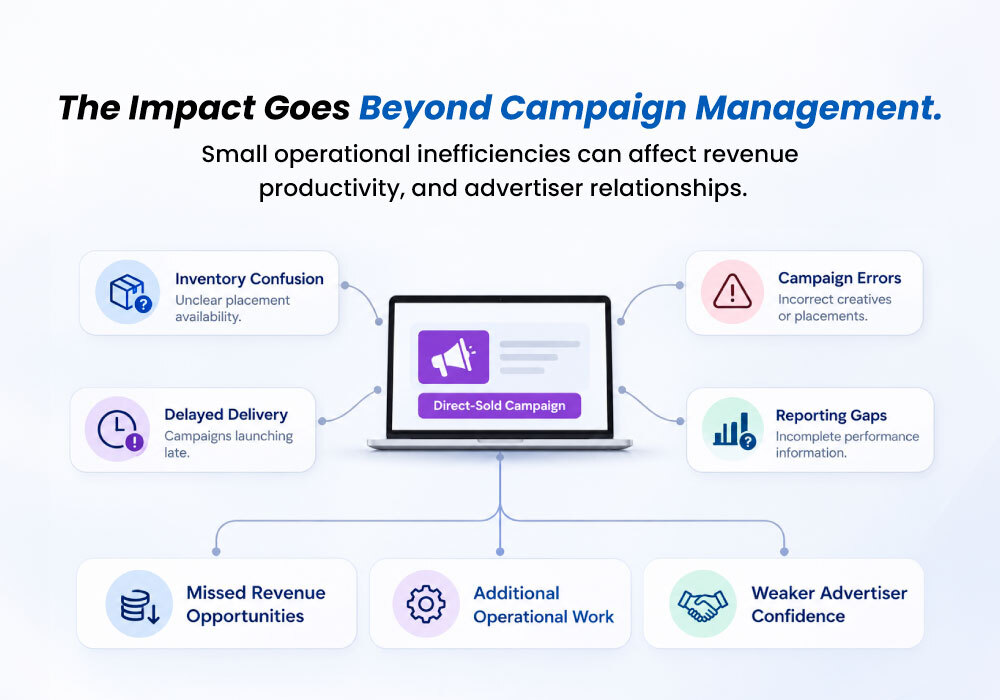
11. Scaling Advertising Operations Becomes Difficult
A manual process that works for a small number of campaigns may become difficult to maintain as the business grows.
Consider a publisher that initially manages three direct-sold campaigns per month. The team may be able to track everything through a simple spreadsheet and a few internal procedures.
Now imagine that the publisher begins managing thirty campaigns across multiple website sections, with different advertisers, creative requirements, campaign dates, and reporting expectations.
The workload increases significantly.
More campaigns mean more details to record, more placements to manage, more updates to coordinate, and more performance information to review.
If the publisher continues relying on the same manual process, operational complexity can increase faster than the team's ability to manage it.
This can lead to:
More administrative work.
Greater dependence on individual employees.
Increased risk of campaign conflicts.
Slower campaign setup.
Inconsistent reporting.
Difficulty maintaining quality as volume grows.
Growth should create more advertising opportunities, not an endless increase in operational confusion.
An ad management system helps publishers build a more repeatable process for managing campaign activity.
It supports consistency as the number of advertisers and campaigns increases.
12. Dependence on Individual Employees Creates Operational Risk
Another hidden cost of not using a structured ad management system is dependence on individual team members.
In many publishing organizations, important campaign information is known by the people managing it.
One employee may know which placements are reserved. Another may remember which advertiser requested a creative update. Someone else may maintain the reporting spreadsheet or understand how a particular campaign was configured.
This knowledge may not always be documented in a shared and consistent way.
What happens when an employee is unavailable, changes roles, or leaves the organization?
Other team members may struggle to understand the current status of campaigns, locate important files, or identify which updates are still pending.
This creates operational disruption.
A structured system and clearly documented workflow reduce reliance on individual memory.
Campaign details, placement information, schedules, and reporting records become easier for authorized team members to access and understand.
This improves continuity and makes it easier for publishers to maintain consistent operations even when responsibilities change.
13. The Real Cost Is Bigger Than the Software Decision
Some publishers delay adopting an ad management system because they want to avoid additional software expenses.
It is understandable to consider the cost of introducing a new system. However, evaluating the decision only through the price of the software can overlook the cost of existing manual processes.
The real cost of not using an organized ad management system may include several factors.
Employee time
How many hours are spent updating spreadsheets, searching for campaign information, coordinating changes, and preparing reports?
Campaign errors
How much time is spent correcting incorrect placements, outdated creatives, scheduling mistakes, or incomplete campaign information?
Missed advertising opportunities
Are available placements being overlooked because inventory information is incomplete or outdated?
Delayed delivery
Do campaign launches or advertiser-requested changes take longer because information is scattered?
Reporting delays
How much effort is required to collect and organize campaign performance data?
Advertiser dissatisfaction
Are advertisers repeatedly following up because they do not receive timely updates or clear reports?
Limited growth capacity
Can the current team manage additional campaigns without creating more operational pressure?
These costs may not appear as a single expense in the company's accounts.
Instead, they are distributed across employee hours, operational inefficiencies, campaign corrections, missed opportunities, and advertiser relationship challenges.
That is why publishers should evaluate ad management based on the overall efficiency and reliability of their advertising operations, not just the purchase price of a system.
14. What Should Publishers Look for in an Ad Management System?
Not every publisher has the same operational requirements.
A small digital publication managing a limited number of direct-sold campaigns may need a simpler setup than a large media organization managing multiple websites and advertisers.
However, there are several important capabilities publishers should consider.
1. Ad Inventory Management
The system should help publishers maintain an organized view of available advertising placements, booked inventory, and campaign assignments.
2. Campaign Setup and Management
Teams should be able to record important campaign information, including advertiser details, creative specifications, placements, and campaign schedules.
3. Campaign Scheduling
Publishers need a clear way to manage campaign start dates, end dates, and placement requirements.
4. Creative Organization
Campaign creatives and updates should be managed through a clear process so that teams can identify the correct approved materials.
5. Campaign Monitoring
The system or supporting workflow should help teams review active campaigns and identify delivery issues.
6. Performance Reporting
Publishers should be able to organize relevant campaign information and prepare clear reports for advertisers.
7. Team Coordination
The process should make campaign information easier for relevant sales and AdOps team members to access and understand.
The most suitable solution depends on the publisher's size, advertising volume, website structure, and internal capabilities.
The important thing is to move away from disconnected processes and establish a reliable way to manage direct-sold campaigns.
15. How RevAdOps Helps Publishers Manage Direct-Sold Advertising
For publishers, introducing a system is only one part of improving advertising operations.
The team also needs the right processes, campaign knowledge, and operational support to manage direct-sold advertising consistently.
This is where RevAdOps can help.
RevAdOps works as an extension of publishers' teams, supporting the operational activities involved in managing direct-sold advertising campaigns.
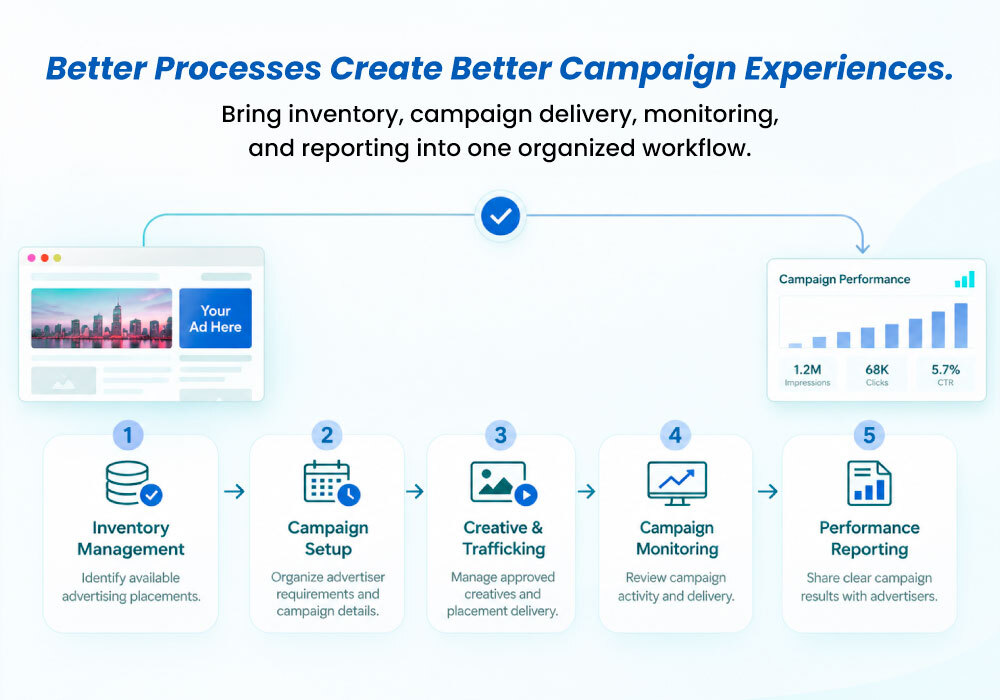
Its services focus on key areas of AdOps, including:
Ad Inventory Management
Helping publishers organize advertising inventory and maintain clearer visibility into available placements and campaign assignments.
Campaign Setup and Trafficking
Supporting campaign setup, creative coordination, placement requirements, and the operational steps needed to get direct-sold campaigns ready for delivery.
Campaign Optimization
Monitoring campaign activity and supporting adjustments that help campaigns meet their agreed requirements.
Performance Reporting
Organizing campaign performance information and preparing detailed reports that help publishers communicate results to advertisers.
For publishers with limited internal AdOps resources, this support can help reduce the operational burden of managing direct-sold campaigns.
Instead of expecting a small team to handle every campaign-related task independently, publishers can work with dedicated AdOps support to establish more consistent processes.
RevAdOps helps publishers focus on their core business while ensuring that the operational side of direct-sold advertising receives the attention it needs.
Conclusion: Don't Let Disconnected Processes Limit Your Advertising Revenue
An ad management system is not simply another piece of software. It is part of building a more organized advertising operation.
Without a structured system or process, publishers may spend unnecessary time managing spreadsheets, tracking placements, coordinating campaign changes, checking delivery, and preparing reports.
These challenges can affect employee productivity, campaign accuracy, advertiser confidence, and the publisher's ability to grow its direct-sold advertising business.
The cost is not always obvious, but it can accumulate across every stage of the campaign lifecycle.
Publishers should look beyond the immediate cost of adopting an ad management solution and consider the time, opportunities, and operational consistency that better processes can support.
The objective is straightforward: manage inventory clearly, set up campaigns accurately, monitor delivery consistently, and provide advertisers with reliable performance information.
Because successful direct-sold advertising is not just about selling an ad placement. It is about managing the entire campaign experience.
Ready to bring more structure to your direct-sold advertising operations?
Explore how RevAdOps can support your team with ad inventory management, campaign setup and trafficking, campaign optimization, and performance reporting.
Leave a reply
Your email address will not be published. Required fields are marked *