



Digital advertising revenue is built on more than the number of visitors who land on a publisher's website. It also depends on how effectively that audience is connected with advertisers, how well advertising inventory is managed, and how reliably campaigns are delivered.
For digital publishers, direct-sold advertising can be a valuable source of revenue. Advertisers pay for access to a relevant audience and specific placements across a publisher's website, app, newsletter, or digital magazine. But securing an advertising deal is only one part of the process. The campaign still needs to be set up, creatives need to be uploaded, placements need to be assigned, schedules need to be followed, and delivery needs to be monitored.
When these activities are handled entirely through manual processes, the workload can quickly become difficult to manage.
A campaign update might require several emails. A banner replacement might depend on a developer. Inventory availability might be tracked in a spreadsheet that is not updated regularly. Campaign reports might take hours to prepare because information is scattered across different systems.
Individually, these issues may seem manageable. Together, they can create delays, operational mistakes, missed advertising opportunities, and unnecessary pressure on the publisher's team.
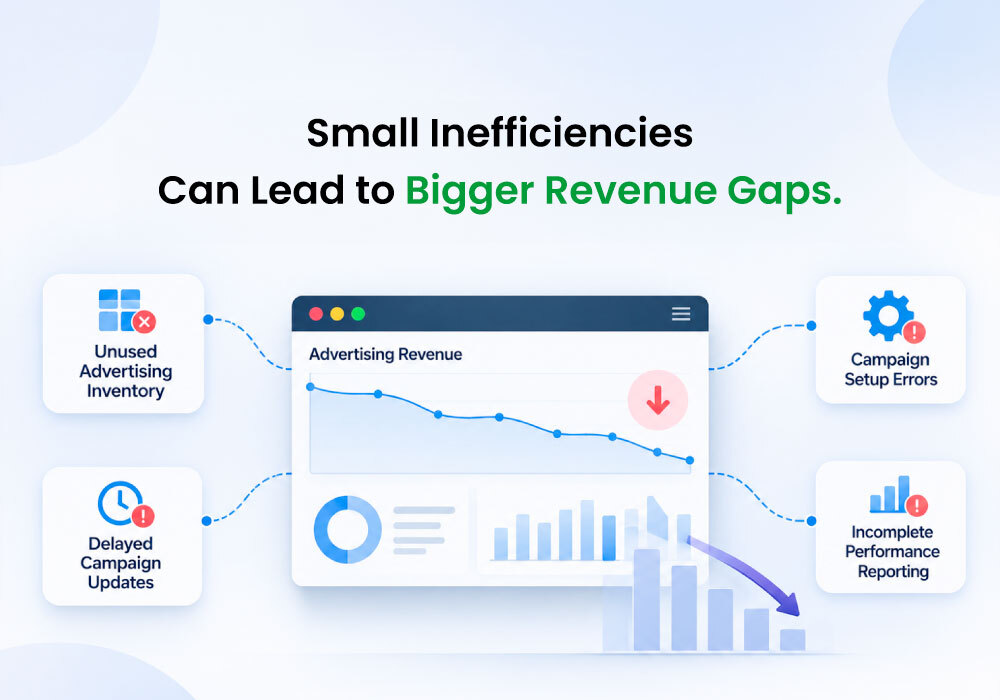
The most concerning part is that the financial impact is not always immediately visible. Publishers may continue selling advertising while losing time, efficiency, and potential revenue through disconnected workflows.
Manual ad management can quietly become one of the biggest obstacles to a publisher's advertising growth.
1. What Does Manual Ad Management Actually Mean?
Manual ad management refers to handling advertising operations through separate, largely human-dependent tasks rather than following a centralized and structured process.
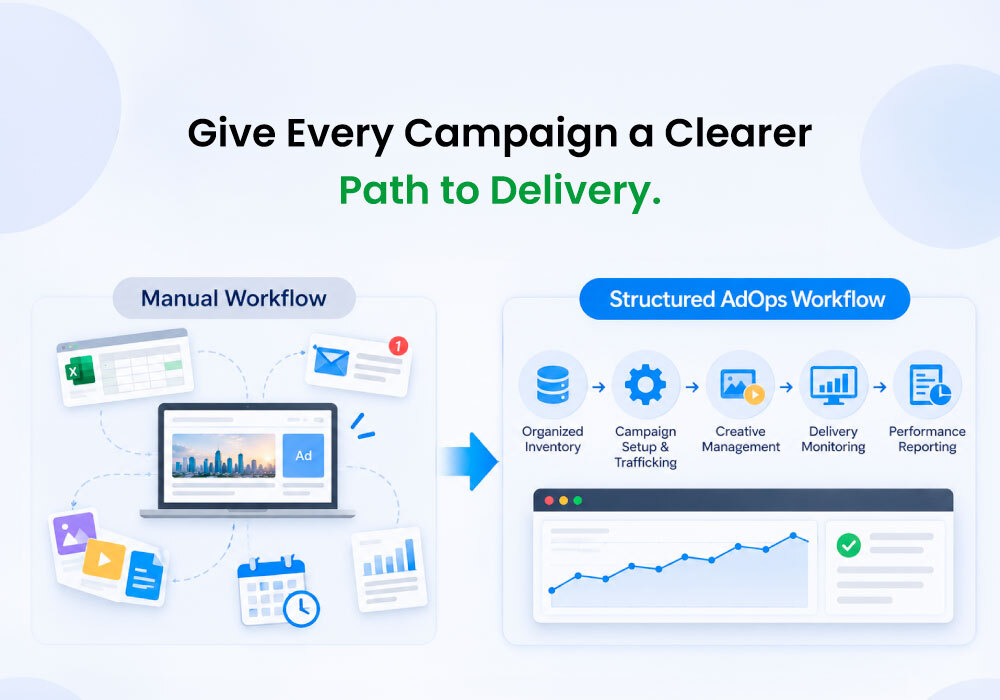
For example, a publisher might use one spreadsheet to track available advertising placements, email conversations to collect campaign requirements, shared folders to store creative files, and direct website updates to publish banners.
The team then has to coordinate all these activities to ensure that each campaign runs as agreed.
A typical manual workflow may involve:
Checking available advertising inventory.
Confirming campaign requirements through emails or calls.
Recording campaign details in spreadsheets.
Collecting and reviewing creative assets.
Assigning advertisements to website placements.
Coordinating banner uploads or website changes.
Tracking campaign start and end dates.
Checking whether advertisements are displaying correctly.
Preparing reports manually.
None of these activities is unnecessary. Every direct-sold campaign requires proper coordination and attention.
The challenge is how these activities are managed.
When information is spread across different places and every update depends on someone remembering to complete a task, the process becomes difficult to maintain. As campaign volume increases, the team has to spend more time coordinating operations instead of focusing on campaign quality and advertiser relationships.
2. The Hidden Cost of Time-Consuming Ad Operations
One of the first consequences of manual ad management is the amount of time it consumes.
A task that should take a few minutes can become a lengthy process when it involves multiple people, repeated communication, and manual updates.
Consider a publisher managing several direct advertising campaigns simultaneously.
One advertiser requests a banner update. Another needs a placement change. A third campaign is approaching its scheduled end date. Meanwhile, the team is preparing a performance report for an existing advertiser.
Each request needs attention.
Without a structured workflow, employees may have to search through emails, check spreadsheets, locate creative files, confirm campaign details, and coordinate with other departments before completing even a small update.
This creates a cycle of repetitive administrative work.
Where Does the Time Go?
Searching for campaign information: Team members spend time locating booking details, creative approvals, placement information, and previous communications.
Following up on pending tasks: Employees repeatedly contact advertisers, designers, sales representatives, or developers to confirm updates.
Updating multiple records: The same campaign information may need to be entered into several documents or systems.
Checking campaign schedules: Teams manually review start dates, end dates, placement assignments, and delivery requirements.
Preparing reports: Campaign performance information may need to be collected, organized, and formatted before it can be shared.
These activities may not generate revenue directly, but they consume resources that could be used to improve the publisher's advertising operations.
The more time a team spends managing administrative tasks, the less time it has to focus on inventory planning, campaign monitoring, advertiser communication, and future sales opportunities.
3. Missed Advertising Opportunities Due to Poor Inventory Visibility
Advertising inventory is one of a publisher's most valuable business assets.
Every available placement represents an opportunity to generate revenue through a direct advertising agreement. However, publishers can only make effective use of that inventory when they understand what is available, what is already booked, and when placements will become free.
Manual inventory tracking can make this difficult.
Imagine a publisher with multiple banner placements across its homepage, category pages, article pages, and newsletter.
If availability is tracked through spreadsheets, employees must keep those records updated whenever a new campaign is booked, an existing campaign is extended, or a placement becomes available.
If updates are delayed or information is incomplete, the sales team may not have an accurate view of the inventory.
This can lead to several problems:
Available placements may go unnoticed.
Previously booked placements may appear available.
Sales representatives may provide incorrect availability information.
Campaigns may be assigned without checking existing commitments.
Unsold inventory may remain unused because nobody has clear visibility into it.
Poor inventory visibility can affect both revenue generation and advertiser trust.
For example, an advertiser may be interested in booking a premium homepage placement. If the publisher cannot quickly confirm its availability, the opportunity may take longer to close. If the information provided is inaccurate, the publisher risks creating confusion during the booking process.
A clear inventory management process helps publishers understand their advertising capacity and make more informed decisions about which placements can be offered to advertisers.
4. Campaign Setup Errors Can Affect Revenue and Relationships
Every direct-sold advertising campaign comes with specific requirements.
An advertiser may book a particular placement, request a specific banner size, provide a campaign schedule, or agree to certain delivery expectations.
These details need to be recorded accurately and followed throughout the campaign.
When campaign setup relies heavily on manual data entry and communication, small mistakes can become costly.
For example:
A banner may be assigned to the wrong placement.
A campaign may be scheduled for the wrong date.
An outdated creative may be uploaded.
A campaign may remain live after its agreed end date.
An approved placement may not be updated correctly.
Campaign requirements may be misunderstood between teams.
The issue is not that employees are careless. Manual processes create more opportunities for information to be missed, duplicated, or entered incorrectly.
When the same campaign details are communicated through multiple emails and documents, there is also a risk that different team members will work with different versions of the information.
Why Small Errors Matter
A campaign setup error can affect the advertiser's experience.
If an advertisement appears in the wrong location or does not display as expected, the advertiser may question whether the publisher is delivering the agreed service.
The publisher may then need to spend additional time investigating the issue, correcting the setup, communicating with the advertiser, and reviewing campaign delivery.
These activities create additional operational work and can affect the advertiser's confidence in future campaigns.
A standardized campaign setup process helps reduce these risks by ensuring that important information is recorded, reviewed, and communicated consistently.
5. Delayed Campaign Updates Can Affect Advertiser Satisfaction
Advertising campaigns are not always static.
Advertisers may request creative replacements, updated messaging, revised landing page links, or changes to campaign schedules. These requests need to be handled carefully while maintaining the agreed campaign requirements.
In a manual environment, even a straightforward update can involve several steps.
The publisher may need to receive the request, locate the original campaign information, confirm the new creative, coordinate the change with the relevant team, update the website, and verify that the revised advertisement is displaying correctly.
If these responsibilities are not clearly assigned, requests can remain pending.
The advertiser may follow up several times before receiving confirmation.
This creates an unnecessary communication gap.
From the advertiser's perspective, the publisher is responsible for managing the campaign professionally. They may not see the internal coordination required to make a simple update. They simply expect the agreed change to happen on time.
Delayed updates can create frustration, particularly when campaigns are connected to product launches, seasonal promotions, events, or time-sensitive offers.
A more organized campaign management process helps publishers record requests, assign responsibilities, track progress, and confirm when changes have been completed.
6. Manual Scheduling Creates Unnecessary Complexity
Campaign scheduling is a critical part of direct-sold advertising.
Every campaign has a defined duration, and publishers need to ensure that advertisements appear during the agreed period.
As the number of campaigns increases, tracking these dates manually becomes more complicated.
A publisher might be managing:
Campaigns starting on different dates.
Advertisements with different end dates.
Creative replacements during active campaigns.
Campaign extensions.
Multiple advertisers sharing different website placements.
Time-sensitive promotional campaigns.
When schedules are maintained in separate spreadsheets or email threads, the team must regularly review and update the information.
A missed reminder or an outdated record can result in an advertisement remaining live longer than agreed or a new campaign not appearing when expected.
Both situations can create problems.
An advertisement that remains live beyond its contracted period may affect the publisher's ability to fulfill another booking. A campaign that starts late may fail to deliver the exposure the advertiser expected.
Scheduling should therefore be treated as an important part of campaign operations, not simply as a calendar entry.
A structured schedule gives the team a clearer view of upcoming campaigns, active bookings, approaching end dates, and required changes.
7. Poor Campaign Monitoring Can Hide Delivery Problems
Setting up a campaign correctly does not guarantee that everything will continue working as expected.
Advertisements need to be monitored throughout their scheduled duration.
A banner might stop displaying because of a website update. A creative might load incorrectly. A placement might not appear as intended on certain pages or devices. A campaign might experience delivery issues that are not immediately obvious.
Without a consistent monitoring process, these problems can remain unnoticed.
Manual monitoring is especially challenging when publishers manage a large number of placements and campaigns.
Employees may need to visit different website pages, check individual advertisements, compare campaign records, and investigate reported issues.
If the team is already occupied with campaign setup, advertiser communication, and reporting, regular checks may become inconsistent.
What Can Publishers Miss?
Incorrect creative display: An advertisement may appear with the wrong image, outdated messaging, or an incorrect destination link.
Placement issues: A banner may not appear in the intended location or may display incorrectly after a website update.
Campaign timing problems: Advertisements may not start or stop according to the agreed schedule.
Delivery gaps: A campaign may not receive the expected exposure, and the issue may go unnoticed until an advertiser raises a concern.
Monitoring helps publishers identify these issues earlier and respond before they become larger campaign problems.
The goal is not simply to confirm that a campaign was launched. It is to make sure the campaign continues to meet the agreed requirements.
8. Reporting Becomes Difficult When Information Is Scattered
Reporting is an important part of the relationship between publishers and advertisers.
Advertisers want to understand how their campaigns performed. Depending on the campaign objectives and available measurement setup, reports may include impressions, clicks, click-through rates, campaign dates, placement details, and other relevant performance information.
However, producing a useful report requires accurate and accessible data.
When campaign information is scattered across spreadsheets, emails, website records, and separate tracking sources, collecting it can become a time-consuming task.
The reporting process may involve:
Locating the campaign details.
Confirming the campaign duration.
Collecting available performance data.
Checking that the information corresponds to the correct placement.
Organizing the results.
Preparing a report.
Reviewing the report before sharing it.
If this process is repeated for every advertiser, the workload can become substantial.
Manual reporting also increases the possibility of inconsistent formats, missing information, and delayed communication.
A late report can leave advertisers waiting for an update about a campaign that has already ended.
More importantly, incomplete reporting makes it harder for publishers and advertisers to understand what worked, what needs improvement, and what opportunities may exist for future campaigns.
A consistent reporting process supports better conversations and helps publishers demonstrate the value of their advertising inventory.
9. Overdependence on Individual Employees Creates Operational Risks
In many publishing organizations, advertising operations depend on a small number of experienced employees.
One person may know which placements are available. Another may understand the website's banner structure. Someone else may maintain the campaign spreadsheet or handle creative updates.
This knowledge is valuable, but it can become a problem when the entire process depends on individual memory.
What happens when the employee responsible for a campaign is unavailable?
Can another team member quickly understand the campaign status, locate the approved creative, confirm the schedule, and complete the next required task?
If the answer is no, the publisher may have an operational dependency.
This can create delays during employee leave, team transitions, workload changes, or unexpected staff shortages.
It can also make training new employees more difficult because important information may exist only in informal conversations or personal records.
A reliable advertising operation should not depend entirely on one person's memory.
Campaign details, placement information, schedules, creative approvals, and reporting requirements should be documented in a way that authorized team members can access and understand.
Clear processes improve continuity and make it easier for the organization to manage campaigns consistently.
10. Manual Workflows Make Advertising Growth More Difficult
A publisher may be able to manage a small number of campaigns manually without experiencing major difficulties.
However, the same process may become challenging when advertising activity increases.
More advertisers mean more campaign requirements. More campaigns mean more creative assets, placement assignments, schedules, updates, and reports.
If the publisher continues using the same disconnected processes, operational complexity increases.
The team may respond by spending more time on repetitive tasks or adding more manual checks.
This can create a cycle:
More campaigns create more administrative work.
More administrative work reduces available team capacity.
Limited capacity makes campaign updates and monitoring harder.
Delays and errors create additional work.
Additional work makes it harder to manage more campaigns.
This is where manual ad management becomes a barrier to growth.
The publisher may have valuable website traffic and strong advertiser demand, but its internal processes may struggle to support a larger advertising operation.
Growth requires more than selling additional placements. It requires the ability to manage campaigns accurately, maintain inventory visibility, communicate effectively, and deliver consistent service.
11. How Publishers Can Move Beyond Manual Ad Management
Reducing manual inefficiencies does not mean removing human involvement from advertising operations.
Direct-sold advertising depends on communication, judgment, coordination, and attention to advertiser requirements.
The goal is to create a more structured process so that employees can spend less time searching for information and more time managing campaigns effectively.
Here are several practical steps publishers can take.
Step 1: Organize Advertising Inventory
Start by creating a clear record of all available advertising placements.
Document important details such as:
Placement name.
Website section or page.
Banner dimensions.
Placement type.
Availability.
Campaign booking status.
Relevant pricing or commercial details.
This gives sales and operations teams a shared understanding of the publisher's advertising inventory.
Step 2: Standardize Campaign Information
Every campaign should have a consistent record containing the information required for execution.
This may include:
Advertiser name.
Campaign name.
Approved placement.
Campaign start and end dates.
Creative specifications.
Approved creative files.
Destination URLs.
Campaign objectives.
Reporting requirements.
Standardized records reduce confusion and make it easier for team members to locate important details.
Step 3: Establish a Clear Campaign Setup Process
Define the steps required to move a campaign from booking to launch.
For example:
Confirm the advertiser's requirements.
Check inventory availability.
Record campaign details.
Collect and review creative assets.
Assign the approved placement.
Confirm the campaign schedule.
Verify the advertisement after launch.
A consistent process makes responsibilities clearer and reduces the likelihood of missed steps.
Step 4: Maintain a Centralized Campaign Schedule
Keep campaign start dates, end dates, extensions, and creative update requirements organized in one accessible place.
The team should be able to identify active campaigns, upcoming launches, and campaigns approaching completion without searching through multiple email threads.
Step 5: Create a Regular Monitoring Routine
Establish a process for checking whether campaigns are displaying correctly and meeting their agreed requirements.
Monitoring should include creative accuracy, placement visibility, campaign timing, and available delivery information.
When an issue is identified, record it, assign responsibility, and confirm that it has been resolved.
Step 6: Standardize Reporting
Create a consistent reporting format for direct-sold campaigns.
Include the metrics relevant to the advertiser's campaign objectives and the measurement capabilities available to the publisher.
A clear reporting process makes it easier to communicate results and identify opportunities for improvement.
Step 7: Review and Improve the Workflow
A campaign process should not remain unchanged simply because it has always been used.
Regularly review where delays occur, which tasks are repeated, where errors happen, and which activities consume the most time.
Use those findings to improve the workflow and make responsibilities more clearly defined.
12. The Role of Ad Operations in Reducing Manual Work
Ad Operations, or AdOps, plays an important role in helping publishers manage the operational side of direct-sold advertising.
While the sales team focuses on advertiser relationships and securing business, AdOps supports the execution and management of the campaigns that have been sold.
This can include:
Organizing and managing advertising inventory.
Reviewing campaign requirements.
Coordinating campaign setup.
Managing creative assets.
Assigning advertising placements.
Handling campaign scheduling.
Monitoring campaign delivery.
Identifying and addressing operational issues.
Preparing campaign performance reports.
When these responsibilities are handled through a clear process, publishers can reduce unnecessary coordination and improve the consistency of their advertising operations.
AdOps also helps create a connection between what the sales team promises and what the publisher delivers.
That connection matters.
An advertiser's experience does not end when a deal is signed. The campaign still needs to be executed correctly, monitored throughout its duration, and reported on professionally.
Strong AdOps support helps publishers maintain that standard.
13. How RevAdOps Helps Publishers Manage Direct Advertising More Effectively
For publishers managing multiple direct-sold advertising campaigns, having the right operational support can make a significant difference.
RevAdOps works with digital media and online magazine publishers to support the operational side of direct advertising.
Instead of leaving campaign execution and management entirely to an already busy internal team, publishers can get support across important AdOps responsibilities.
This includes inventory management, campaign setup and trafficking, campaign optimization, and reporting.
The objective is to help publishers establish more organized advertising workflows and manage direct-sold campaigns with greater consistency.
For publishers with a print background, this support can also be valuable when expanding their digital advertising operations.
Established publishers often have strong audience relationships and valuable editorial environments. However, managing digital advertising placements requires processes that are different from managing traditional print advertisements.
RevAdOps helps publishers manage those operational requirements so they can focus on their audience, advertiser relationships, and broader business priorities.
The aim is straightforward: make advertising operations easier to manage while helping publishers make better use of their available digital inventory.
Conclusion: Revenue Growth Starts With Better Ad Management
Manual ad management rarely creates one dramatic problem that immediately stops a publisher's business.
Instead, it creates small inefficiencies that accumulate over time.
A delayed campaign update here. An outdated inventory record there. A missed scheduling change. A report that takes too long to prepare. A creative issue that goes unnoticed.
Each problem may seem minor, but together they consume time, create additional work, affect advertiser confidence, and limit the publisher's ability to manage more campaigns.
The real cost of manual ad management is not limited to the hours employees spend completing administrative tasks. It also includes the advertising opportunities that become harder to manage, the operational mistakes that affect campaign delivery, and the time that could have been invested in growing the business.
Publishers do not need more complicated processes. They need clearer ones.
By organizing inventory, standardizing campaign setup, improving scheduling, monitoring delivery, and creating consistent reporting practices, publishers can build a stronger foundation for direct-sold advertising.
Because revenue growth is not only about selling more advertisements.
It is also about managing every campaign effectively after the sale.
Stop letting manual processes slow your advertising business. Build a better AdOps workflow and give every direct advertising campaign the attention it deserves.
Leave a reply
Your email address will not be published. Required fields are marked *