



For many digital publishers, hardcoding advertising banners into a website seems like a simple and convenient way to manage advertisements.
An advertiser books a banner placement, the creative is shared with the website team, and a developer adds the image and destination link directly into the website's code. The advertisement appears in the selected location, and the campaign goes live.
For publishers managing only a handful of advertising campaigns, this approach may seem perfectly reasonable.
But what happens when the number of advertisers increases? What if campaigns need to run on different pages, creatives change frequently, or multiple advertisers book the same website placements?
Suddenly, something that once took a few minutes can become a time-consuming operational task.
Hardcoded banners can create hidden challenges around campaign updates, website maintenance, inventory visibility, scheduling, and advertising revenue. These problems may not be obvious when a publisher first starts selling digital advertising, but they can become increasingly difficult to manage as the business grows.
For publishers building their digital advertising operations, understanding these risks is essential.
Let's explore what hardcoded banners mean, why publishers use them, the challenges they create, and how a more structured approach to ad management can help.
What Are Hardcoded Ad Banners?
A hardcoded ad banner is an advertisement added directly into a website's source code or page template.
Instead of managing the advertisement through a dedicated campaign management process, the publisher or developer manually inserts the banner image, destination URL, and associated display code into the website.
For example, imagine a magazine publisher wants to display an advertisement for a travel company on its homepage.
The advertiser provides a banner image and a link to its website. The publisher shares these details with a developer, who adds the banner to the homepage code.
Once the website is updated, visitors can see the advertisement in the selected location.
The process is straightforward, but the advertisement is now closely tied to the website's code.
If the advertiser wants to change the creative, update the destination link, or remove the banner after the campaign ends, someone may need to make another manual change.
This is where the limitations begin.
Why Publishers Initially Choose Hardcoded Banners
There are several reasons publishers rely on hardcoded advertising placements, especially when they are first building their digital advertising business.
1. Simple Initial Setup
Adding one banner to a website can be relatively straightforward. A developer inserts the creative and link into the required page or template.
2. Limited Campaign Volume
Publishers with only a few advertisers may not initially need a more structured campaign management process.
3. Familiar Website Development Process
For publishers with an internal development team, manually adding a banner may seem like the easiest option.
4. Direct Control Over Placement
Hardcoding allows developers to specify exactly where an advertisement appears within a page.
These benefits can make hardcoded banners appear convenient in the beginning.
However, the problem is that a website's advertising requirements rarely remain the same as its digital business grows.
1. Every Campaign Update Becomes a Development Task
One of the biggest risks of hardcoded advertising is the dependency on developers for routine campaign changes.
Imagine a publisher managing five advertisers.
One advertiser wants to replace its banner with updated artwork. Another wants to change its destination URL. A third has completed its campaign and needs the advertisement removed.
If every banner is hardcoded, these requests may require separate website updates.
The publisher has to communicate the changes, wait for the developer to make them, and verify that the correct advertisement appears afterward.
This creates unnecessary delays.
Why This Becomes a Problem
Advertising campaigns often require updates during their booking periods.
For example:
An advertiser changes a promotional offer.
A campaign needs to be extended.
A banner must be replaced with a new creative.
A destination URL needs correction.
An advertisement needs to be removed after its booking ends.
A new advertiser needs to take over an existing placement.
When every change requires code modification, campaign management becomes dependent on development availability.
A developer who is already working on website maintenance, design updates, or technical improvements may not be able to respond immediately to every advertising request.
As a result, advertisers may experience delays even when the requested change is relatively small.
How Publishers Can Avoid It
Publishers should separate routine advertising management from regular website development wherever possible.
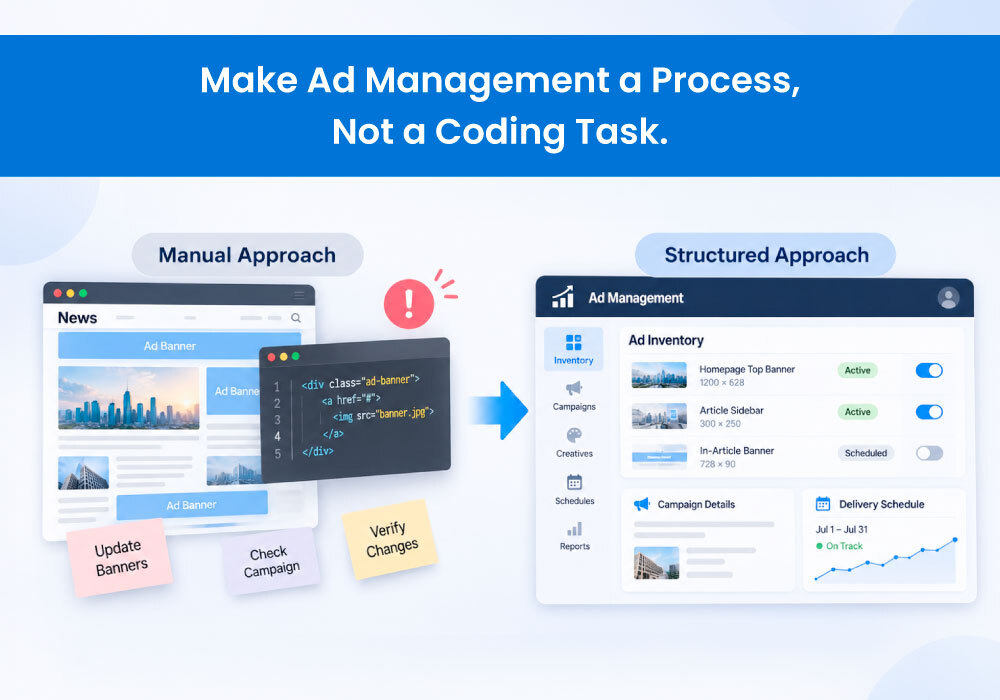
A structured ad management process allows authorized team members to manage campaign details, update creatives, and handle scheduled placements without requesting a website code change for every adjustment.
Developers can then focus on website functionality and technical improvements rather than routine banner updates.
Advertising campaigns should not require a development task every time an advertiser makes a small change.
2. Campaign Scheduling Becomes Difficult to Manage
Direct-sold advertising campaigns usually have agreed start and end dates.
An advertiser may book a homepage banner for two weeks, a category placement for one month, or a promotional campaign for a specific event.
With hardcoded banners, publishers may need to manually manage these dates.
For example, a developer might add an advertisement before its campaign begins and remove it once the booking period ends.
If the publisher manages several campaigns simultaneously, keeping track of every update can become difficult.
What Can Go Wrong?
Consider a publisher running three campaigns:
Advertiser A: January 1–15.
Advertiser B: January 10–31.
Advertiser C: February 1–15.
If the banners are hardcoded, the team must ensure that each advertisement is added and removed at the correct time.
A missed update can create several problems.
An advertisement may continue running after the advertiser's booking has ended. A new campaign may not appear on its agreed start date. A placement may remain empty because the replacement banner was not added on time.
These issues can affect advertiser satisfaction and create confusion around campaign delivery.
How Publishers Can Avoid It
Maintain a centralized campaign schedule containing:
Advertiser name.
Campaign name.
Assigned website placement.
Start date.
End date.
Approved creative.
Campaign status.
Required update or removal date.
A structured campaign management system can also help authorized team members manage campaign schedules more consistently.
Before a campaign launches, its schedule should be checked against the original booking confirmation.
Accurate scheduling protects campaign commitments and helps publishers avoid unnecessary placement gaps or outdated advertisements.
3. Website Advertising Inventory Becomes Difficult to Track
A publisher's website may contain several advertising opportunities.
These can include:
Homepage banner placements.
Category page advertisements.
Article-level banner positions.
Sidebar placements.
Mobile banner positions.
Sponsored content locations.
Together, these spaces make up the publisher's digital advertising inventory.
However, when advertisements are hardcoded across different website pages and templates, it can become difficult to maintain a clear picture of available inventory.
The publisher may know where advertisements currently appear but may not have a reliable record of which placements are booked, available, reserved, or scheduled for future campaigns.
Why Inventory Visibility Matters
Imagine a publisher's homepage has two premium banner positions.
Both are currently occupied by advertisers.
A new brand approaches the publisher and requests a homepage campaign for the following month.
Without an updated inventory record, the sales team may not know whether either placement will become available.
This can lead to unnecessary communication delays or booking conflicts.
The problem becomes more complicated when the website has multiple categories and advertising positions.
How Publishers Can Avoid It
Create a structured inventory record for every advertising placement.
Each record should include:
Placement name.
Website location.
Advertising format.
Available dimensions.
Device compatibility.
Current campaign status.
Booking availability.
Relevant placement specifications.
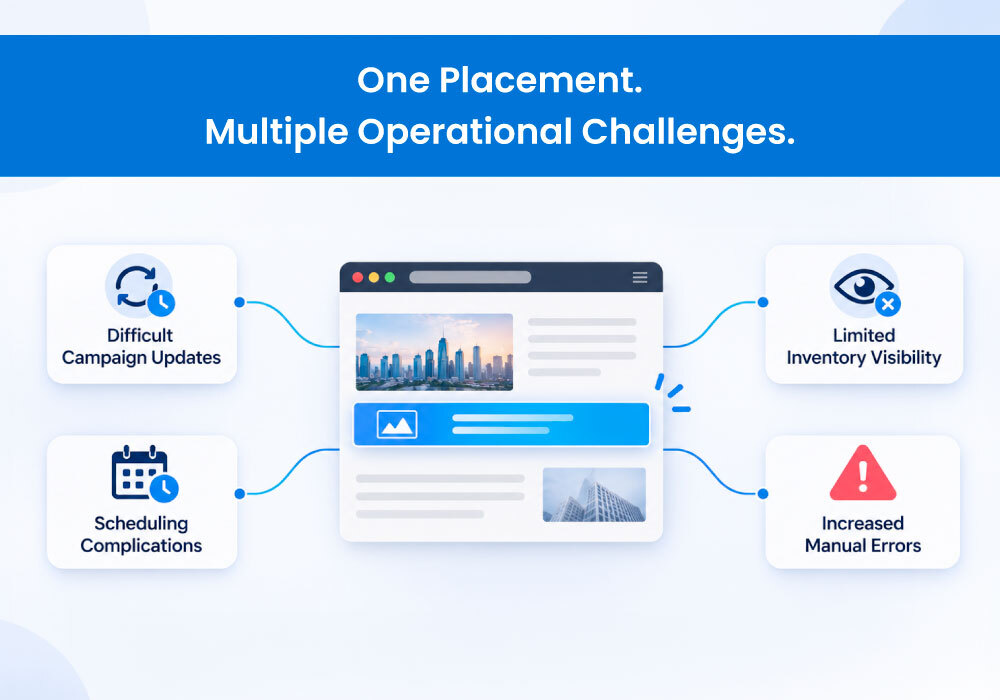
This gives the sales and AdOps teams a clearer understanding of the advertising spaces available for direct booking.
It also makes it easier to recommend suitable alternatives when an advertiser requests a placement that is already occupied.
You cannot manage your advertising inventory effectively if you do not have a clear view of what is available.
4. Manual Banner Changes Increase the Risk of Errors
Hardcoded advertising often involves repeated manual updates.
Every new campaign may require a developer to insert a banner, update a link, modify a page template, or remove an existing creative.
The more frequently these tasks occur, the more opportunities there are for mistakes.
Common Errors Publishers May Encounter
Incorrect Banner Creative
A developer may upload an outdated version instead of the latest advertiser-approved artwork.
Broken Destination Links
The banner may display correctly, but clicking it takes visitors to an incorrect or unavailable webpage.
Wrong Placement
An advertisement intended for the technology section may accidentally appear on another website category.
Missed Campaign Removal
An old advertisement may remain visible after its agreed campaign period.
Inconsistent Display
A banner may appear correctly on one page template but not on another.
These mistakes can affect the advertiser's campaign and create additional work for the publisher.
How Publishers Can Avoid It
Introduce a standard advertising update and verification process.
Before making a campaign live, confirm:
The correct advertiser and campaign.
The approved creative version.
The destination URL.
The correct website placement.
The campaign schedule.
The expected display across relevant devices.
After an update, the team should verify that the correct banner appears and that its destination link works.
Keeping creative assets organized by advertiser and campaign can also reduce confusion.
A simple review process can prevent small manual errors from becoming larger campaign problems.
5. Developers Become a Bottleneck for Advertising Operations
A publisher's development team has several important responsibilities.
They may manage website functionality, page performance, security updates, technical maintenance, design improvements, and new website features.
When advertising campaigns also depend on developers for every routine update, these responsibilities begin to overlap.
This can create an operational bottleneck.
The Impact on Publisher Teams
Consider a situation where the sales team confirms a new advertising booking.
The advertiser has already approved the creative and expects the campaign to go live on Monday.
However, the developer is occupied with another website update.
The advertising team must wait for the developer to insert the banner.
If the developer is unavailable, the campaign launch may be delayed.
This can affect:
Campaign launch timelines.
Advertiser communication.
Internal team productivity.
Website development priorities.
The ability to manage multiple bookings.
It also means that the advertising team has limited control over routine campaign execution.
How Publishers Can Avoid It
Publishers should define clear responsibilities between their development, sales, and AdOps teams.
Developers should be responsible for website infrastructure, technical functionality, and the underlying advertising setup.
The AdOps team should manage routine campaign activities such as:
Campaign configuration.
Creative management.
Placement assignment.
Campaign scheduling.
Delivery monitoring.
Reporting.
A suitable ad management system can provide authorized team members with the ability to manage these activities without depending on developers for every campaign change.
Your development team should support the advertising infrastructure, not become responsible for every advertising update.
6. Campaign Performance and Delivery Become Harder to Monitor
Hardcoded banners can make it difficult for publishers to maintain consistent campaign delivery records.
When advertisements are inserted directly into website pages, the publisher may know that a banner is visible but may not have a convenient way to track its performance.
Important questions can become difficult to answer:
How many impressions did the campaign receive?
How many clicks were generated?
Which pages displayed the advertisement?
Did the campaign run for the entire booked period?
Did the advertisement reach its agreed delivery target?
Without reliable tracking and reporting, publishers may struggle to demonstrate campaign performance.
Why This Matters to Advertisers
Imagine an advertiser books a banner for a month and expects a report at the end of the campaign.
The publisher can confirm that the banner appeared on the website, but it cannot provide accurate delivery figures.
This creates an information gap.
The advertiser may question whether the campaign was delivered as agreed, even if the advertisement was visible throughout the booking period.
For publishers, this can make it harder to build trust and secure repeat bookings.
How Publishers Can Avoid It
Publishers should establish appropriate tracking and reporting for their direct advertising campaigns.
Depending on the campaign requirements and available measurement setup, this may include:
Impression tracking.
Click tracking.
Campaign start and end dates.
Placement-level reporting.
Delivery against agreed commitments.
Campaign performance summaries.
Tracking requirements should be defined before the campaign launches.
Publishers should also maintain campaign records so that delivery information can be reviewed and shared with advertisers.
An advertisement being visible is not the same as having a clear record of its campaign delivery.
7. Website Maintenance Becomes More Complicated
Hardcoded banners are directly connected to website code or page templates.
This means advertising updates can become part of broader website maintenance activities.
A publisher may redesign its homepage, update its website layout, change a page template, or introduce new content categories.
When these changes happen, existing hardcoded advertising placements may need to be reviewed.
Some banners may shift position, disappear, or stop displaying correctly.
How Website Changes Affect Advertising
Consider a publisher redesigning its homepage.
The old website has a banner positioned between two content sections.
The redesigned homepage uses a different page structure, so the original banner placement may no longer exist.
If the advertising placement is hardcoded into the old template, developers may need to identify and modify the relevant code before the banner can be displayed correctly again.
This can become particularly complicated when multiple advertisements are inserted across different page templates.
How Publishers Can Avoid It
Publishers should maintain a clear record of their website advertising zones and placements.
Advertising positions should be considered during website design and development updates.
Whenever a website change is planned, the relevant teams should review:
Existing advertising locations.
Active advertiser campaigns.
Placement dimensions.
Page template changes.
Creative display requirements.
Campaign delivery implications.
A structured ad management approach can also make advertising placements easier to maintain as the website evolves.
Your advertising setup should be able to accommodate website improvements without creating unnecessary campaign disruptions.
8. Scaling Direct Advertising Becomes More Difficult
Hardcoded banners may work when a publisher manages only a few advertisers.
However, the operational effort increases as the number of campaigns grows.
A publisher managing five campaigns may find manual updates manageable.
But what happens when the publisher starts managing 20, 30, or 50 campaigns across different website sections?
Each campaign may have its own creative assets, booking dates, placement requirements, and advertiser instructions.
The publisher must coordinate all these details while ensuring that every advertisement appears correctly.
Why Growth Exposes the Limitations
As campaign volume increases, manual management can lead to:
More frequent developer requests.
Greater difficulty tracking inventory.
More complicated scheduling.
Increased risk of conflicting campaigns.
Additional creative management work.
More demanding reporting requirements.
The challenge is not simply the number of banners.
It is the number of campaign-related tasks that need to be completed accurately and on time.
How Publishers Can Avoid It
Publishers should review their advertising management process before campaign volume becomes difficult to handle.
Start by documenting the current workflow.
Identify which tasks require manual website changes, which tasks can be managed by AdOps, and where campaign information is difficult to access.
Then introduce a more structured approach to inventory management, campaign records, creative handling, scheduling, and reporting.
The goal is to build a process that can support more advertising activity without creating unnecessary operational complexity.
A growing advertising business needs a management process that can grow with it.
Hardcoded Banners vs. Structured Ad Management
Understanding the difference between hardcoded banners and structured ad management helps publishers identify where their current approach may be creating limitations.
AreaHardcoded BannersStructured Ad ManagementCampaign updatesOften require code changesCan be handled through authorized campaign management workflowsSchedulingMay require manual updatesCampaign dates can be organized centrallyInventory visibilityCan be spread across website pages and recordsPlacements can be documented and trackedCreative managementManual file and code updatesCampaign creatives can be organized by bookingDeveloper dependencyHigher for routine changesReduced for routine campaign activitiesDelivery trackingRequires separate tracking arrangementsCan be managed alongside campaign recordsScalabilityBecomes harder as campaigns increaseProvides a more organized operational process
Structured ad management does not eliminate the need for developers.
Website infrastructure, technical integrations, and maintenance still require development expertise.
The difference is that routine campaign management does not need to depend on manual code changes every time an advertiser requests an update.
How Publishers Can Move Beyond Hardcoded Banners
Moving away from hardcoded banners does not need to happen all at once.
Publishers can take a gradual approach by reviewing their existing advertising setup and identifying the areas that create the most operational difficulty.
Step 1: Review Existing Website Placements
Start by identifying every advertising position across the website.
Document homepage banners, category placements, article-level positions, sidebar spaces, and mobile advertising locations.
Record the dimensions and specifications of each placement.
Step 2: Identify Current Campaign Dependencies
Review how existing campaigns are managed.
Identify which activities require developer involvement, such as replacing banners, updating links, changing campaign dates, or removing advertisements.
This helps reveal where manual processes are creating delays.
Step 3: Organize Advertising Inventory
Create a central record of available advertising placements.
Include their locations, formats, specifications, and current booking status.
Make sure the sales and AdOps teams can access the information they need.
Step 4: Standardize Campaign Information
Create a consistent booking and campaign setup process.
Every campaign should have clear information about the advertiser, creative, placement, schedule, destination URL, and delivery expectations.
Step 5: Establish a Creative Management Process
Organize creative assets by advertiser and campaign.
Make sure the correct version is approved and available before the campaign launches.
Step 6: Introduce Structured Campaign Management
Use a suitable ad management system or workflow to manage campaign setup, scheduling, creative updates, and delivery records.
The right approach depends on the publisher's website, campaign volume, and operational requirements.
Step 7: Review and Improve the Process
Monitor how the new process performs.
Check whether campaign updates are becoming easier, whether inventory information is more accurate, and whether the team can manage advertising bookings more consistently.
A gradual transition allows publishers to improve their advertising operations without unnecessarily disrupting existing campaigns.
Why AdOps Support Matters
Managing digital advertising involves more than inserting banners into website pages.
Publishers must coordinate advertising inventory, advertiser bookings, campaign setup, creative assets, scheduling, delivery monitoring, and reporting.
For publishers transitioning from print to digital, these responsibilities can be especially challenging.
Their existing teams may already have experience selling print advertising, maintaining advertiser relationships, and coordinating publication schedules.
However, managing digital advertising introduces additional operational requirements.
This is where dedicated Ad Operations support can make a difference.
An experienced AdOps team can help publishers with:
Inventory Management: Organizing website advertising placements and maintaining clear records of available inventory.
Campaign Setup: Reviewing booking details and configuring advertisements according to the agreed campaign requirements.
Creative Management: Checking banner assets, dimensions, destination URLs, and approved versions before launch.
Campaign Trafficking: Managing the process of preparing, scheduling, and launching direct-sold advertising campaigns.
Delivery Monitoring: Reviewing campaign delivery and identifying issues that may affect advertiser commitments.
Reporting: Preparing clear campaign reports to help publishers communicate results and maintain advertiser confidence.
RevAdOps supports digital publishers with the operational side of direct-sold advertising, including inventory management, campaign setup, trafficking, optimization, and reporting.
The aim is to help publishers manage their digital advertising operations more efficiently while reducing the burden of routine campaign tasks on their internal teams.
For publishers relying on hardcoded banners, a more structured approach can create a stronger foundation for managing current campaigns and supporting future growth.
Conclusion: Your Advertising Operations Should Not Depend on Website Code
Hardcoded banners can be a practical starting point for publishers managing a small number of digital advertising placements.
But as advertising activity grows, the limitations become harder to ignore.
Routine campaign updates require developer involvement. Scheduling becomes more complicated. Inventory visibility decreases. Manual errors become more likely, and campaign delivery becomes harder to monitor.
These challenges can affect more than the publisher's internal workflow. They can also influence advertiser satisfaction, campaign reliability, and future revenue opportunities.
The solution is not to remove developers from the advertising process.
It is to create a clearer separation between website development and routine campaign management.
With organized inventory records, structured campaign workflows, reliable creative management, and dedicated AdOps support, publishers can gain better control over their digital advertising operations.
Your website is an important advertising asset. Managing the advertisements on it should be just as organized as the process of selling them.
Stop treating every banner as a coding task. Start treating your advertising inventory as a valuable business asset.
Leave a reply
Your email address will not be published. Required fields are marked *