



Direct-sold advertising remains an important revenue stream for digital publishers. It allows publishers to build relationships directly with advertisers, sell website placements, negotiate campaign terms, and create advertising opportunities around their audience and content.
However, selling an advertising campaign is only one part of the process. Publishers must also make sure that the campaign is set up correctly, the right inventory is available, advertisements appear in the agreed locations, delivery is monitored, and advertisers receive clear performance reports.
Even publishers with established audiences and strong advertiser relationships can make mistakes that affect campaign performance and revenue.
Some mistakes happen during the sales process. Others occur when checking inventory, preparing creatives, scheduling campaigns, or reporting results. While each issue may appear minor on its own, repeated problems can affect advertiser confidence, create operational delays, and limit future bookings.
Understanding these challenges is the first step toward building a more reliable direct advertising operation.
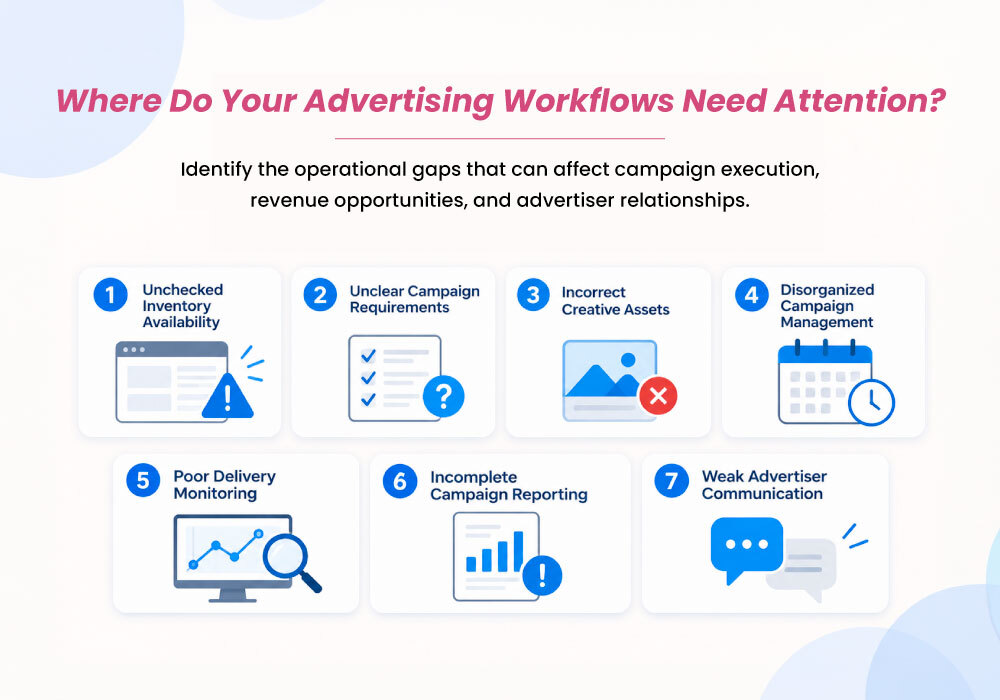
Here are seven common mistakes publishers make when managing direct-sold advertising campaigns—and how to avoid them.
1. Selling Advertising Inventory Without Understanding Its Availability
One of the most common mistakes publishers make is selling advertising placements without having a clear understanding of their available inventory.
A website may receive thousands of daily visitors and offer several banner positions across its homepage, category pages, and individual articles. However, not every advertising space is necessarily available for a new campaign.
Some placements may already be booked. Others may be reserved for existing advertisers or available only during specific periods.
Without accurate inventory information, publishers risk promising placements they cannot deliver.
Why This Becomes a Problem
Imagine a publisher selling a premium homepage banner to two different advertisers for the same dates.
Both advertisers expect prominent visibility, but the publisher has only one available placement.
This creates a conflict that may require rescheduling campaigns, offering alternative placements, or renegotiating the original booking.
Similar problems can occur when publishers do not account for campaign duration, placement availability, expected impressions, or existing commitments.
The consequences can include:
Double-booked advertising placements.
Conflicts between advertiser campaigns.
Difficulty meeting delivery commitments.
Last-minute changes to campaign schedules.
Reduced advertiser confidence.
How Publishers Can Avoid It
Publishers should maintain an organized record of their website advertising inventory.
This should include:
Available ad zones and slots.
Placement locations across the website.
Campaign booking dates.
Existing advertiser commitments.
Available inventory for upcoming periods.
Relevant placement specifications.
Before confirming a campaign, the sales team should coordinate with the AdOps team to verify that the requested inventory is available.
The key is simple: Never sell an advertising opportunity without first understanding what you can realistically deliver.
2. Failing to Define Campaign Requirements Clearly
A direct advertising campaign usually begins with an agreement between the publisher and the advertiser.
The advertiser may request a homepage banner, a placement within a specific category, a sponsored content position, or a campaign running across selected website pages.
However, problems arise when the campaign requirements are communicated informally or recorded incompletely.
A booking confirmation that only mentions the advertiser's name and campaign dates is not enough to manage a campaign accurately.
The publisher needs to understand exactly what has been sold.
What Information Should Be Confirmed?
Before campaign setup begins, publishers should document important campaign details, including:
Advertiser and campaign name.
Agreed advertising format.
Website placement or ad zone.
Target pages, categories, or URLs.
Campaign start and end dates.
Agreed impression quantity, where applicable.
Creative specifications.
Destination URL.
Reporting expectations.
Any special campaign instructions.
For example, an advertiser may book a banner campaign for the technology section of a publisher's website.
If the campaign instructions simply say "run on technology pages," the AdOps team may interpret the requirement differently from the sales team or advertiser.
Does it include every technology article? Does it include the technology category landing page? Should the campaign appear on mobile and desktop?
These details need to be clarified before launch.
How Publishers Can Avoid It
Create a standard campaign booking document or campaign order form.
Every campaign should have a consistent record of its requirements, approved specifications, delivery expectations, and important instructions.
Sales teams should also ensure that any changes agreed upon with advertisers are communicated to the people responsible for campaign execution.
Clear campaign requirements reduce misunderstandings and help publishers deliver exactly what advertisers have booked.
3. Using Incorrect or Unapproved Creative Assets
Creative management is another area where direct advertising campaigns can experience unnecessary problems.
An advertiser may provide multiple banner sizes, updated artwork, different versions for mobile and desktop, or revised destination links.
If the publisher does not organize and verify these assets properly, the wrong advertisement may go live.
For example, an advertiser might approve a particular banner design but later send an updated version with a different offer or landing page.
If the older creative is uploaded accidentally, the publisher may deliver an advertisement that no longer reflects the advertiser's approved campaign.
Common Creative Management Mistakes
Some frequent issues include:
Uploading the wrong banner version.
Using incorrect creative dimensions.
Publishing an advertisement with a broken destination URL.
Missing mobile or desktop versions.
Launching creative assets before advertiser approval.
Failing to replace outdated artwork.
Using files with incorrect names or unclear versions.
Even a small creative mistake can affect the advertiser's campaign experience.
A banner with an incorrect offer, outdated promotion, or broken link may generate complaints and require immediate corrections.
How Publishers Can Avoid It
Publishers should introduce a clear creative review process before every campaign goes live.
The process should include:
Collecting all required creative assets.
Checking banner dimensions and format specifications.
Confirming the destination URL.
Verifying advertiser approval.
Organizing files by campaign and version.
Testing the creative before launch.
A simple naming convention can also make a difference.
For example:
Advertiser_Campaign_Placement_Version_Date
This makes it easier for AdOps teams to identify the correct creative and avoid confusion when multiple versions are received.
Publishers should also keep a record of approved assets so that the team can identify which version is authorized for delivery.
A campaign is only ready to launch when its creative assets have been reviewed and approved.
4. Managing Campaigns Manually Without a Consistent Process
Many publishers begin managing direct advertising campaigns through spreadsheets, emails, shared folders, and manual website updates.
For a publisher handling only a few campaigns, this approach may seem manageable.
However, as the number of advertisers increases, coordinating every campaign becomes more complicated.
Campaign information may be spread across different documents. Sales teams may maintain one booking sheet, while AdOps teams use another schedule. Creative files may be stored separately, and campaign updates may be communicated through email.
This creates unnecessary complexity.
Why Disorganized Campaign Management Creates Problems
Consider a publisher managing 20 active advertising campaigns.
Each campaign has different booking dates, banner creatives, placement requirements, and advertiser contacts.
If these details are maintained across separate spreadsheets and email conversations, the team must repeatedly search for information before making even a small campaign update.
This increases the chances of:
Missing campaign start or end dates.
Forgetting creative replacement requests.
Publishing advertisements in incorrect placements.
Overlooking advertiser instructions.
Delaying campaign changes.
Losing track of campaign status.
The problem is not necessarily that publishers use spreadsheets. It is that they lack a consistent process for maintaining and sharing campaign information.
How Publishers Can Avoid It
Create a centralized campaign management process.
Every campaign should have one reliable record containing its booking details, placement information, creative assets, schedule, delivery status, and reporting requirements.
The publisher should also establish clear responsibilities.
For example:
Sales teams manage advertiser communication and booking details.
AdOps teams handle campaign setup, trafficking, and delivery monitoring.
Reporting teams or assigned AdOps personnel prepare campaign performance updates.
The exact team structure may differ between publishers, but responsibilities should be clearly defined.
A consistent workflow makes it easier to manage multiple campaigns without relying on scattered information.
Better organization does not simply save time. It helps publishers protect the quality of every advertiser commitment.
5. Not Monitoring Campaign Delivery Regularly
A campaign going live does not mean the work is finished.
Publishers must continue monitoring campaign delivery to make sure advertisements are appearing in the correct locations and meeting the agreed campaign requirements.
One common mistake is assuming that a campaign will run correctly from its launch date until its scheduled end date without further checks.
In reality, several issues can affect delivery.
A banner may stop appearing after a website update. A placement may be configured incorrectly. A campaign may receive fewer impressions than expected, or an advertisement may continue running after its booking period.
Without regular monitoring, these issues may remain unnoticed.
What Should Publishers Monitor?
Depending on the campaign agreement and advertising setup, publishers should review:
Whether the correct creative is displaying.
Whether the campaign is appearing on the agreed pages.
Whether the campaign is running within its scheduled dates.
Whether impressions are being recorded correctly.
Whether delivery is progressing toward the agreed target.
Whether clicks and destination links are functioning.
Whether any technical or placement issues have occurred.
For example, imagine an advertiser books 100,000 impressions over a 30-day campaign.
After the first 15 days, the campaign has delivered only 25,000 impressions.
If the publisher does not review delivery until the campaign ends, there may not be enough time to address the shortfall.
Regular checks give the team an opportunity to identify delivery issues earlier.
How Publishers Can Avoid It
Establish a campaign monitoring schedule.
High-priority campaigns, premium placements, and campaigns with specific delivery commitments may require more frequent checks.
Publishers should also assign responsibility for reviewing campaign performance and investigating unusual delivery patterns.
If a campaign is underdelivering, the team should identify the reason and discuss appropriate corrective action.
This could involve reviewing placement availability, campaign settings, creative configuration, or the agreed delivery schedule.
Campaign monitoring helps publishers identify problems before they become advertiser complaints.
6. Providing Incomplete or Delayed Campaign Reports
Reporting is an important part of the direct advertising relationship.
Once a campaign has finished, advertisers want to understand how their investment performed.
They may want to know how many impressions were delivered, how many clicks were generated, which placements were used, and whether the campaign met its agreed objectives.
However, some publishers treat reporting as a task that can be completed only when the advertiser requests it.
Others provide basic numbers without explaining what they represent.
This can make it difficult for advertisers to evaluate the campaign.
What Makes a Campaign Report Useful?
A useful campaign report should communicate the most relevant information clearly.
Depending on the campaign agreement, it may include:
Advertiser and campaign details.
Campaign start and end dates.
Agreed advertising placements.
Total impressions delivered.
Total clicks recorded.
Click-through rate, where relevant.
Performance by placement or page category, where available.
Any delivery issues or campaign adjustments.
For example, reporting that a campaign delivered 75,000 impressions is useful.
However, explaining that those impressions were delivered across the agreed homepage and category placements gives the advertiser more context.
Reports should also be accurate and consistent with the campaign's tracking and measurement setup.
Publishers should avoid presenting metrics they have not actually measured or cannot verify.
Why Reporting Matters Beyond the Numbers
A campaign report is also an opportunity to strengthen the advertiser relationship.
It shows that the publisher understands the campaign, takes delivery seriously, and can communicate results transparently.
Clear reporting can support future conversations about campaign extensions, new placements, or additional advertising opportunities.
How Publishers Can Avoid It
Create a standard reporting template that can be used across campaigns.
Define reporting responsibilities before the campaign begins, including the expected reporting date and the metrics that will be shared.
Keep campaign records organized throughout the delivery period so that reporting does not become a last-minute exercise.
If a campaign experienced an issue, explain it clearly rather than presenting incomplete results without context.
Good reporting does more than close a campaign. It gives advertisers a reason to consider booking again.
7. Treating Advertiser Relationships as One-Time Transactions
Direct-sold advertising is built around relationships.
Unlike a simple one-time transaction, a publisher's relationship with an advertiser can develop over several campaigns, seasons, and business objectives.
Yet one common mistake is focusing entirely on securing the initial booking without paying enough attention to the advertiser experience during and after the campaign.
An advertiser may be happy to purchase a banner placement once, but whether they return depends on several factors.
Did the publisher understand their requirements? Was the advertisement delivered correctly? Were campaign updates communicated on time? Was the reporting clear? Did the publisher respond when an issue occurred?
These details influence whether an advertiser sees the publisher as a reliable long-term partner.
What Weak Advertiser Relationships Can Lead To
When communication is inconsistent, advertisers may experience:
Unclear campaign expectations.
Delayed responses to questions.
Limited visibility into campaign delivery.
Confusion about creative changes.
Delayed performance reports.
Unresolved campaign concerns.
Even when the publisher has a valuable audience, a poor campaign experience can affect future advertising decisions.
How Publishers Can Avoid It
Publishers should treat every campaign as part of a longer advertiser relationship.
This starts with clear communication before launch and continues throughout the campaign.
A strong advertiser experience includes:
Understanding the advertiser's campaign objectives.
Confirming all booking and placement details.
Communicating campaign timelines clearly.
Sharing updates when important changes occur.
Monitoring delivery and addressing issues.
Providing accurate reports after completion.
Discussing relevant opportunities for future campaigns.
Publishers should also use campaign learnings to improve future recommendations.
For example, if an advertiser received strong engagement from a particular website category, the publisher can discuss similar placements for the next campaign.
The goal is not simply to sell another banner. It is to understand what advertising opportunities can create value for both sides.
Strong advertiser relationships are built through consistent delivery, transparent communication, and dependable campaign management.
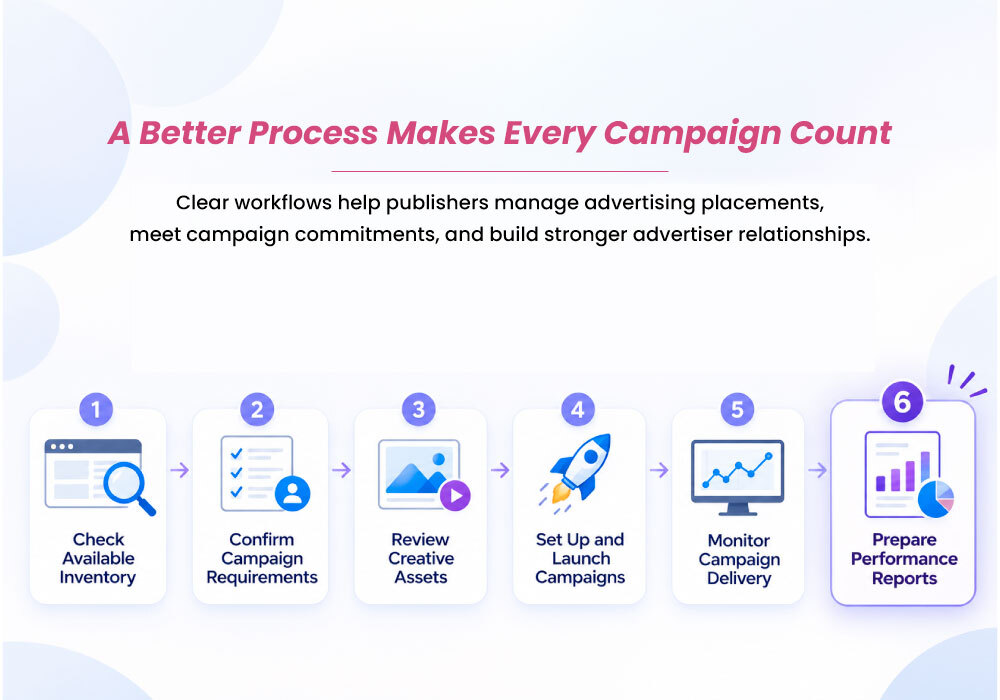
How Publishers Can Build a More Reliable Direct Advertising Process
Avoiding these seven mistakes does not require publishers to completely redesign their advertising operations overnight.
The most effective starting point is to review how campaigns are currently sold, recorded, launched, monitored, and reported.
A few improvements can make a significant difference.
1. Maintain Accurate Inventory Records
Document all advertising zones, slots, formats, and placement locations across the website.
Keep booking schedules updated so that the team can understand which placements are available and which are already committed.
2. Standardize Campaign Booking Information
Use a consistent booking form or campaign order document.
Make sure every campaign includes the necessary advertiser details, creative requirements, dates, placements, and delivery expectations.
3. Establish a Creative Approval Process
Review all creative assets before launch.
Confirm dimensions, destination links, approved versions, and any placement-specific requirements.
4. Create a Consistent Campaign Workflow
Define the steps involved in receiving a booking, checking inventory, setting up the campaign, testing the creative, launching the advertisement, and monitoring delivery.
Make sure everyone involved understands their responsibilities.
5. Monitor Campaigns Throughout Their Duration
Do not wait until the end of a campaign to check whether it has delivered correctly.
Review performance regularly and investigate issues as soon as they appear.
6. Make Reporting Part of the Campaign Process
Decide what needs to be reported and when before the campaign launches.
Keep delivery information organized so that advertisers receive accurate and timely reports.
7. Keep Advertiser Communication Consistent
Maintain clear communication from the initial booking through campaign completion.
Address questions promptly, share relevant updates, and use campaign results to support future advertising conversations.
How AdOps Support Helps Publishers Avoid These Mistakes
Managing direct-sold advertising involves much more than placing a banner on a website.
Publishers need to coordinate inventory, campaign bookings, creative assets, schedules, delivery requirements, and reporting.
As advertising operations grow, these responsibilities can become difficult for internal teams to manage alongside their other publishing activities.
This is where dedicated Ad Operations support can make a difference.
An experienced AdOps team can help publishers:
Organize and manage digital advertising inventory.
Verify campaign requirements before setup.
Handle creative checks and campaign trafficking.
Configure placements and campaign schedules.
Monitor delivery throughout the campaign.
Identify and address campaign issues.
Prepare clear and accurate performance reports.
For print publishers expanding their digital advertising business, this support can be especially valuable.
Their established advertiser relationships and trusted publications already provide a foundation for digital revenue growth. What they need is a reliable process for managing the advertising opportunities available on their websites.
RevAdOps supports publishers with the operational side of direct-sold digital advertising, helping manage campaign setup, trafficking, optimization, and reporting.
The objective is straightforward: make digital advertising easier to manage while helping publishers deliver a dependable experience to advertisers.
Conclusion: Better Campaign Management Builds Better Advertising Relationships
Direct-sold advertising offers publishers an opportunity to turn their digital audience and website placements into valuable advertising revenue.
But successful campaigns require more than securing advertiser bookings.
Publishers must understand their available inventory, document campaign requirements, review creative assets, maintain organized workflows, monitor delivery, and provide clear reports.
The seven mistakes discussed in this article are common because they often develop gradually as advertising operations become more demanding.
A campaign detail gets missed. A creative is not updated. An advertising placement is double-booked. A delivery issue goes unnoticed. A report arrives late.
Over time, these small problems can affect revenue opportunities and advertiser confidence.
The solution is to build a more structured approach to direct-sold advertising.
When publishers have clear processes, accurate inventory records, consistent campaign management, and dependable AdOps support, they are better positioned to deliver campaigns successfully and build long-term advertiser relationships.
Your audience creates the opportunity. Your advertising operations determine how effectively you manage it.
Leave a reply
Your email address will not be published. Required fields are marked *