


Introduction
Digital advertising involves more than selling an advertising space and placing a banner on a website. Once a publisher confirms an advertising deal with a brand or agency, several operational steps must happen before the campaign can go live.
The creative assets need to be collected, campaign details must be entered, advertising placements have to be configured, and schedules need to be checked. The team must also verify that the advertisement appears in the correct location and runs according to the agreed campaign requirements.
This process is known as ad trafficking.
Ad trafficking is an essential part of digital ad operations, particularly for publishers managing direct-sold advertising campaigns. It connects the commercial agreement between a publisher and an advertiser with the technical and operational work required to deliver the campaign.
Although the term may sound technical, the concept is straightforward: ad trafficking ensures that the advertisement a publisher has agreed to deliver is properly prepared, scheduled, placed, and monitored.
Without an organized trafficking process, even a confirmed advertising campaign can experience delays, incorrect placements, missing creatives, or delivery issues.
In this guide, we will explain what ad trafficking means, how it works, why it matters to digital publishers, and how a structured trafficking process can improve direct-sold advertising operations.
1. What Is Ad Trafficking?
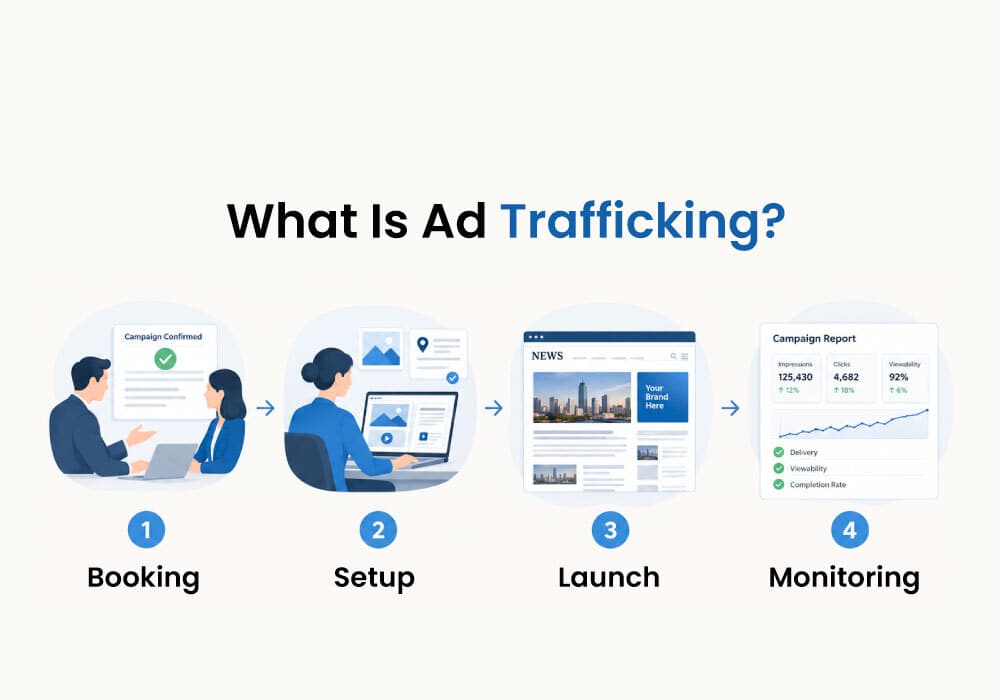
Ad trafficking is the process of setting up, managing, and preparing digital advertising campaigns for delivery across a publisher's website, app, or other digital properties.
It involves taking the details of a confirmed advertising campaign and translating them into the instructions needed to display the advertisement correctly.
For example, imagine a brand purchases a homepage banner on a digital news website for a period of two weeks.
The agreement may specify:
The advertising placement.
The campaign start and end dates.
The banner dimensions.
The agreed delivery requirements.
The advertiser's creative assets.
The destination URL.
However, simply confirming the booking does not make the advertisement appear on the website.
Someone must prepare the creative, configure the campaign, assign the correct placement, enter the schedule, and verify that everything works as expected.
These activities are part of ad trafficking.
In simple terms, ad trafficking is the operational process that takes an advertising booking from confirmation to live delivery.
It helps publishers ensure that every campaign is implemented according to the advertiser's agreement.
2. Why Is Ad Trafficking Important?
For publishers, advertising revenue depends not only on selling available inventory but also on delivering the campaigns they have sold.
A publisher may have excellent website traffic, attractive advertising placements, and strong relationships with advertisers. However, if campaigns are not set up correctly, those commercial opportunities can turn into operational problems.
Ad trafficking helps prevent these issues by creating a structured process for campaign execution.
Here are some important reasons why it matters.
Accurate Campaign Delivery
Every advertising agreement contains specific requirements. An advertiser may purchase a particular banner position, request a specific campaign duration, or provide creative assets with exact dimensions.
Ad trafficking ensures these instructions are followed during campaign setup.
Without accurate configuration, an advertisement could appear in the wrong location, run outside the agreed dates, or display an incorrect creative.
Fewer Campaign Errors
A structured trafficking process includes checks for campaign details, creative assets, placement information, and destination URLs.
These checks help identify mistakes before they affect the live campaign.
For example, a simple review can prevent an outdated banner from being uploaded or an incorrect landing-page link from being used.
Better Use of Ad Inventory
Publishers manage multiple advertising positions across their digital properties.
Ad trafficking helps connect confirmed bookings with the correct placements and schedules. This makes it easier to coordinate campaigns and avoid conflicts between advertisers.
Stronger Advertiser Relationships
Advertisers expect publishers to deliver what has been agreed upon.
When campaigns launch on time, appear correctly, and are monitored consistently, advertisers receive a more professional experience.
Reliable execution can strengthen trust and create opportunities for repeat business.
Improved Operational Efficiency
A consistent trafficking process gives the operations team a clear sequence of tasks.
Instead of searching through emails or trying to remember campaign instructions, team members can work from organized campaign records and established procedures.
This reduces unnecessary communication and helps teams manage multiple campaigns more effectively.
3. How Does the Ad Trafficking Process Work?
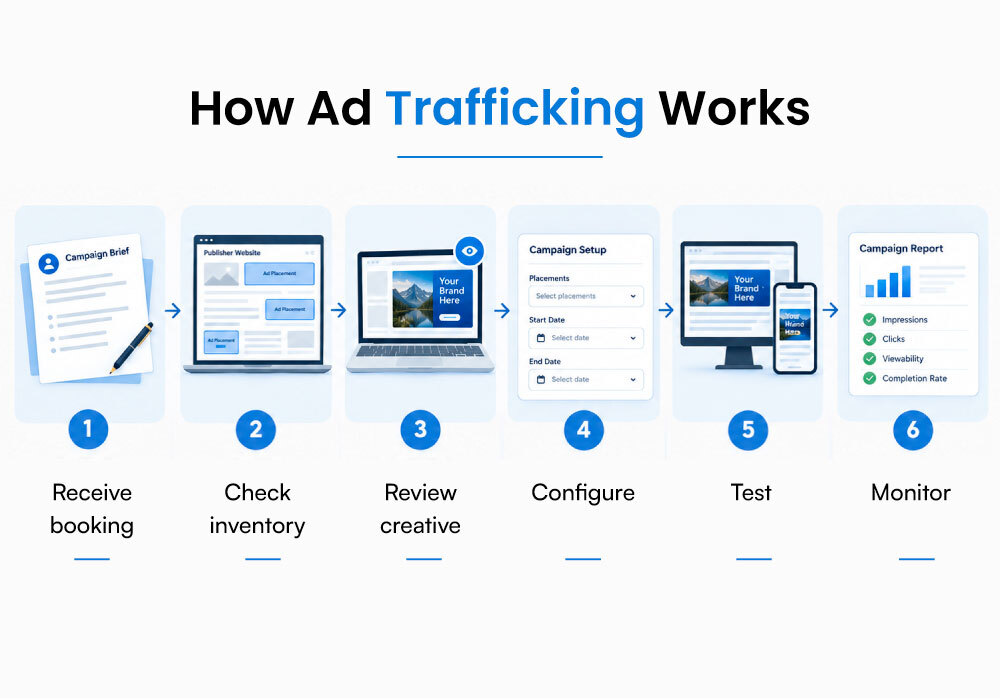
Ad trafficking involves several connected steps. Although the exact process may differ between publishers, the overall objective remains the same: prepare the campaign correctly and ensure it is ready for delivery.
Let's look at the typical stages.
Step 1: Receive the Campaign Booking
The process usually begins after the publisher confirms an advertising agreement with a brand or agency.
The sales team shares the campaign details with the ad operations team.
These details may include:
Advertiser and campaign name.
Campaign objectives.
Agreed advertising placements.
Start and end dates.
Creative specifications.
Contracted impressions or other delivery commitments.
Pricing and commercial terms.
Special instructions from the advertiser.
The operations team reviews this information before beginning the setup.
If anything is missing or unclear, it should be clarified before the campaign moves forward.
For example, if the advertiser has booked a homepage banner but has not confirmed the creative dimensions, the team should request the correct specifications before preparing the placement.
A clear booking handoff creates the foundation for accurate trafficking.
Step 2: Verify the Advertising Placement
Once the campaign details are received, the team needs to confirm that the agreed advertising space is available.
This involves reviewing the publisher's inventory and checking the requested placement against existing bookings.
For example, a digital magazine may offer:
Homepage banner placements.
Article-page advertisements.
Category-page banners.
Sponsored content positions.
Newsletter advertising placements.
If an advertiser has booked a specific homepage position for a particular week, the team must confirm that the placement is available during that period.
This step helps prevent scheduling conflicts and overbooking.
It also ensures that the campaign is assigned to the correct advertising position.
Step 3: Collect and Review Creative Assets
Creative assets are the actual materials used in the advertisement.
They may include banner images, animated creatives, logos, advertising copy, headlines, and destination URLs.
The advertiser or agency usually provides these materials according to the publisher's specifications.
The trafficking team reviews the assets before using them.
Important checks include:
Correct creative dimensions.
Supported file format.
Appropriate file size.
Clear images and readable text.
Correct advertiser branding.
Working destination URL.
Compliance with publisher guidelines.
Final advertiser approval, where required.
Consider a campaign that includes desktop and mobile advertising placements.
The advertiser may need to provide separate creative versions for each placement. If the team uses a desktop banner in a smaller mobile position, the creative may appear distorted or difficult to read.
Reviewing the assets beforehand helps avoid these problems.
Step 4: Configure the Campaign
Campaign configuration is one of the central parts of ad trafficking.
At this stage, the operations team enters the campaign information into the publisher's advertising management system or relevant campaign setup tools.
Depending on the publisher's setup, configuration may include:
Creating a campaign record.
Adding the advertiser's details.
Assigning the correct advertising placement.
Uploading the approved creative.
Entering the campaign start and end dates.
Adding the destination URL.
Setting the agreed delivery requirements.
Recording any special campaign instructions.
The exact fields and configuration options depend on the publisher's technology and internal workflow.
The important point is that the campaign must reflect the original advertising agreement.
For example, if an advertiser has purchased a banner on the homepage from November 1 to November 14, the campaign must be configured with the correct placement and dates.
A mistake during configuration can affect the entire campaign, even when all the original booking details are correct.
Step 5: Schedule the Advertisement
After configuration, the advertisement needs to be scheduled.
Scheduling determines when the campaign should begin and when it should stop.
The team should verify the campaign dates, launch timing, and any special scheduling instructions.
For campaigns involving multiple placements, each component should be checked individually.
For example, an advertiser may purchase:
A homepage banner for two weeks.
An article-page placement for one month.
A sponsored content feature for a specific publication date.
Although these placements belong to the same advertiser, they may have different schedules and requirements.
Clear scheduling ensures that each component runs during the agreed period.
Step 6: Test the Campaign Before Launch
Before an advertisement goes live, the team should verify that the campaign has been configured correctly.
This is an important quality-control stage.
The team should check:
Creative display: Does the advertisement appear correctly without distorted images or cut-off text?
Placement: Is it appearing in the correct website section and advertising position?
Destination URL: Does clicking the advertisement take visitors to the intended page?
Campaign dates: Are the start and end dates correct?
Device compatibility: Does the creative display properly across the relevant desktop and mobile layouts?
Advertiser approval: Has the final creative received the necessary approval?
These checks help identify problems before the campaign reaches the audience.
For example, an advertisement may look correct in the uploaded file but appear incorrectly when displayed on the publisher's website. Testing helps catch this difference.
A campaign should be considered ready only after the necessary checks are complete.
Step 7: Launch and Monitor the Campaign
Once the setup has been verified, the advertisement can go live according to the agreed schedule.
However, the trafficking process does not end at launch.
The operations team should confirm that the advertisement is displaying correctly and monitor its delivery throughout the campaign.
Depending on the campaign requirements, monitoring may involve checking:
Whether the advertisement is live.
Whether it appears in the correct placement.
Whether the campaign is running within the scheduled dates.
Whether impression delivery is progressing as expected.
Whether clicks and other agreed metrics are being recorded.
Whether any technical or creative issues have appeared.
If a problem is identified, the team should investigate and take appropriate corrective action.
For example, if an advertisement is not appearing on the intended page, the team may need to review the placement configuration or check whether the campaign has been scheduled correctly.
Regular monitoring helps publishers address issues before they affect the advertiser's campaign objectives.
4. What Is the Difference Between Ad Trafficking and Ad Operations?
Ad trafficking and ad operations are closely connected, but they do not mean exactly the same thing.
Ad operations (AdOps) refers to the broader function responsible for managing the operational side of digital advertising.
It includes activities such as:
Advertising inventory management.
Campaign setup and trafficking.
Campaign scheduling.
Creative quality checks.
Delivery monitoring.
Campaign optimization.
Performance reporting.
Troubleshooting and operational support.
Ad trafficking is one specific part of this broader function.
It focuses on preparing and configuring advertising campaigns so that they can be delivered correctly.
Think of ad operations as the overall process of managing digital advertising, while ad trafficking is the campaign-level work that makes an individual advertisement ready to run.
For example, an AdOps team may manage a publisher's entire advertising inventory, coordinate multiple advertiser campaigns, monitor delivery, and prepare reports.
The trafficking specialist focuses on setting up the individual campaigns, assigning placements, entering schedules, uploading creatives, and checking configurations.
Both functions work together to support reliable advertising delivery.
5. Common Ad Trafficking Mistakes Publishers Should Avoid
Even a well-organized publishing team can experience trafficking problems.
Many of these issues occur because campaign information is incomplete, responsibilities are unclear, or important checks are skipped.
Here are some common mistakes publishers should watch for.
Incorrect Campaign Dates
Entering the wrong start or end date can cause an advertisement to launch too early, too late, or continue running beyond the agreed period.
Always compare the configured schedule with the original booking.
Wrong Advertising Placement
An advertisement may be assigned to the wrong website section or position.
This can affect the campaign's visibility and may result in the publisher failing to deliver the agreed placement.
Verify the placement before launch.
Incorrect Creative Assets
Using an outdated banner, incorrect image size, or unapproved creative can create a poor advertising experience.
Maintain a clear record of the final approved creative version.
Broken Destination URLs
A campaign may display correctly but send visitors to an incorrect or unavailable landing page.
Always test the destination URL before the campaign goes live.
Incomplete Campaign Information
Missing advertiser instructions, delivery commitments, or placement details can create confusion during setup.
Make sure the campaign brief contains all the information required by the operations team.
Skipping Quality Checks
Launching an advertisement without reviewing its display, placement, and destination link increases the risk of avoidable errors.
A pre-launch checklist should be part of every campaign workflow.
Poor Communication Between Teams
If sales and operations work with different versions of the campaign details, mistakes become more likely.
Use a shared campaign record and communicate important changes clearly.
Avoiding these mistakes does not require an unnecessarily complicated process. It requires accurate information, consistent checks, and clear responsibilities.
6. How Publishers Can Improve Their Ad Trafficking Process?
As a publisher's advertising business grows, managing campaigns becomes more demanding.
There may be several advertisers, multiple placements, different creative formats, and overlapping campaign schedules.
A structured trafficking process helps teams handle this complexity.
Here are some practical ways to improve it.
Create a Standard Campaign Brief
Every campaign should begin with a consistent set of information.
Create a standard campaign brief that includes advertiser details, objectives, placements, dates, creative specifications, delivery commitments, and reporting requirements.
This gives the operations team a reliable starting point.
Maintain Accurate Inventory Records
Keep a clear record of available, booked, and reserved advertising placements.
An updated inventory calendar helps sales and operations teams understand what can be offered to advertisers.
It also reduces the risk of conflicting bookings.
Use Consistent Naming Conventions
Campaign names should be easy to identify.
Include useful details such as the advertiser, campaign name, and campaign period.
Consistent naming makes it easier to search for records, review campaign status, and prepare reports.
Establish a Creative Approval Process
Define how creative assets should be submitted, reviewed, revised, and approved.
Make sure the team can identify the final approved version without searching through multiple email attachments.
Introduce Pre-Launch Checklists
Create a checklist covering campaign dates, placements, creative files, destination URLs, and display testing.
Use the same basic process for every campaign while allowing additional checks for more complex bookings.
Monitor Campaigns Regularly
Do not wait until a campaign ends to review its performance.
Establish a monitoring schedule based on campaign duration and delivery requirements.
This helps identify potential issues early.
Keep Reporting Consistent
Use a consistent reporting format so advertisers can understand campaign delivery.
Include the relevant metrics, reporting dates, and agreed delivery information.
Clear reporting also makes it easier for internal teams to evaluate campaign outcomes.
7. What Does an Ad Trafficking Specialist Do?
An ad trafficking specialist is responsible for preparing and managing the operational setup of digital advertising campaigns.
The role requires attention to detail, organizational skills, technical understanding, and the ability to coordinate with different teams.
Typical responsibilities include:
Campaign setup: Creating campaign records and entering the necessary information into advertising management systems.
Creative management: Collecting, reviewing, and uploading approved advertising materials.
Placement coordination: Assigning advertisements to the correct website positions.
Campaign scheduling: Entering campaign dates and ensuring that advertisements run during the agreed period.
Quality assurance: Checking that creatives display correctly and destination links work.
Delivery monitoring: Reviewing campaign status and identifying potential issues.
Troubleshooting: Investigating configuration, creative, or placement problems.
Reporting support: Helping prepare campaign delivery information for advertisers and internal teams.
An effective trafficking specialist understands that small details can have a significant impact on campaign delivery.
A wrong date, incorrect creative, or broken link may seem like a minor issue, but it can affect the advertiser's experience and the publisher's credibility.
That is why accuracy and consistency are essential in this role.
8. Why Direct-Sold Advertising Needs Reliable Ad Trafficking?
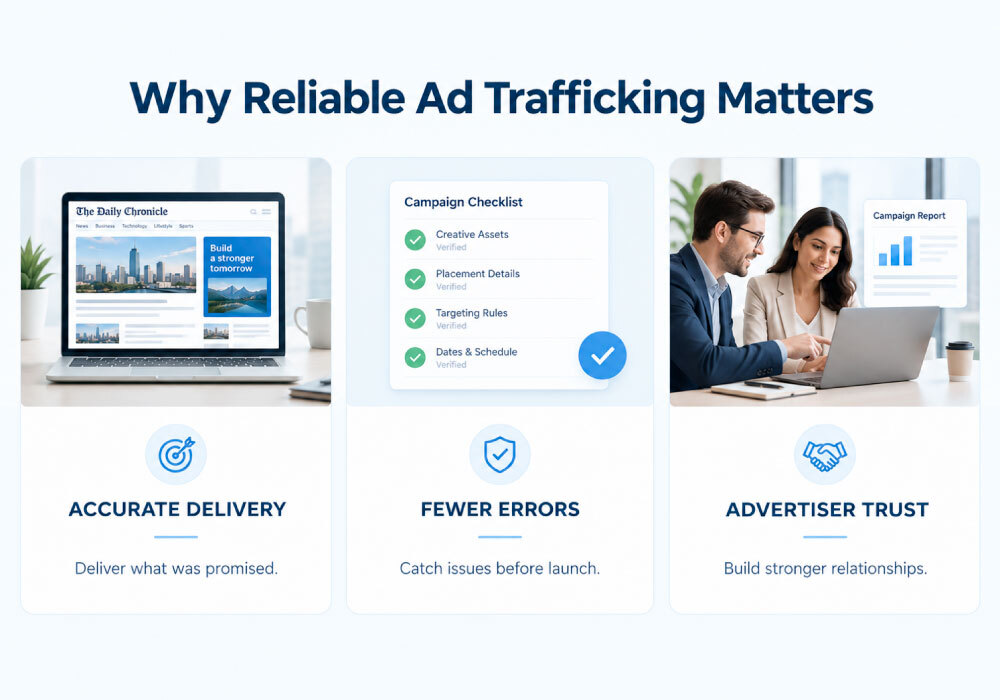
For publishers working with direct-sold advertising, campaign execution is closely connected to advertiser relationships.
When a publisher sells an advertising placement directly, it makes a commitment to the advertiser.
That commitment may involve a specific website position, campaign duration, creative format, or delivery target.
The publisher is responsible for ensuring that the campaign is delivered according to those agreed terms.
Ad trafficking supports this responsibility by connecting the booking with the actual campaign setup.
Consider a digital news publisher that works with several local and national brands.
Each advertiser may have different campaign dates, creative formats, and placement requirements.
Without a consistent trafficking process, the team may struggle to coordinate these campaigns accurately.
One advertiser may experience a delayed launch, another may receive the wrong creative, and a third may not receive the expected placement.
These issues can damage advertiser confidence.
A reliable trafficking process helps the publisher maintain control over campaign execution, communicate clearly, and demonstrate that every booking is handled professionally.
It also helps the publisher make better use of its advertising inventory and manage a growing number of direct advertiser relationships.
9. How AdOps Support Helps With Ad Trafficking?
Managing ad trafficking requires time, attention, and a clear understanding of the publisher's advertising setup.
For publishers with limited internal resources, handling every campaign task can become challenging.
This is where dedicated AdOps support can make a difference.
An experienced AdOps team can support publishers with:
Campaign booking handoffs.
Inventory and placement coordination.
Campaign configuration.
Creative asset checks.
Campaign scheduling.
Pre-launch quality assurance.
Delivery monitoring.
Troubleshooting.
Performance reporting.
Having an organized operational team helps ensure that campaign details are handled consistently from booking to completion.
It can also reduce the workload on internal publishing teams, allowing them to focus on advertiser relationships, content, audience development, and business growth.
For publishers that are expanding their digital advertising operations, reliable AdOps support can provide the operational foundation needed to manage direct-sold campaigns more effectively.
Conclusion
Ad trafficking is a fundamental part of digital advertising operations.
It is the process that takes a confirmed advertising booking and prepares it for accurate delivery across a publisher's digital properties.
From receiving campaign details and checking inventory to configuring placements, reviewing creative assets, scheduling advertisements, and monitoring delivery, every step contributes to the success of a campaign.
For publishers, effective ad trafficking means fewer errors, smoother campaign execution, better inventory coordination, and stronger advertiser relationships.
It does not need to be complicated. What matters is having a consistent process, accurate campaign information, clear responsibilities, and proper quality checks.
As digital publishers continue to develop their direct-sold advertising businesses, reliable trafficking becomes increasingly important.
A successful advertising campaign starts long before the advertisement goes live. It starts with getting the setup right.
Leave a reply
Your email address will not be published. Required fields are marked *