



For publishers transitioning from print to digital, understanding advertising can feel like stepping into an entirely new business. There are unfamiliar terms, new platforms, and technical processes that can make digital advertising seem more complicated than it needs to be.
But the fundamental idea behind digital advertising is something publishers have understood for decades: advertisers pay to reach the right audience in the right place.
In print, that might mean selling a front-page strip, a half-page advertisement, or a premium position in a special edition. In digital publishing, it means offering advertisers opportunities to reach readers through website banners, newsletter sponsorships, mobile placements, video advertisements, and sponsored content.
These opportunities collectively make up what is known as ad inventory.
Understanding ad inventory is one of the first steps toward building a stronger digital advertising business. It helps publishers identify what they can sell, understand what advertisers value, establish appropriate pricing, and develop direct advertising relationships that generate sustainable revenue.
The good news? You do not need to be an ad tech expert to understand it.
This guide explains digital ad inventory in straightforward terms, using familiar print publishing examples to show how publishers can recognize, organize, price, and sell their advertising opportunities more effectively.
What Is Ad Inventory?
Ad inventory is the collection of advertising opportunities available across a publisher’s digital properties.
These opportunities can exist on a website, within a mobile application, in an email newsletter, alongside digital video content, or across other platforms where a publication connects with its audience.
Think of your digital publication as a collection of spaces that advertisers can purchase to communicate with your readers.
For example, a publisher might have:
- A banner advertisement at the top of its homepage.
- Display advertisements alongside news articles.
- Advertising placements between sections of a long-form article.
- Sponsored positions in a daily email newsletter.
- Video advertisements before or during video content.
- Sponsored articles developed in collaboration with advertisers.
Each of these represents an advertising opportunity. Together, they form the publication’s available digital ad inventory.
The concept is similar to managing advertising space in a newspaper or magazine. A print publication has a finite number of pages and advertising positions available in each edition. A digital publication offers advertising opportunities as readers visit pages, open newsletters, or consume content.
Digital inventory differs from print inventory because the number of advertising opportunities can vary with website traffic, newsletter readership, content consumption, placement configuration, and existing campaign commitments.
In simple terms, ad inventory is the advertising space and opportunities your publication has available to sell directly to advertisers.
Once publishers understand this definition, they can begin looking at their websites and other digital properties not just as places to publish content, but as valuable advertising assets.
How Does Digital Ad Inventory Compare to Print Advertising?
For traditional publishers, the easiest way to understand digital inventory is to compare it with the advertising models they already know.
Print publishers have long understood that advertising value depends on more than the physical size of an advertisement. Its position, the publication’s audience, the content surrounding it, and the timing of the edition can all influence its commercial value.
Digital advertising follows a similar principle.
Print advertising includes front-page advertisements, half-page or full-page advertisements, placements within special sections, sponsored inserts, advertorials, and advertisements in themed editions. Digital advertising offers equivalent opportunities through premium homepage banners, large display placements on article pages, advertisements within dedicated website categories, sponsored newsletter placements, sponsored digital articles, and digital sponsorships tied to specific topics or events.
The format changes, but the underlying business principle remains consistent: advertisers pay for opportunities to reach an audience in a relevant environment.
For instance, a regional newspaper may have a strong readership among homeowners, business owners, and local consumers. Its digital website can offer advertisers access to those same audience groups through relevant article placements, homepage visibility, and newsletter sponsorships.
A local real estate agency might be interested in advertising alongside property news. An automotive dealership might prefer placements around local business coverage or automotive content. A financial services company could be interested in reaching readers who regularly consume business and economic reporting.
Publishers can use their existing advertiser relationships and knowledge of their audiences to develop relevant digital campaigns.
Rather than treating digital advertising as an entirely separate business, publishers can build on their print advertising experience to create direct-sold digital opportunities.
What Are the Main Types of Digital Ad Inventory?
Digital ad inventory comes in several formats. Each offers a different way for advertisers to reach readers, and each can play a distinct role in a publisher’s direct advertising strategy.
Understanding these formats helps publishers identify the opportunities they already have and determine which options make sense for their audiences and advertisers.
1. Website Display Advertising
Display advertising is one of the most recognizable forms of digital inventory.
These are advertisements that appear in designated spaces across a website. They may include static images, animated creative, or other supported advertising formats.
Common placements include:
- Homepage banners.
- Sidebar advertisements.
- Advertisements within article pages.
- In-content placements between sections.
- Footer advertisements.
Not all display placements offer the same value. A prominent homepage position may provide greater visibility than an advertisement placed near the bottom of a long article.
However, placement value also depends on audience behavior. A sidebar advertisement that consistently reaches a highly relevant audience may be attractive to certain advertisers, even if it receives less attention than a homepage banner.
Publishers should understand where their advertisements appear, which audiences encounter them, and how effectively those placements serve advertiser objectives.
This information helps sales teams explain the value of each placement and build advertising packages that fit a client’s campaign goals.
2. Newsletter Advertising
Email newsletters provide publishers with another valuable advertising opportunity.
A newsletter may reach readers who have actively subscribed to receive updates, making it a useful channel for advertisers seeking to connect with an established audience.
Publishers can offer different newsletter advertising formats, including:
- Banner placements within an email.
- Sponsored sections.
- Dedicated newsletter sponsorships.
- Sponsored links or recommendations.
- Branded content created for a particular newsletter edition.
For example, a business publication that sends a weekly industry newsletter could offer sponsorship opportunities to software companies, professional service providers, or other businesses relevant to its readers.
The value of newsletter inventory depends on factors such as subscriber engagement, audience relevance, delivery volume, and the placement itself.
Publishers should distinguish between the number of emails delivered, the number opened, and the number of times advertising content is viewed or clicked. These are different measurements and should not be treated as interchangeable.
When approaching advertisers, publishers can use available newsletter data to demonstrate audience relevance, set expectations, and create clearly defined sponsorship packages.
3. Video Advertising
As publishers expand into video, they can create additional advertising opportunities.
Video advertisements may appear before a video begins, during supported video content, or after a video ends. The formats available depend on the publisher’s video platform and advertising setup.
For example, a publisher producing interviews with local business leaders could offer video sponsorships to companies interested in reaching business professionals.
Video inventory can be attractive because it combines visual storytelling with an opportunity for advertisers to communicate their message in a more engaging format.
However, publishers need to consider factors such as video viewership, completion rates, audience fit, and the actual availability of advertising placements before assigning value to these opportunities.
For direct-sold campaigns, these details also help publishers agree on deliverables with advertisers and report campaign performance clearly.
4. Sponsored Content
Sponsored content gives advertisers an opportunity to communicate with readers through content developed or presented in collaboration with a publisher.
Examples include sponsored articles, branded editorial series, sponsored guides, and other clearly identified commercial content.
A publication covering regional development might work with a property company on a sponsored guide to the local housing market. A business magazine might partner with a technology provider on a sponsored series about digital transformation.
Sponsored content differs from standard display advertising because it offers a more substantial storytelling opportunity.
Publishers can use their editorial expertise to create content that is relevant to their audience while helping advertisers communicate useful information.
Transparency is essential. Sponsored content should be clearly identified, and its commercial nature should not mislead readers or compromise editorial independence.
Because sponsored content often involves additional planning and production, publishers should define the scope, timelines, responsibilities, and deliverables with the advertiser before a campaign begins.
5. Mobile Advertising
Many readers access digital publications through smartphones and tablets.
Mobile inventory includes advertising placements designed for smaller screens, such as mobile banners, in-article advertisements, and supported placements within publisher applications.
Mobile advertising should be planned carefully because screen size, page speed, placement visibility, and the reader experience all influence how effectively an advertisement works.
A placement that performs well on a desktop website may need a different configuration on mobile.
Publishers should evaluate mobile inventory as its own opportunity rather than assuming that all website placements perform equally across devices.
When creating direct-sold packages, it is useful to specify which devices and placements are included so advertisers understand exactly what they are purchasing.
What Makes One Ad Placement More Valuable Than Another?

One of the biggest misconceptions about ad inventory is that more advertising space automatically means more advertising revenue.
In reality, the value of inventory depends on several factors.
A publisher may have thousands of advertising opportunities available, but advertisers will not necessarily value every opportunity equally.
Three important considerations are audience, attention, and placement.
1. Audience: Who Are You Reaching?
Advertisers want to connect with people who are likely to be interested in their products or services.
That makes audience quality a major factor in inventory value.
For example, a niche publication serving healthcare professionals may attract advertisers offering specialized software, medical equipment, or professional education. A local lifestyle publication may be better suited to restaurants, retailers, real estate agencies, and community businesses.
A website with a smaller but highly relevant audience can therefore offer meaningful advertising value.
This does not mean that audience size is unimportant. Reach matters, especially for campaigns focused on broad awareness. However, reach is only one part of the overall picture.
Publishers should understand who their readers are, what subjects they follow, which sections attract their attention, and why advertisers might want to reach them.
These insights help sales teams develop more relevant advertising packages and explain the value of their inventory with greater confidence.
2. Attention: How Do Readers Engage With Your Content?
An advertisement can appear on a page without necessarily receiving meaningful attention.
For that reason, publishers should look beyond the number of available advertising spaces and examine how readers interact with their digital properties.
Useful measurements may include:
- Page views.
- Time spent on relevant pages.
- Newsletter open and click activity.
- Video views and completion rates.
- Advertising impressions.
- Ad viewability and click-through rates, where applicable.
Each measurement tells a different story.
For example, page views help publishers understand the potential scale of an advertising opportunity. Viewability provides insight into whether an advertisement had a chance to be seen. Click-through rate measures the proportion of impressions that result in clicks, but it does not independently establish campaign profitability or overall effectiveness.
Publishers do not need to become data analysts overnight. They need to understand which measurements help them demonstrate the value of their advertising opportunities.
For direct-sold campaigns, this information also supports more informed conversations with advertisers about campaign expectations and results.
3. Placement: Where Does the Advertisement Appear?
Placement influences visibility, context, and the reader’s experience.
An advertisement near the top of a popular article may receive more exposure than one placed far below the main content. A sponsorship associated with a relevant topic may be more attractive to an advertiser than a generic placement across unrelated pages.
Consider a publication covering local elections.
A company interested in reaching politically engaged local readers might value an appropriate sponsorship connected to the publication’s local affairs coverage. A standard banner across an unrelated section may be less aligned with that advertiser’s objective.
This does not mean every premium placement will outperform every standard placement. Actual performance depends on audience behavior, design, device, campaign requirements, and other factors.
The important lesson is that publishers should evaluate inventory based on the opportunity it provides, not simply the physical dimensions of an advertisement.
When selling directly, publishers can use these distinctions to recommend placements that align with each advertiser’s goals.
Understanding Ad Impressions Without the Technical Language
When discussing digital inventory, publishers will frequently encounter the term impression.
An impression generally represents an instance in which an advertisement is served or recorded as displayed, depending on the measurement method used.
Think of impressions as a way to measure advertising delivery.
In print, publishers often use circulation figures to demonstrate the potential reach of an edition. In digital publishing, impressions help advertisers understand how many times an advertisement was delivered across a campaign.
For example, imagine that a publisher sells an advertising campaign expected to deliver 100,000 impressions over a month.
The campaign’s delivery can be measured against that target to determine whether the agreed number of impressions was achieved.
However, impressions are not the same as unique people reached. One reader may generate multiple impressions by visiting several pages or returning to the website throughout the month.
Impressions also do not guarantee that an advertisement was actually seen. That is why viewability and other campaign measurements can be important.
For publishers, understanding impressions makes it easier to discuss campaign expectations, report delivery, and explain advertising results to clients.
The goal is not to memorize every technical definition. It is to understand what is being measured and how that measurement supports an advertising agreement.
Why Direct-Sold Advertising Matters for Publishers?
Once publishers understand their inventory, the next step is to turn those advertising opportunities into direct client relationships.
Direct-sold advertising involves a publisher or its sales partner working directly with an advertiser or agency to agree on a campaign. The parties discuss campaign goals, audience requirements, placements, timing, pricing, deliverables, and reporting expectations.
For example, a regional publisher might approach a local automotive dealership with a campaign package that includes homepage visibility, placements across relevant articles, and a sponsored feature about a community event.
Rather than offering advertising space without context, the publisher can develop a package around the advertiser’s objectives and explain how each placement supports the campaign.
A direct-sold approach can help publishers:
- Build stronger advertiser relationships through direct communication and ongoing collaboration.
- Create tailored campaign packages based on the advertiser’s audience and business objectives.
- Agree on pricing and deliverables that reflect the placements, expected delivery, and campaign scope.
- Develop recurring sponsorships that create opportunities for longer-term partnerships.
- Maintain clearer campaign oversight from planning and setup through delivery and reporting.
Direct sales also require careful planning, relationship management, realistic inventory estimates, and reliable campaign execution. Premium pricing is not guaranteed; it must be supported by audience value, campaign results, and advertiser demand.
For publishers, the objective is to understand what they can offer, identify advertisers who would benefit, and deliver on the commitments made during the sales process.
How to Identify and Organize Your Digital Ad Inventory?
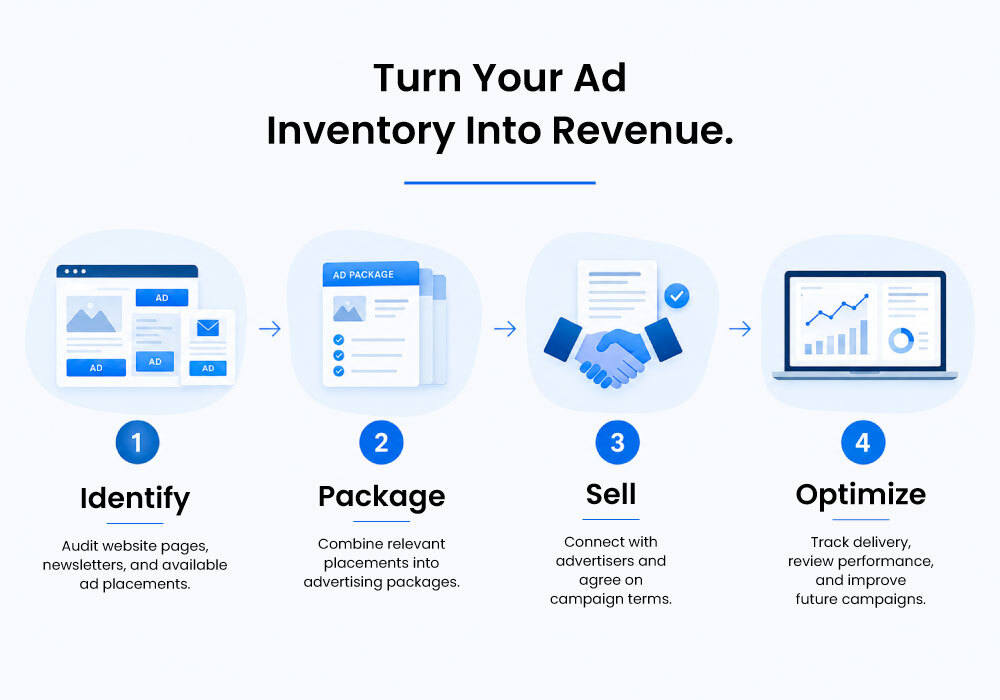
Before selling inventory, publishers need a clear understanding of what they have available. A straightforward inventory overview can provide a useful starting point.
Step 1: List Your Digital Properties
Start by identifying every digital channel your publication operates.
This may include your website, mobile application, email newsletters, video channels, podcasts, and other relevant platforms.
Not every publisher will have all these channels. Focus on the properties you currently operate and can realistically monetize through direct advertising agreements.
Step 2: Identify Available Advertising Placements
Next, document the advertising opportunities within each property.
For a website, this might include homepage banners, article-page placements, category-page advertisements, and sponsored content opportunities.
For newsletters, it could include banner placements, sponsored sections, and dedicated sponsorships.
Record the format, location, device availability, and any restrictions associated with each placement.
This inventory list gives your sales team a clearer picture of what can be offered to advertisers.
Step 3: Understand Audience and Traffic
Review available audience and performance data to understand which pages and channels attract the most attention.
Identify your strongest content categories, popular pages, newsletter engagement patterns, and other useful audience characteristics.
This information can help you distinguish high-demand opportunities from placements that may need further development.
Avoid assuming that the most visited page is always the most valuable. Relevance, viewability, competition, and campaign objectives also matter.
Step 4: Estimate Available Capacity
Inventory management also involves understanding how much advertising you can realistically sell and deliver.
For example, if a placement generates a certain number of impressions each month, you need to account for existing campaign commitments before promising additional inventory.
Publishers should also consider seasonality, traffic fluctuations, advertiser exclusivity, and any limitations on the number or type of advertisements displayed.
Accurate availability estimates reduce the risk of overbooking campaigns or promising delivery that cannot be achieved.
Step 5: Develop Clear Advertising Packages
Once inventory is organized, consider how individual placements can be combined into useful advertising packages.
For example, a local business package might include homepage visibility, relevant article placements, and a newsletter sponsorship.
A sector-specific package could combine placements across business coverage, an industry newsletter, and a sponsored content opportunity.
Packages should be designed around advertiser objectives rather than simply grouping together every available placement.
This helps sales teams explain what the advertiser receives, why the opportunity is relevant, and how success will be evaluated.
How Should Publishers Price Their Ad Inventory?
Pricing is one of the most important decisions in digital advertising.
There is no universal price for every placement because inventory value depends on the audience, demand, campaign structure, delivery expectations, and commercial agreement.
However, publishers can approach pricing more confidently by understanding several common models.
CPM, or cost per thousand impressions: The advertiser pays according to the number of impressions delivered. CPM is a common way to price display advertising and other impression-based campaigns.
Flat-fee sponsorship: The advertiser pays an agreed amount for a defined sponsorship or placement over a specified period. This may be suitable for homepage sponsorships, newsletters, or exclusive advertising opportunities.
Package pricing: The publisher combines several placements or advertising formats into a single commercial offer. The package can be priced according to its scope, audience value, expected delivery, and campaign requirements.
For example, a publisher might offer an advertiser a monthly package that includes website placements and newsletter sponsorship. The price should reflect the actual deliverables, expected reach, production requirements, and any exclusivity included.
When establishing prices, publishers should consider historical performance, audience relevance, comparable opportunities, operational costs, and existing advertiser demand.
It is also important to distinguish between the price charged to an advertiser and the revenue the publisher ultimately retains. Agency arrangements, production costs, and other expenses may affect the final return.
Most importantly, publishers should be able to explain the reasoning behind their prices. Clear expectations and credible reporting help advertisers understand what they are buying and why the opportunity may be worthwhile.
Common Ad Inventory Mistakes Publishers Should Avoid
Even publishers with established audiences can miss revenue opportunities if their inventory is not managed effectively.
Several common mistakes are worth addressing.
1. Focusing only on traffic volume
A large audience can be valuable, but advertisers may also care about relevance, engagement, geography, and the context in which their advertisements appear. Publishers should communicate both reach and audience quality.
2. Treating every placement equally
A homepage sponsorship, an in-article banner, and a newsletter placement serve different purposes. Each should be evaluated according to its audience, visibility, format, and commercial potential.
3. Selling more inventory than can be delivered
Campaigns must be planned around realistic availability. Overbooking can lead to missed commitments, poor client experiences, and reduced trust.
4. Ignoring the reader experience
Too many advertisements, intrusive placements, or slow-loading pages can frustrate readers. Protecting the quality of the publishing experience is essential to maintaining long-term audience value.
5. Failing to report campaign results
Advertisers want to understand what their campaigns achieved. Clear reporting on delivery, impressions, relevant engagement metrics, and agreed objectives helps publishers demonstrate value and support future renewals.
6. Failing to coordinate campaign operations
A direct-sold agreement is only the beginning. Publishers must ensure that the agreed advertisements are set up correctly, delivered according to schedule, monitored during the campaign, and reported accurately.
Clear workflows and defined responsibilities help prevent avoidable errors and give advertisers a more reliable experience.
Avoiding these mistakes helps publishers create a more organized, dependable, and commercially effective direct advertising operation.
How Better Inventory Management Supports Direct Sales ?
Understanding inventory is only the beginning. The real opportunity comes from using that understanding to build stronger advertising relationships.
When publishers know which placements they offer, how those placements perform, and which audiences they reach, they can have more informed conversations with potential advertisers.
Instead of saying, “We have banner space available,” a publisher can explain how a particular placement connects an advertiser with a relevant audience.
Instead of selling isolated advertisements, the sales team can develop a campaign around a specific objective.
For example, a regional publisher might identify that its business section attracts a concentrated audience of local entrepreneurs and decision-makers. It could then develop a sponsorship package designed for financial services companies, business software providers, or professional service firms.
A publisher with a strong newsletter audience might create recurring sponsorship opportunities for advertisers seeking regular exposure to engaged subscribers.
These approaches shift the conversation from selling space to presenting an advertising solution.
Good inventory management also supports internal efficiency. When placements, availability, campaign commitments, and reporting requirements are documented clearly, teams can spend less time resolving operational confusion and more time developing advertiser relationships.
For publishers with limited digital advertising resources, organized workflows and reliable campaign execution can make an especially meaningful difference.
This is where ad operations support can help. A dedicated ad operations team or external partner can assist with campaign setup, trafficking, monitoring, optimization, and reporting for direct-sold campaigns.
The objective is straightforward: make digital inventory easier to understand, easier to sell, and easier to deliver.
Turning Digital Ad Inventory Into a Long-Term Revenue Opportunity
For print publishers expanding into digital, ad inventory represents more than a collection of website advertisements.
It is an opportunity to extend established audience relationships into new formats, create additional commercial offerings, and build a stronger direct advertising business.
Your publication may already have the foundations needed to build that opportunity: a trusted name, an established readership, strong local connections, valuable editorial coverage, and relationships with advertisers who understand the importance of reaching your audience.
Digital channels allow you to bring those strengths to readers in new ways.
But success does not come from simply adding more advertisements to a website. It comes from understanding your available inventory, recognizing what makes each opportunity valuable, pricing it appropriately, and delivering campaigns reliably.
Start with the basics. Identify your digital properties, document your placements, understand your audience, review available performance data, and develop advertising packages that meet real advertiser needs.
Then build a direct sales process that connects relevant advertisers with the right placements, supported by clear campaign planning, reliable delivery, and meaningful reporting.
You do not need to master every technical term before taking the first step. You need a clear understanding of what you can offer, who would benefit from it, and how to demonstrate its value.
Final Thoughts
Ad inventory may sound like a technical advertising term, but its underlying concept is familiar to every publisher.
It is the advertising space your publication has available to sell and the opportunity that space creates for businesses to reach your audience.
Print publishers have managed advertising space for generations. Digital publishing introduces new formats, measurements, and workflows, but the fundamental commercial principle remains the same.
The real value of ad inventory lies not just in how much space you have, but in the audience you reach, the attention you earn, and the advertising opportunities you create.
By understanding those elements, publishers can make more informed sales decisions, build stronger advertiser partnerships, and develop a more sustainable digital revenue strategy.
No complicated jargon required. Just a clear understanding of your audience, your inventory, and the value your publication brings to advertisers.
Leave a reply
Your email address will not be published. Required fields are marked *